[Column] Is the far-right wave receding?
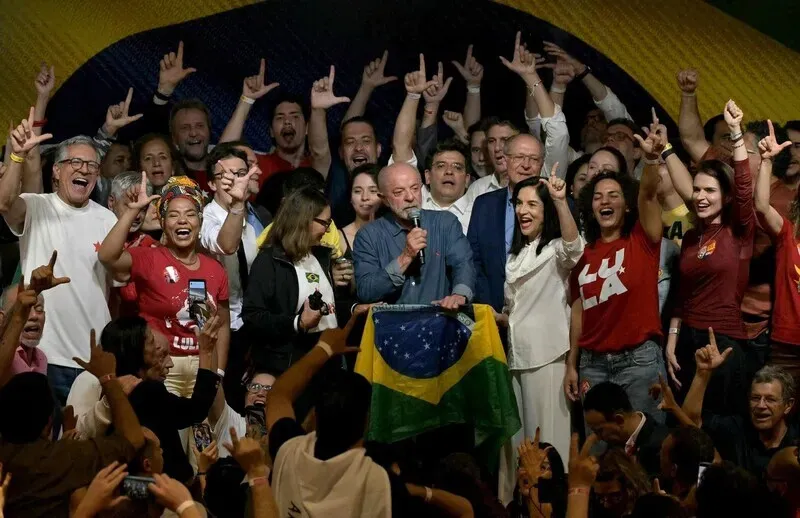
Luiz Inácio Lula da Silva of the Workers’ Party (PT) gives a speech in São Paulo, Brazil, on Oct. 25, 2026, after the runoff vote count results were announced. Lula won the runoff by defeating candidate Flávio Bolsonaro after losing in the first round. (AFP/Yonhap)

By John Feffer, author and director of Foreign Policy in Focus at the Institute for Policy Studies
The victory of incumbent Lula in the Brazilian presidential election was a surprise. The longtime leftist politician ran second in the first round behind far-right challenger Flávio Bolsonaro — the son of disgraced former leader Jair Bolsonaro — and no one in the history of Brazilian democracy had come from behind to win in the second round. But by mounting a huge get-out-the-vote effort, Lula defied all predictions.
Lula also defied the current trend in Latin American elections. In the last 18 months, right-wing candidates had won in seven countries, including Chile, Colombia and Peru. The trend worldwide has been similar, with the far right winning in local elections in Germany, the extremist party of Marine Le Pen leading the polls in France, and the far right participating in governments in Italy, Finland and the Czech Republic. Far-right leaders remain in place in Russia, India, the Philippines, and, for now, Israel.
Is Lula the outlier? Or does he perhaps represent a political course correction?
For those eager to see a political wave in the making, Lula is not the only example of the electoral repudiation of the far right. On the same day as the Brazilian elections, students managed to oust the longtime autocrat Aleksandar Vučić in the equally surprising Serbian elections. Earlier this year, Viktor Orbán also lost at the hands of a unified opposition. The anticipated “blue wave” rejection of Donald Trump in the upcoming midterm elections in the United States would continue the trend.
There is a natural feeling among voters in democratic societies to “throw the bums out.” In Latin America, a “pink” wave of progressive politicians like Ecuador’s Rafael Correa and Colombia’s Gustavo Petro has given way to a “brown” wave of ultra-conservative politicians. Voters, especially in today’s quicksilver environment of social media, respond positively to candidates who promise sweeping change. And thus, the political pendulum swings from left to right and back again.
But the far right is not just another conventional option on the political menu. It offers something radically different because it threatens to undermine the very democratic norms by which it has achieved power. In countries like Russia, Hungary, Turkey and India, right-wing authoritarians have used democratic means — elections, constitutional changes, legal challenges — to weaken democracy.
Other leaders have attempted to do away with democracy much more rapidly, as Jair Bolsonaro tried to do when he plotted to overturn the Brazilian elections that Lula won four years ago. Inspired by these rule-breakers, even traditional conservative politicians, like Yoon Suk-yeol in Korea, have attempted to suspend democracy.
And then there’s the case of Donald Trump. The US president was reelected despite his efforts to overturn the 2020 election that he lost. During his second term, he has attempted to unilaterally change the Constitution. He has ignored court orders, bypassed Congress, and waged war against the mainstream media. He has repeatedly called into question the legitimacy of elections.
But Trump now has the lowest approval rating — 31 percent — of his presidency. In the upcoming midterm elections, voters are poised to reject Trump’s party. Polling suggests that the Democratic Party will easily retake control of the House of Representatives, and it has a better than even chance of capturing the Senate as well.
Unlike in Brazil, American voters are prioritizing their pocketbooks. A narrow majority of Brazilians supported Lula despite the country’s problems with debt and inflation. American voters, on the other hand, are abandoning Trump because of the economy — rising gas prices, the impact of sanctions, the consequences of the Iran War. As they demonstrated by electing Trump to a second term, many American voters don’t seem concerned about his anti-democratic rhetoric or actions.
This, more than the specific victories of the far right, is the more distressing takeaway. After all, democracy is not exactly enjoying its finest hour at the moment. Global freedom, according to the latest Freedom House report, declined for the 20th consecutive year last year, with the United States, Bulgaria, Italy, El Salvador and Madagascar registering significant deterioration in political and civil liberties.
Voters are turning toward anti-democratic candidates in part because they are disenchanted with democracy itself. Democratic mechanisms just don’t seem up to the task of addressing the threats currently facing the globe.
Democracies have proved incapable of slowing climate change or responsibly controlling technologies like artificial intelligence. Democracies have utterly failed at ensuring broad prosperity in a globalizing economy. If democrats were more successful at dealing with these problems, the far right’s promises of top-down solutions and returning to mythic pasts would not be so appealing.
This deeper problem with democracy suggests that even if the far right loses elections — in Brazil yesterday, the United States tomorrow, France next year — it will not gracefully surrender the stage. Figures like Yoon Suk-yeol and Jair Bolsonaro can be jailed for their transgressions — and perhaps Trump too will follow in their footsteps. But voters will keep turning to more authoritarian alternatives if democratic institutions don’t deliver and democratic values don’t appeal.
The far right does not offer any better answers to the world’s problems. Its general response to global threats has been to turn its back. The far right supports high tariff walls, more fossil fuel extraction, and stricter controls on immigration. It repudiates all forms of globalization, lumping together neoliberal trade policies with green energy programs and sensible approaches to immigration. The far right despises democracy not just because it puts controls on autocratic leaders but because of its association with globalization.
This, then, is the essential task of both the left and the center — to devise a new, robust internationalism that provides concrete gains to the average person while also safeguarding the planet for the next generations.
Until this happens, far-right candidates will continue to win. They might lose this or that election. But they will continue to win support with their anti-global agenda, while remaining focused on their ultimate goal of destroying democracy. They don’t want to be subject to the pendulum swings of democratic politics. They want to rip out the pendulum so that they can remain in power indefinitely.
KioskNews shows a cleaned-up reading view extracted from the publisher’s page — the original always lives on their site, not ours.