Attack aircraft, military vehicles visible at China-Laos base
Reuters, HONG KONG and BANGKOK


Light attack aircraft and military vehicles have arrived at a new China-Laos joint training facility announced on Tuesday last week, according to satellite images reviewed by Reuters.
The images, taken by commercial satellite provider Vantor, show what security analysts believe are eight K-8 light attack jets and more than two dozen support vehicles on a runway that is still being built — China’s latest expansion of its overseas military presence.
Taken on Wednesday last week — the day after the Chinese Ministry of National Defense announced it had set up the facility at Ban Keun outside the capital, Vientiane — the images show extensive construction work around the runway.
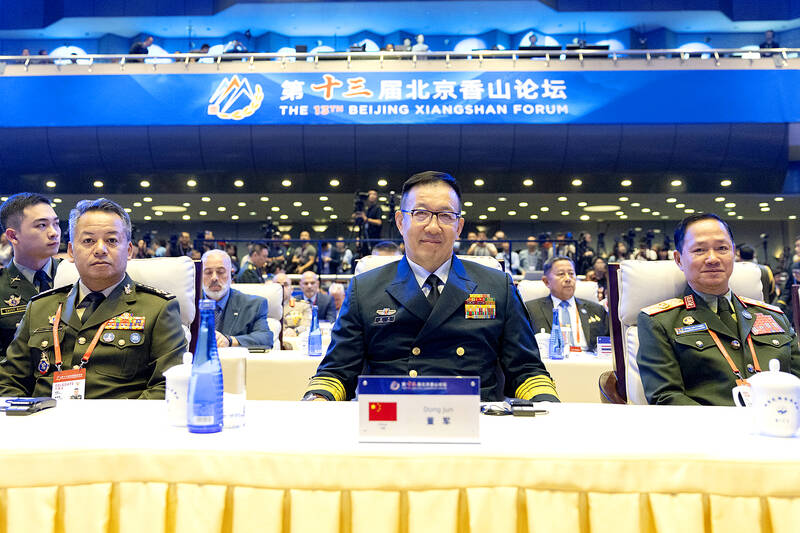
From left, Cambodian Deputy Prime Minister and Minister of National Defense Tea Seiha, Chinese Minister of National Defense Dong Jun and Laotian Minister of Defense Khamlieng Outhakaisone pose for photographs before the opening ceremony of the Beijing Xiangshan Forum on Sept. 16.
Photo: EPA
The swift development of the new facility is being closely watched by regional military attaches and security academics, some of whom say its construction potentially marks China’s first fully fledged overseas military base in Southeast Asia.
Despite more than 20 years of intense military modernization, China is widely perceived to lack a strong network of overseas facilities beyond the South China Sea, port access in Ream, Cambodia, and a logistics base in Djibouti.
Australian Strategic Policy Institute senior analyst Rachel Vandenbrink said the selection of Ban Keun for a facility that the Chinese People’s Liberation Army could access “is likely more about a target of opportunity than filling an obvious operational need.”
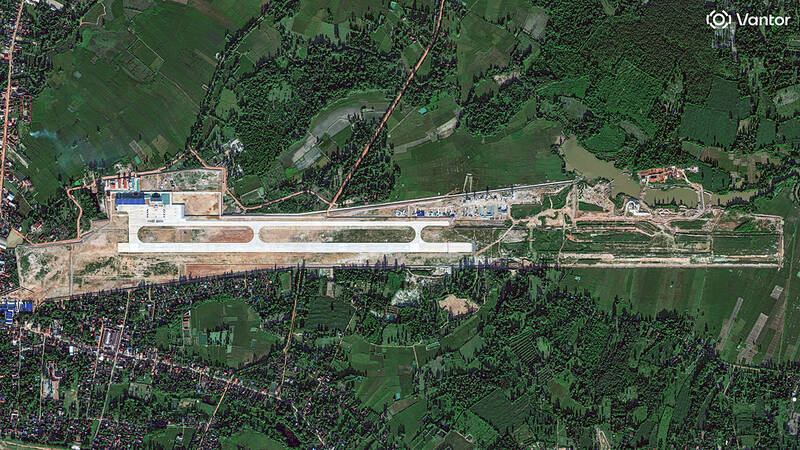
A satellite image shows a new China-Laos joint training facility, with a runway that is being expanded, in Ban Keun, Vientiane Province, Laos, September 30, 2026.
Photo: Vantor/Handout via Reuters
“Laos does have some geostrategic value as an accessible foothold in mainland Southeast Asia, given its shared border with China and infrastructure links, including [its] railway,” Vandenbrink said.
The Chinese defense ministry did not immediately respond to a request for comment.
The Laotian embassy in Bangkok and the Laotian Ministry of Foreign Affairs did not immediately respond to requests for comment.
Singapore-based security analysts Collin Koh (高瑞連) and Alexander Neill, as well as Vantor specialists, said the planes appeared to be Hongdu JL-8 aircraft, which the Chinese and Laotian air forces operate.
Also known as the K-8, the two-seater aircraft is extensively used for training as well as having light attack capabilities. It was jointly developed by China and Pakistan and is exported to other militaries.
Laos has four of the planes, according to the London-based International Institute for Strategic Studies’ annual assessment of the world’s militaries.
Koh, a senior fellow at the S. Rajaratnam School of International Studies, described the Laotian planes as being of “questionable serviceability.”
As construction continues, diplomats and analysts are keeping watch for any sign of air defenses, ammunition and fuel storage as well as surveillance facilities — all of which could point to the base serving broader military functions beyond training.
Neill said that while the airfield looked relatively short and innocuous, it could later serve larger aircraft, including signals intelligence and electronic-surveillance planes to extend China’s reach into Southeast Asia.
“It looks like the airfield has been engineered to accommodate a runway extension allowing larger aircraft to operate,” said Neill, an adjunct fellow at Pacific Forum think tank in Hawaii.
In helping Laos build up Ban Keun, China is occupying a site the US used covertly at the height of the Vietnam War.
During the US war against communist forces in Laos in the 1970s, Ban Keun was an airfield known as “Lima Site 44” used by Air America, an airline discreetly owned by the CIA, according to records shared with Reuters by Ryan Wolfson-Ford, a Southeast Asia specialist at the Library of Congress.
The airline carried US-backed troops from the country’s Hmong highland minority as well as supplies into rough mountain airstrips known as “Lima Sites.”
As early as 1968, Ban Keun was used as a point from where Air America helicopters delivered Hmong troops to other combat zones, said Joachim Leeker, an academic who has written about the history of the airline.
KioskNews shows a cleaned-up reading view extracted from the publisher’s page — the original always lives on their site, not ours.