National exams for years 6, 10, and 12 proposed in major Australian schools shake-up
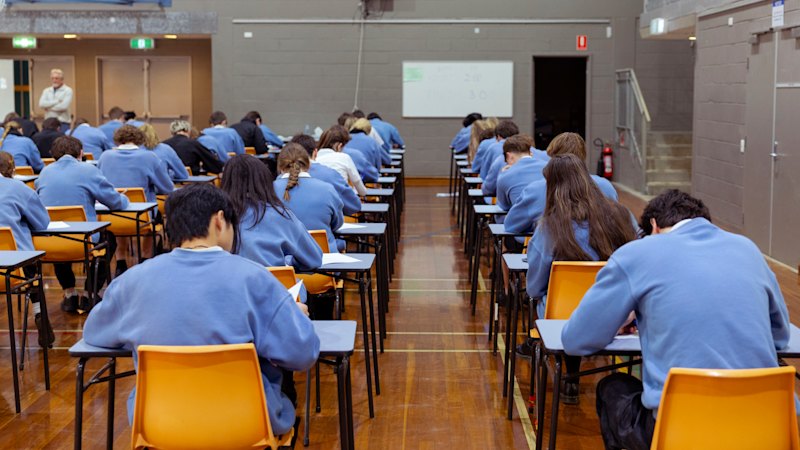
Australian students would face national exams in years 6, 10 and 12 under a radical policy overhaul to fix the nation’s “inconsistent” school assessment system, which the federal opposition said warrants serious consideration.
A landmark report by The Nationals-backed think tank, the Page Research Centre, warns that the different assessments across states, “grade-creep” and unchecked AI use are harming the integrity of Australia’s school system.
The report recommends the government commission a feasibility study into the development of three new national exams to measure student progress from kindergarten to year 12. In each exam period, students would complete an English test.
The report argued assessment should be considered as crucial to education as curriculum and pedagogy, finding Australia lacks nationally consistent standards governing the design and quality assurance of student tests.
Under the proposed changes, students would sit a series of examinations in year 6 to measure performance in core areas of the curriculum. They would sit another series of exams in year 10 and have the opportunity to opt in to final standardised tests in year 12.
It found that because each state sets its own rules some students can obtain an ATAR without ever sitting a formal exam, while others are mandated to do so. Furthermore, it also found the system’s reliance on take home assessments leaves it highly vulnerable to AI misuse and external tutoring.
Opposition education spokesman Julian Leeser said now was the time to question existing approaches and demand change.
“ATAR is a national system, but how can we be confident in our school-leavers if an ATAR from Perth doesn’t carry the same weight as an ATAR from Melbourne?” Leeser said.
“We need the ability to distinguish between whether a student has completed an assessment task, and whether they have learned from it.”
In NSW, the Universities Admissions Centre says ATARs are comparable across all Australian states and territories. “An ATAR of 85.00 in NSW or the ACT is equivalent to an ATAR of 85.00 in any other state,” it says.
The report found evidence of “grade creep” in year 12 reports, where an increasing number of students are receiving top marks, contradicting Australia’s stagnant or declining performance in independent standardised tests like NAPLAN and PISA.
The report has called for an independent review into Australia’s current assessment system which will evaluate the quality of the Australian Tertiary Admission Rank (ATAR), and calls for a national framework to guide school-leavers.
Report author, Dr Fiona Mueller, said Australian education policies are disproportionately influenced by unproven, experimental approaches to curriculum, teaching, student assessment and other critical areas.
“As many Australians are aware, state and territory education authorities are now racing to introduce what they refer to as ‘evidence-based reforms’ to curriculum and teaching,” she said. “However, we need to pay equally close attention to the third key element of schooling – student assessment.
“The world’s highest performing education systems are unequivocal about the importance of formal examinations for measuring student achievement across the curriculum in valid and reliable ways. The OECD calls these ‘trusted signals of achievement’.”
More to come
Start the day with a summary of the day’s most important and interesting stories, analysis and insights. Sign up for our Morning Edition newsletter.

KioskNews shows a cleaned-up reading view extracted from the publisher’s page — the original always lives on their site, not ours.