Hokusai: Thirty-Six Views of Mount Fuji review – sublime wonders from the Great Wave to that heroic, eternal peak
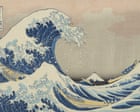
The giant wave’s foaming white summit spreads high over the heads of the helpless souls huddled in their long thin boats, crackling into what look like many sharp claws. It is a monster, hungry to swallow human flesh. But beyond it, over the wild water, soothing the terror of those in peril on the sea, is Mount Fuji – a solid cone of hope and solace. The mountain, not the wave, is the hero of this masterpiece, as it is the hero of all the prints in Dulwich Picture Gallery’s stunning exhibition – the first in Britain – of the complete Thirty-Six Views of Mount Fuji.
When you look closely here at three different, superb impressions of Katsushika Hokusai’s Under the Wave off Kanagawa – widely known today as the Great Wave – your mental picture of this icon is shattered by the violent onrush of water. In reproductions the wave just seems beautiful, an elegant curl of blue and white. But here, to paraphrase Tennyson, it is nature, blue in tooth and claw. The wretched people are the emotional heart of the picture, their imminent risk of drowning its whole point.
The wave is out of control, murderous, yet it is also a passing moment, shows Hokusai, a devout Buddhist. He offers this consolation: the wave looks as vast as a mountain but soon it will break and be gone. Meanwhile the sacred peak of Mount Fuji endures eternally. It can’t be hurt by the ephemeral dragon of saltwater. Put your faith in the essential, enduring things beyond the nightmare of mutable appearances and you will find inner peace. The wave is an illusion. Mount Fuji is the truth.
Yet that colossal truth is easy to forget as we move around it, pass it by, catch sight of it in the everyday rush – a distant peak on the horizon. On a city bridge people swarm without looking up from under their round hats at the mountain in the distance. A man working bare-chested, wiry and worn, has no time to study the far-off peak as he concentrates on making a barrel.
Hokusai delights in epic shifts of perspective, seeing Mount Fuji as an apparently small insignificant object while filling the foreground with distracting action. You do a double take at Fuji from Kanaya on the Tōkaidō Highway. Dressed people sit on the shoulders of nude men who are almost completely submerged in turbulent blue and white water, while others are sealed inside boxlike palanquins to be carried too over the water by crushed bearers gasping for air. It is no illusion. This crossing point over the Ōi River was a key military point for the city of Edo, so no bridges were allowed to be built there. Travellers had to be borne across.
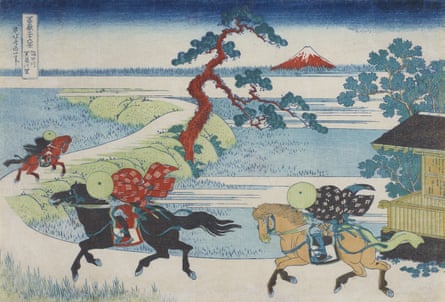
No one in this strange scene looks at Mount Fuji. And yet not to notice the mountain is to miss out on something very big indeed. In another image a ferryman does pay attention to it, set against a golden evening sky under a layer of deep blue, as he rows people across another river: some passengers also look, while others do not. Other people – tourists as well as pilgrims – seek out the views, like Hokusai himself, delighting in nature and its mystery, even in extreme conditions: one group has trekked to a country teahouse in winter to view Mount Fuji in the snow. They’re rewarded with an icy scene of devastating beauty, picked out in golden white and intense deep blue.
Hokusai’s miracle colour, Prussian blue, came from Europe, where it was first used in the early 18th century. His knowledge of perspective is also coloured by European art. But the traffic of influence went both ways. It is impossible to overstate the centrality of Thirty-Six Views of Mount Fuji to the birth of modernism. It is the first global masterpiece. When Hokusai created this series of closely linked prints in the early 1830s he reinvented landscape art as a conceptual and symbolic meditation that would thrill and inspire artists across the world.
It’s no secret that Van Gogh, Whistler and other members of the European avant garde collected and emulated Japanese woodblock prints. But I hadn’t realised how deeply Cézanne was in his debt: the French painter’s repeated efforts to paint Mont Sainte-Victoire in Provence, fragmenting its rocky mass into shards of perception to see its true nature and discover its secret, echo Hokusai’s journey around Mount Fuji. So do Monet’s obsessive paintings of Rouen Cathedral, a haystack and his (very Zen) waterlily garden. Hokusai taught these Frenchmen to see landscape as metaphysical.
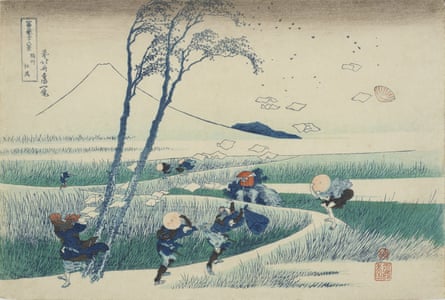
That we make icons of separate images from this series – and not just the wave – is understandable. Here is Ejiri Station, Province of Suruga, Hokusai’s depiction of people holding on to their hats as the sky fills with blown paper in an unexpected turn in the weather. Jeff Wall famously restaged it in his photograph A Sudden Gust of Wind (After Hokusai).
What a timeless artist Hokusai is, influencing Monet and Cézanne and still inspiring remakes today. But it distorts his meaning if we focus on his separate images without seeing them as part of one long meditation on Mount Fuji. By itself, Hokusai’s gust of wind may seem an image of crisis and impermanence. But Mount Fuji is in the background: the godlike summit that shows us there’s a serenity beyond the chaos.
KioskNews shows a cleaned-up reading view extracted from the publisher’s page — the original always lives on their site, not ours.