Akmal Nasrullah: Removing 30pc Bumiputera equity rule for private education will not weaken empowerment agenda
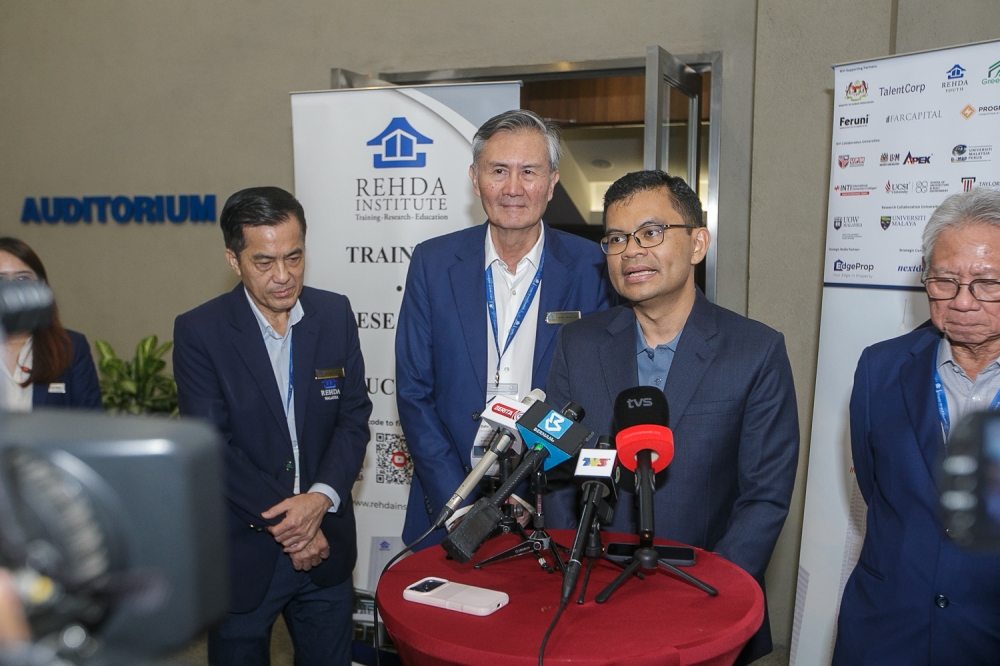

Economy Minister Akmal Nasrullah Mohd Nasir (center) speaks to the media during a press conference at the Read Institute Youth Initiative held at Monash University Malaysia in Bandar Sunway, Selangor, September 26, 2026. — Picture by Raymond Manuel
By R. Loheswar
First Published: Saturday, 26 Sep 2026 3:25 PM MYT
SUBANG JAYA, Sept 26 — The removal of the 30 per cent Bumiputera equity requirement for private education institutions (IPS) will not undermine the government’s agenda to empower the community, Economy Minister Akmal Nasrullah Mohd Nasir said today.
He said implementation and follow-up measures arising from the removal of the requirement would be handled by the relevant ministries according to their respective jurisdictions.
Akmal Nasrullah said the Bumiputera empowerment agenda should instead be viewed in terms of strengthening the community’s capacity to participate in and expand its presence in the economy.
“The government will continue to strengthen the Bumiputera empowerment agenda through approaches that can increase their capacity to continue growing and participating in economic activities,” he said.
He was speaking to reporters after attending the closing ceremony of the Rehda Institute Youth Initiative (RIYI) 2026 here.
Akmal Nasrullah said the government remained focused on increasing Bumiputera participation and capabilities in economic activities, and that removing the equity requirement did not signal any reduction in its commitment to the community’s economic empowerment.
At the event, the minister was also presented with the RIYI 2026 closing summary report, which highlighted a gap between students’ expectations and employers’ assessments of graduates’ workplace readiness.
The survey found that 41.6 per cent of student respondents considered one to three months a realistic period for fresh graduates to begin adding commercial value at work, compared with just 2.9 per cent of employers who held the same view.
Meanwhile, 62 per cent of students said they felt adequately prepared by their universities, while only 32.3 per cent of employers agreed that local universities sufficiently prepared graduates for workplace realities.
The survey involved students and recent graduates from 21 Malaysian universities as well as employers, although the report cautioned that the findings came from targeted surveys and were not nationally representative.
The report also highlighted the growing impact of artificial intelligence on entry-level employment. Some 76.4 per cent of student respondents said they regularly used AI tools, while half of the employers surveyed expected AI to reduce the number of entry-level positions they would hire for over the next three years.
On career development, 79.4 per cent of employers said they were willing to provide structured training and a clear career path in return for a commitment from employees to stay, while 67.6 per cent of students said they would accept such an arrangement.
The survey also found that 82.4 per cent of students and 58.3 per cent of employers supported compulsory salary-range disclosure in job advertisements, while 57.1 per cent of students said they were likely or very likely to work outside Malaysia within five years.
The findings form part of RIYI 2026’s focus on narrowing the gap between universities and industry, with the initiative bringing students together with industry leaders to gain exposure to workplace expectations, career development and the skills needed in a technology-driven economy.
Rehda Institute chairman Datuk Jeffrey Ng Tiong Lip said closer collaboration between universities and industry was needed to give students earlier exposure to workplace realities.
“A university qualification provides an important foundation, but young people also need to understand how workplaces operate, how decisions are made and what employers expect from them.
“This is where RIYI plays an important role in bringing students closer to industry through direct engagement and mentorship, while helping them develop the judgement, resilience, communication and adaptability needed to build sustainable careers,” he said.
The RIYI 2026 programme brought together students from more than 21 universities, with its final session focusing on AI’s impact on junior roles, productivity, decision-making and the capabilities expected of future leaders.
KioskNews shows a cleaned-up reading view extracted from the publisher’s page — the original always lives on their site, not ours.