Venus' mysterious haze is actually cosmic dust
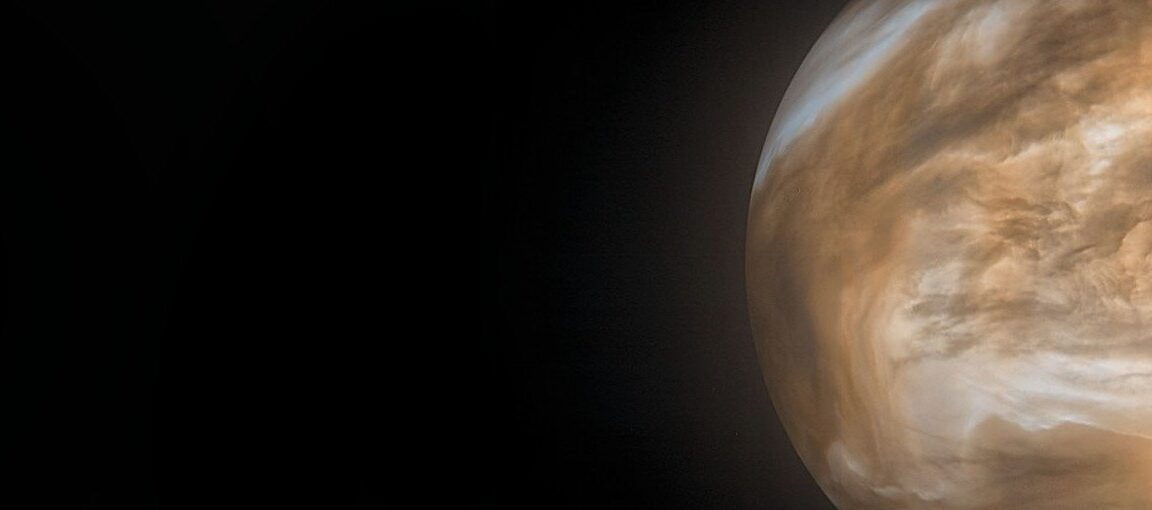
Meteorites often contain metals such as magnesium, silicon, and iron, and iron compounds were previously speculated to be absorbers. The magnesium and silicon found in meteorites are terrible absorbers of UV radiation. But iron was more promising; Venera and the Vega probes had detected atmospheric iron, while the mass spectrometer aboard the Pioneer Venus Large Probe found the compound iron sulfate, but these discoveries eluded explanation for decades.
Lingering suspicions that iron compounds were the mysterious absorber were confirmed when researchers found that iron sulfate matched the haze’s properties.
It turns out that for haze particles at a certain height (40 to 50 km or about 25 to 31 miles above the surface), condensation is not possible because the high energy of the particles creates a barrier that does not allow droplets of sulfuric acid to stick to their surface. (This is called a nucleation barrier.) Particles with a strong nucleation barrier are taken to the upper cloud layer by hotter air rising in the process of convection, where they cool enough to be incorporated into sulfuric acid particles. While previous observations had suggested this, Karyu’s team now has stronger evidence.
This discovery has implications for other planets. Upper hazes on gas giants have been studied ad nauseam, but microphysical processes beneath the main cloud layer remain an enigma. Venus may have shed light on at least some of the secrets of haze. On a planet like Jupiter, it might be that particles that cannot evaporate, like those from meteorites, settle on the outer layers of clouds. Further studies could give more insight into how cosmic dust promotes cloud and haze formation on planets like Jupiter, Saturn, and Neptune.
“As on Venus, observing the metal layers in the atmosphere of the outer planets would help [determine] the deposition rates of [metals] within their atmospheres and, by extension, the resulting haze abundances,” said Karyu. “These effects establish cosmic dust as an essential component of planetary climates, a role that is also likely to be important for exoplanets.”
KioskNews shows a cleaned-up reading view extracted from the publisher’s page — the original always lives on their site, not ours.