Heightened Chinese activity detected
FORTY-NINE AIRCRAFT: The frequency and number of aircraft and ship sorties will likely continue to increase, but the important thing is vigilance, an analyst said
By Fang Wei-li and Jonathan Chin / Staff reporter, with staff writer


Taiwan detected 49 sorties of military aircraft around Taiwan in the 24 hours leading up to 6am yesterday, in what analysts described as heightened “gray zone” activity.
Aside from the 49 Chinese military aircraft, six warships and six government vessels were also detected around the nation during the period, the Ministry of National Defense said.
Su Tzu-yun (蘇紫雲), director of the Institute for National Defense and Security Research’s Defense Strategy and Resources Division, said that the sudden surge in Chinese military aircraft and vessels around Taiwan was part of what he described as a “quiet exercise,” with Beijing maintaining high-intensity “gray zone” pressure on the nation without formally announcing military drills.
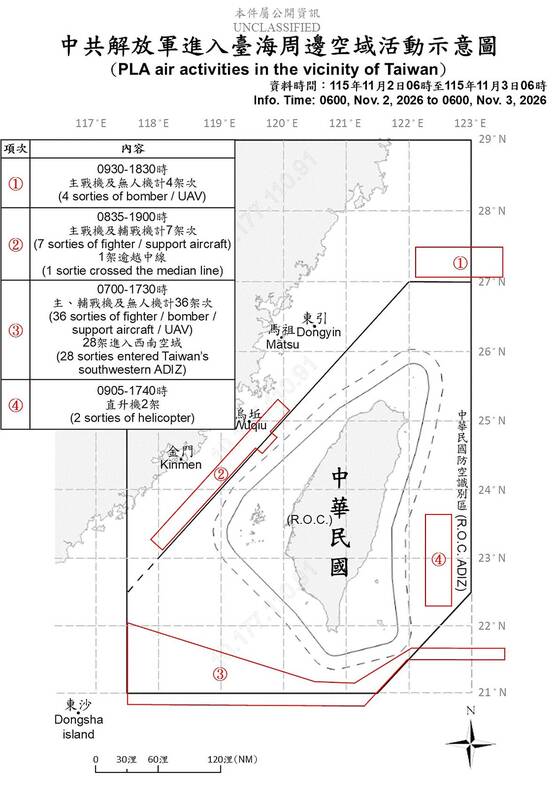
A map shows Chinese People’s Liberation Army activity detected near Taiwan in the 24 hours to 6am yesterday.
Photo courtesy of the Ministry of National Defense
“As Taiwan prepares to conduct elections with a count of heads, China is launching military aircraft in a show of fists,” Su said.
The tactic is an extension of Beijing’s strategy to normalize intrusive activities and expand the China Coast Guard’s jurisdiction into the Taiwan Strait, he said.
“The frequency and number of Chinese aircraft and ship sorties will likely continue to increase, but the important thing for Taiwan is to remain vigilant despite Chinese numbers,” he said. “It is crucial for the Taiwanese armed forces to react and deal with [Chinese People’s Liberation Army (PLA) activities] appropriately.”
Beijing likely viewed stepping up the intensity of the so-called strategic and readiness patrols near Taiwan as a response to diplomatic developments and the regional military situation, Su said.
The US, Japan and South Korea at last weekend’s G20 Foreign Ministers’ Meeting jointly voiced support for protecting peace and stability in the Taiwan Strait, he said.
Meanwhile, the US’ Theodore Roosevelt aircraft carrier is transiting through the region following last month’s Keen Sword 27, the latest and largest iteration of biennial US-Japan military exercises, Su said.
The Chinese aircraft carrier Liaoning, which is deployed in waters east of the Philippines, is poised to either return to port or conduct a new phase of operations, he said.
Taken together, a “silent drill” could be a way for China to put the finishing touches on the current phase of its military deployments and make a statement to regional rivals, Su said.
Speculation that Beijing could exploit the US midterm elections to launch military action against Taiwan is unfounded, as US President Donald Trump would remain president regardless of the outcome of the elections, he said.
The midterm elections were to be conducted yesterday.
Beijing would not be enthusiastic about engaging in any rash action that could result in a bipartisan backlash against China in the US, Su said.
The PLA routinely conducts an end-of-year strategic exercise to assess its progress in achieving force-building targets, and the Chinese carrier Shandong is likely to be deployed in a long-range naval exercise in the middle of next month, he said.
China could use the drills to increase pressure on Taiwan before the end of the year, he added.
KioskNews shows a cleaned-up reading view extracted from the publisher’s page — the original always lives on their site, not ours.