New blood test could help flag risk of condition that leads to liver failure, cancer
SINGAPORE - A new blood test developed in Singapore can help to flag early the risk of a condition that can lead to liver failure and a common form of liver cancer.
Dubbed CIRRHOClear, the non-invasive test is designed to identify liver cirrhosis risk before symptoms appear.
Developed by local biotechnology firm Mirxes and the National Cancer Centre Singapore (NCCS), CIRRHOClear analyses specific microRNA biomarkers in a standard blood sample.
MicroRNA, or miRNA, refers to small ribonucleic acid molecules involved in many essential biological processes.
When the liver starts getting damaged or inflamed, abnormal levels of specific miRNA molecules are sent into the blood as a distress signal, with CIRRHOClear measuring a combination of these miRNAs.
A proprietary algorithm allows the test – designed for those aged 40 and above – to classify the risk of liver cirrhosis as high, intermediate or low.
In clinical validation studies, the test was able to accurately determine the risk of liver cirrhosis in 89% of cases, and identify those who did not have the condition 95% of the time.
The test can help doctors identify liver cirrhosis risk early in people at higher-risk, such as those with fatty liver disease, chronic hepatitis or alcohol-related liver conditions.
Liver cirrhosis is a serious condition where the organ becomes shrunken, scarred and hardened liver, with its functions failing.
It is a result of chronic damage to the liver from various causes, ranging from fatty liver disease to excessive alcohol intake and autoimmune liver disease.
While cirrhosis cannot be fully reversed, early detection and treatment – which can include medications such as antivirals for those with chronic hepatitis B and C – can slow its progression and manage symptoms.
However in its more advanced stages there is a high mortality risk. Patients with decompensated cirrhosis – where the liver is no longer able to function normally – have an average life expectancy of about two years without a transplant.
According to the 2021 Global Burden of Disease study, there are more than 1.7 billion cases of liver cirrhosis worldwide, with 1.43 million deaths linked to the condition in 2021.
Left unmanaged, cirrhosis can lead to liver failure and hepatocellular carcinoma, otherwise known as primary liver cancer – the most common form of liver cancer, affecting about 30 in every 100,000 people annually.
Liver cancer is the third leading cause of cancer death in men and the fifth most common cause of cancer death in women here.
Current screening methods for liver cirrhosis pose challenges in detecting the disease in its early stages, presenting obstacles in primary care, said Mirxes and NCCS in a statement.
For example, routine blood tests for liver enzymes and ultrasound lack sensitivity for early-stage scarring, they said.
Meanwhile accurate imaging techniques such as transient elastography and magnetic resonance elastography – non-invasive methods which measure the stiffness and elasticity of body tissues – are often restricted to specialist centres, creating “significant care bottlenecks”, they added.
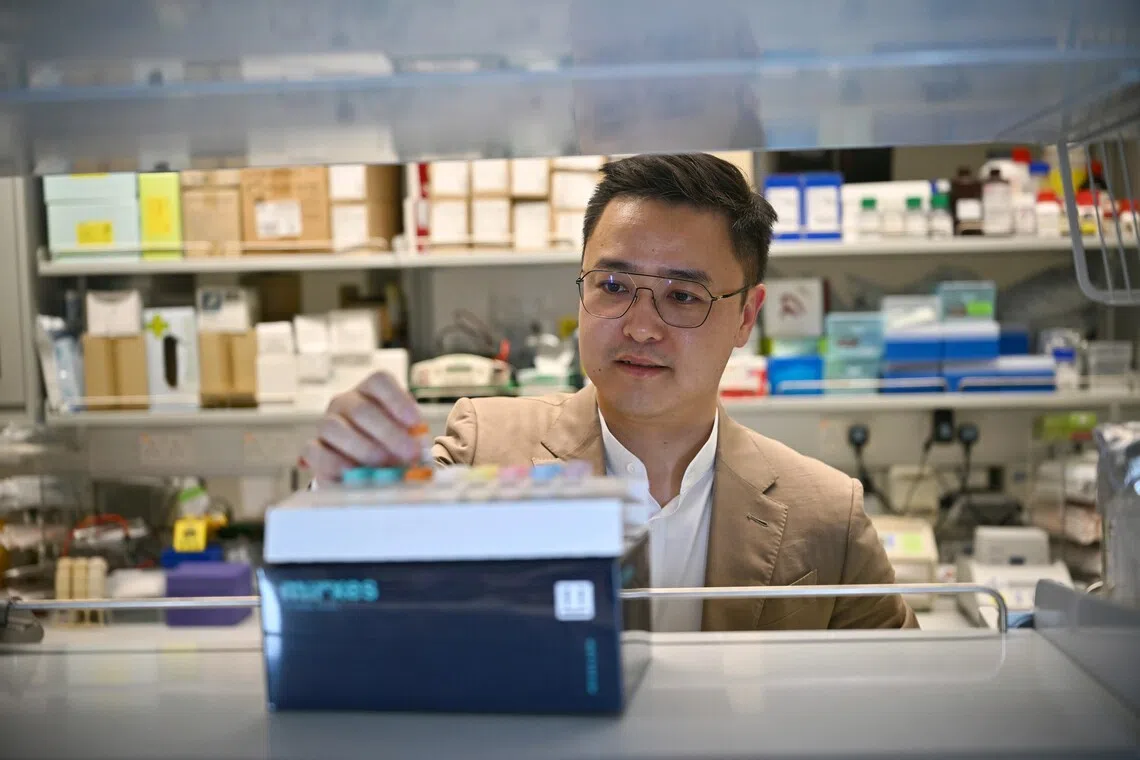
Dr Zhou Lihan, co-founder and CEO of Mirxes at NCCS on Oct 16. Current screening methods for liver cirrhosis pose challenges in detecting the disease in its early stages, presenting obstacles in primary care, said Mirxes and NCCS in a statement.
ST PHOTO: ARIFFIN JAMAR
While liver biopsy is the gold standard, the procedure is invasive and carries risks of pain and bleeding, making it unsuitable for routine population screening, they noted.
CIRRHOClear was launched in Singapore on Oct 16, with plans to eventually introduce the product in other countries as well.
The test – which involves drawing a small amount of blood from patients – will be available for use at clinics and screening centres. Its cost was not immediately available.
The test was developed with findings from ELEGANCE, a landmark study led by NCCS of 2,000 participants with liver disease.
The four-year study sought to develop clinical tools which could provide earlier, more precise identification of those at risk of primary liver cancer.
“Early detection is our best tool to alter the disease trajectory of chronic liver conditions,” said Pierce Chow, a senior consultant in the surgery and surgical oncology division at NCCS and the Singapore General Hospital.
“By identifying liver cirrhosis at an early, actionable stage, CIRRHOClear can provide physicians with a practical risk-stratification tool to guide timely clinical decisions that would benefit their patients,” said the principal investigator of the ELEGANCE study.
Mirxes co-founder and chief executive Zhou Lihan said: “Building on our proven RNA platform, which has successfully demonstrated early detection in stomach and lung cancers, we are confident that CIRRHOClear will empower primary care providers to detect liver scarring early.
“This shift transforms liver care from reactive treatment to proactive prevention, curbing the progression of unmanaged cirrhosis to end-stage liver failure and liver cancer.”
KioskNews shows a cleaned-up reading view extracted from the publisher’s page — the original always lives on their site, not ours.