The 10 Best Horror Books of All Time, Ranked

Luc Haasbroek is a writer and videographer from Durban, South Africa. He has been writing professionally about pop culture for eight years. Luc's areas of interest are broad: he's just as passionate about psychology and history as he is about movies and TV. He's especially drawn to the places where these topics overlap.
Luc is also an avid producer of video essays and looks forward to expanding his writing career. When not writing, he can be found hiking, playing Dungeons & Dragons, hanging out with his cats, and doing deep dives on whatever topic happens to have captured his interest that week.
Sign in to your Collider account
Horror literature has been around for centuries (and even millennia, if we factor in myths and legends), producing a ton of classics that have exerted a kind of gravitational pull on fiction itself. In this sense, the finest horror books go way beyond simply entertaining their readers. They touch on some of our fundamental fears.
With that in mind, this list attempts the daunting task of ranking some of the genre's classics. The titles below span a range of styles and tones, from dark fairy tales to ambiguous psychological horror, but all demonstrate what scary stories can do when they're operating at full power.
10 'The Turn of the Screw' (1898)

"Of course I was under the spell." This is one of the most influential ghost stories ever, practically spawning a subgenre unto itself. In The Turn of the Screw, a young governess (we never learn her name) accepts responsibility for two children, Miles and Flora, at the remote Bly estate. However, in the manor's shadowed halls, she soon begins seeing mysterious figures whom she believes to be the ghosts of former employees Peter Quint and Miss Jessel.
Increasingly convinced that these apparitions intend to corrupt the children, the governess becomes desperate to protect them. Author Henry James elevates this premise hugely by keeping things uncertain, never letting us settle on a comfortable interpretation of what's going on. The governess may genuinely be confronting supernatural forces, but her increasingly obsessive behavior raises the possibility that her perceptions cannot actually be trusted. That ambiguity helped establish a template for psychological horror.
9 'Tales of Mystery and Imagination' (1908)

"There are chords in the hearts of the most reckless which cannot be touched without emotion." Few writers cast a longer shadow over horror than Edgar Allan Poe, and Tales of Mystery and Imagination collects many of his best stories. Bundled within its covers are classics like "The Fall of the House of Usher", "The Tell-Tale Heart, and "The Masque of the Red Death", all of them milestones in the genre's development.
Poe's plots and descriptions are deeply creepy, replete with crumbling mansions, impossible sounds, and diseased bodies, yet he also digs deep thematically here, touching on all his signature preoccupations: madness, guilt, disease, premature burial, obsession, and, of course, death. He broke serious ground, shaping not just horror but detective fiction, thrillers, Gothic literature, and even early sci-fi. This anthology represents a great starting point for those curious about his work.
8 'Something Wicked This Way Comes' (1962)

"Every wish has a price." Something Wicked This Way Comes is a dark gem from author Ray Bradbury, most famous for writing Fahrenheit 451. Whereas that book was set in a dystopian future, this one innovated by setting a horror storyline within a seemingly ordinary American small town, one based heavily on Bradbury's own childhood. In the novel, thirteen-year-old friends Will Halloway and Jim Nightshade become fascinated when Cooger & Dark's Pandemonium Shadow Show arrives unexpectedly. But they soon discover that its attractions offer far more than entertainment.
Something Wicked This Way Comes went on to be hugely influential, particularly on the 1970s horror boom. Writers like R.L. Stine and Stephen King have cited it as a major inspiration. Not to mention, the book is simply very well-written. Its lyrical prose gives the story the quality of a dark fairy tale.
7 'The Bloody Chamber' (1979)

"Fairy tales were always darker than we remembered." Fairy tales have contained violence, monsters, predatory figures, and disturbing transformations for centuries, but The Bloody Chamber allows those darker elements to reclaim center stage. This short story collection reimagines stories like "Bluebeard," "Little Red Riding Hood," "Beauty and the Beast," and "Puss in Boots," ramping up their Gothic horror and sensual imagery, while also occasionally throwing in some feminist revisionism.
For instance, "Sleeping Beauty" becomes the vampiric tale "The Lady of the House of Love", while "Little Red Riding Hood" becomes "The Werewolf", a shocking and extremely dark subversion of the original. That said, while the plots are great, Carter's prose might be the collection's highlight. Dense, extravagant, and deeply atmospheric, it immerses us in a twilit world of castles, forests, isolated mansions, and twisting paths.
6 'The Best of Richard Matheson' (2017)

"That which you believe becomes your world." Another excellent anthology, The Best of Richard Matheson collects several essential short stories by genre legend Richard Matheson, author of bangers like I Am Legend and Hell House, as well as 16 episodes of The Twilight Zone, including "Nightmare at 20,000 Feet". The collection features tales like "Prey", "Dying Room Only," and "Dance of the Dead."
Matheson was another one of the genre's defining voices, shaping the developing sensibilities of later storytellers like Stephen King, George A. Romero, Anne Rice, Roger Corman, and Edgar Wright. This collection is a nice presentation of what made him great, from the juicy plots to the direct, economical writing style itself. The stories were selected by horror author Victor LaValle, and his introduction provides some useful context for them all, adding to the enjoyment.
Collider Exclusive · Horror Survival Quiz Which Horror Villain Do You Have the Best Chance of Surviving? Jason Voorhees · Michael Myers · Freddy Krueger · Pennywise · Chucky
Five killers. Five completely different ways to die — if you're not smart enough, fast enough, or self-aware enough to avoid it. Only one of them is the villain your particular set of instincts gives you a fighting chance against. Eight questions will figure out which one.
🏕️Jason
🔪Michael
💤Freddy
🎈Pennywise
🪆Chucky
01
Something feels wrong. You can't explain it — you just know. What do you do? First instincts are the difference between the survivor and the first act casualty.
02
Where are you most likely to find yourself when things go wrong? Setting is everything in horror. Where you are determines which rules apply.
03
What is your most reliable survival asset? Every survivor has a quality the villain didn't account for. What's yours?
04
What kind of fear is hardest for you to fight through? Knowing your weakness is the first step to not dying because of it.
05
You're with a group when things start going wrong. What's your role? Horror movies are brutally clear about who survives group situations and who doesn't.
06
What's the horror movie mistake you're most likely to make? Honest self-assessment is a survival skill. Denial is not.
07
What's your best weapon against something that can't be stopped by conventional means? Every horror villain has a weakness. The survivors are always the ones who find it.
08
It's the final scene. You're the last one standing. How did you make it? The final survivor always has a reason. What's yours?
Your Survival Odds Have Been Calculated Your Best Chance Is Against…
Your instincts, your strengths, and your particular way of thinking under pressure point to one villain you actually have a fighting chance against. Everyone else — good luck.
Jason Voorhees
Jason is relentless, but he is also predictable — and that is the gap you would exploit.
- He moves in straight lines toward his target. He doesn't strategise, doesn't adapt, doesn't outsmart. He simply pursues.
- Your ability to keep moving, use the environment, and resist the panic that freezes most victims gives you a genuine edge.
- The Crystal Lake survivors were always the ones who stopped running in circles and started thinking about terrain, water, and distance.
- You think like that. Which means Jason, for all his indestructibility, would face someone who simply refused to be where he expected.
Michael Myers
Michael watches before he moves. He is patient, methodical, and almost impossible to detect — until it's too late for anyone who isn't paying close enough attention.
- But you are paying attention. You notice the shape in the window, the car parked slightly wrong, the silence where there should be sound.
- Michael's power lies in the invisibility of ordinary suburbia — the fact that nothing ever looks wrong until it already is.
- Your spatial awareness and instinct to map every room, every exit, and every shadow before you need them is precisely the quality Laurie Strode had.
- You are not a victim waiting to happen. You are someone who already suspects something is wrong — and acts on it.
Freddy Krueger
Freddy wins by getting inside your head — using your own fears, your own memories, your own subconscious as weapons against you. That strategy requires a target who can be destabilised.
- You are harder to destabilise than most. You've faced uncomfortable truths about yourself and you haven't looked away.
- The survivors on Elm Street were always the ones who understood what was happening and chose to face it rather than flee from it.
- Freddy's greatest weakness is that his power evaporates in the presence of someone who refuses to give him the fear he feeds on.
- Your psychological resilience — the ability to stay grounded when reality itself becomes unreliable — is exactly the quality that keeps you alive here.
Pennywise
Pennywise is ancient, shapeshifting, and feeds on terror — but it has one critical vulnerability: it cannot function against someone who genuinely stops being afraid of it.
- The Losers Club didn't survive because they were braver than everyone else. They survived because they faced their fears together, and faced them honestly.
- You ask the questions others avoid. You look directly at what frightens you rather than turning away.
- That directness — the refusal to let fear fester in the dark — is Pennywise's worst nightmare.
- It chose the wrong target when it chose you. You are exactly the kind of person whose fear tastes like nothing at all.
Chucky
Chucky's greatest advantage is that nobody takes him seriously until it's already too late. He exploits the gap between how something looks and what it actually is.
- You don't have that gap. You take threats seriously regardless of how they present — and you never make the mistake of underestimating something because of its size or appearance.
- Chucky relies on surprise, on the delay between recognition and response. You close that delay faster than almost anyone.
- Your instinct to treat every unfamiliar thing with appropriate scepticism — rather than dismissing it because it seems absurd — is the exact quality that keeps you breathing.
- Against Chucky, not laughing is already winning. You are very good at not laughing.
5 'Ghost Story' (1979)

"The past has been waiting for them." Not to be confused with David Lowery's movie about a ghost that wears a literal sheet, Peter Straub's Ghost Story is a brilliant, intelligent horror-drama. It centers on four elderly men in the small town of Milburn, New York, who regularly gather as the Chowder Society to exchange frightening stories. Their meetings take on greater significance after one member dies unexpectedly and the survivors begin experiencing disturbing dreams connected to something they did decades earlier.
Here, Straub takes many of the genre's oldest ingredients (like ghosts, buried secrets, guilt, unreliable narrators, a fascination with storytelling itself) and assembles them into an enormous, intricate novel that simultaneously honors horror's traditions and modernizes them. Not for nothing, Stephen King declared this to be the best horror novel of the 1970s.
4 'Frankenstein' (1818)

"Nothing is so painful to the human mind as a great and sudden change." Frankenstein has had a bit of a resurgence in recent years thanks to Guillermo Del Toro's adaptation and Maggie Gyllenhaal's The Bride! It's impressive just how evergreen this story is, its themes hitting hard no matter the era. The premise is world-famous by now: Scientist Victor Frankenstein becomes obsessed with discovering the principles of life and succeeds in creating a living being. Horrified by what he has accomplished, he immediately abandons his creation.
Rather than being a conventional scary story, the tale that follows is a potent fusion of horror, sci-fi, allegory, and tragedy. Indeed, the book is stranger, sadder, and considerably more philosophically complicated than many adaptations suggest. Crucially, Frankenstein paints the Creature itself in shades of gray, rather than reducing it to a cartoonish antagonist.
3 'Pet Sematary' (1983)
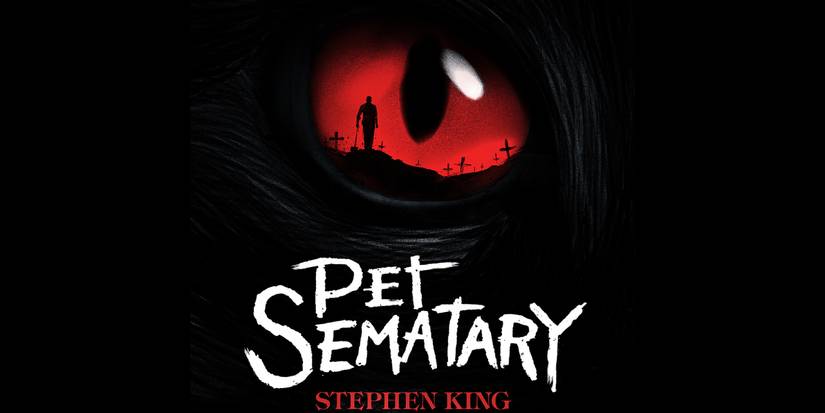
"Sometimes dead is better." Plenty of Stephen King titles could have made this list, though perhaps the most well-rounded of them is Pet Sematary. While the author has given us more technically ambitious novels, he has rarely written anything as thematically punchy or relentlessly bleak as Pet Sematary. In it, Dr. Louis Creed moves with his family to rural Maine and discovers an unusual burial ground hidden beyond the children's pet cemetery near his new home.
He eventually learns that the place possesses an impossible power connected to death, presenting him with an unspeakable temptation. Rather than being a mere pulpy zombie story, King builds this setup into a sharp statement on our desire to undo death. At its core, Pet Sematary is a study in loss and grief. That said, it doesn't scrimp on the frights either, hitting us with more than a few hair-rising scenes.
2 'Dracula' (1897)

"Listen to them, the children of the night." The ur-text of all vampire fiction. While Bram Stoker didn't come up with the idea of undead bloodsuckers (they had been rattling around European folklore for centuries), he did distill them into their most fantastic form, creating a blueprint that countless writers have riffed on. Impact aside, Dracula remains a surprisingly readable novel, in part thanks to its innovative, epistolary structure, unfolding through diary entries, letters, newspaper reports, and other documents.
As with Frankenstein, the plot is iconic: Count Dracula journeys from his Transylvanian castle to Victorian England, seeking to spread his darkness, and Jonathan Harker, Mina Murray, Dr. John Seward, and Abraham Van Helsing are forced to confront the threat. Along the way, Stoker combines Gothic traditions with distinctly modern anxieties, while serving up several frightening passages and a few weirdly sensual ones.
1 'The Haunting of Hill House' (1959)

"No live organism can continue for long to exist sanely under conditions of absolute reality." In many ways, this is the perfect horror novel. In The Haunting of Hill House (the original plot a little different from the TV adaptation), Dr. John Montague invites several people to stay at the notoriously sinister Hill House while he investigates reports of supernatural activity. Among them is the lonely Eleanor Vance, who seems to develop an increasingly intimate relationship with the house itself.
The writing here is fantastic, jam-packed with finely crafted phrases, and the tone ensures that the book feels tense and scary even when nothing overtly spooky is actually happening. Rather than gore and jump scares, The Haunting of Hill House mostly deals in psychological tension. At the same time, the house itself becomes a distinctly malevolent entity, almost a character in its own right.
KioskNews shows a cleaned-up reading view extracted from the publisher’s page — the original always lives on their site, not ours.