Nobel winner Deisseroth to visit in March next year
By Yang Yuan-ting and Jake Chung / Staff reporter, with staff writer


Karl Deisseroth, the Stanford University professor who on Monday won the Nobel Prize in Physiology or Medicine, is scheduled to speak at Academia Sinica in March next year, the Science Media Center Taiwan said.
Peter Hegemann, a professor at Humboldt University of Berlin, Georg Nagel, a professor at the University of Wurzburg in Germany, and Deisseroth shared this year’s Nobel Prize in Physiology or Medicine for “their discoveries concerning light-gated ion channels and optogenetics,” the Nobel Assembly at the Karolinska Institutet said.
Deisseroth is to deliver a lecture as part of a series established by former Academia Sinica president Wong Chi-huey (翁啟惠), the Science Media Center Taiwan told a news conference later on Monday, at which four Taiwanese academics discussed the laureates’ research.
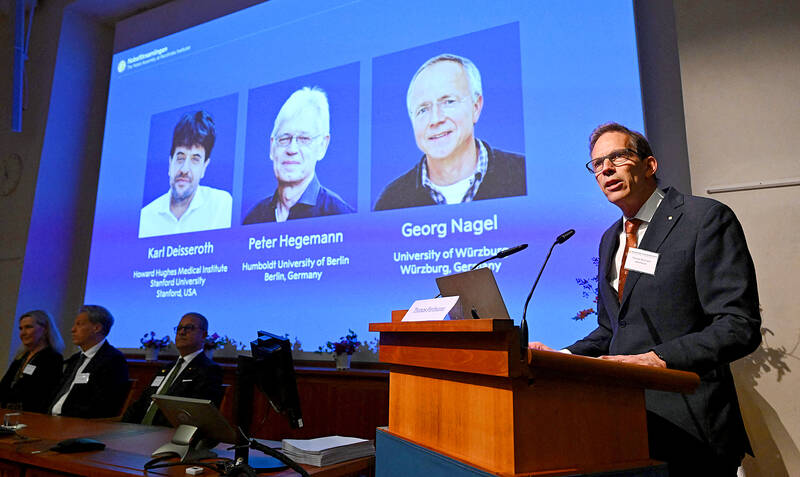
Nobel Committee secretary-general Thomas Perlmann speaks to the media in front of a screen displaying the names of this year’s laureates Karl Deisseroth, Peter Hegemann and Georg Nagel for the Nobel Prize in Physiology or Medicine at the Karolinska Institute in Stockholm on Monday.
Photo: AFP
Lien Cheng-chang (連正章), a professor in National Yang Ming Chiao Tung University’s Institute of Neuroscience and dean of its College of Life Sciences who wrote the foreword to the Chinese edition of Deisseroth’s Projections: A Story of Human Emotions, said that despite Deisseroth’s quiet demeanor, his warmth and sensitivity are evident in the book.
Yao Hao-chieh (姚皓傑), an associate professor in National Taiwan University’s Institute of Brain and Mind Sciences, said that he collaborated with Deisseroth on a research paper that used optogenetic tools developed by Deisseroth to manipulate and regulate neural circuits with light and a high degree of specificity.
The technology enables researchers to better understand the relationship between the brain and behavior, and has become a widely used research tool, Yao said.
Deisseroth has patented the tools and platforms he developed, specifying that they are intended for research and treatment of neurological and psychiatric disorders and pain, Lien said.
The technology has been used in animal studies of drug addiction, mood disorders, depression and Alzheimer’s disease, he said.
Lin Wan-chen (林宛蓁), an assistant research fellow in Academia Sinica’s Institute of Biomedical Sciences, said that Deisseroth readily shares the tools and technologies he develops with other researchers.
It was Deisseroth’s willingness to share his work that helped optogenetics develop into a major field of research, Lin said.
In 2021, a research team used the technology on the retina of a blind person and, with specially designed glasses, restored some vision, Lin said.
Other researchers have also explored using the technology with cochlear implants and to suppress epileptic seizures, she said.
Kuo Hsiao-ying (郭曉縈), an assistant professor in National Yang Ming Chiao Tung University’s Institute of Anatomy and Cell Biology, warned that safety and other issues need to be addressed before the technology can be widely used to treat neurological and psychiatric disorders in humans.
KioskNews shows a cleaned-up reading view extracted from the publisher’s page — the original always lives on their site, not ours.