Edmund Yeo’s ‘The Age of Goodbye’ weaves the darker parts of Malaysian Chinese history into a nostalgic homage to Ipoh (VIDEO)
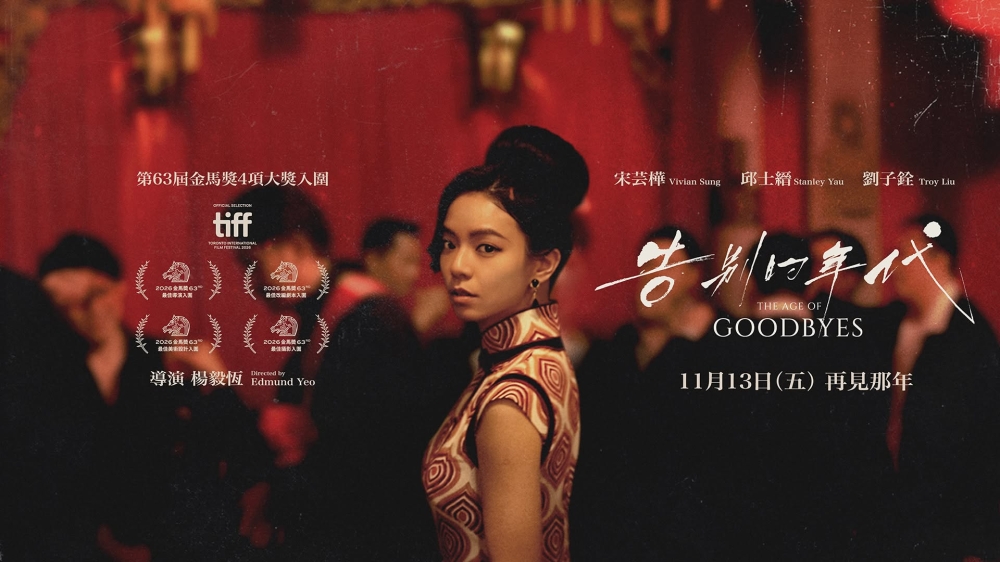

Vivian Sung is luminous in 'The Age of Goodbyes' as a woman haunted by past spectres and the weight of consequences. — Picture via Facebook/告別的年代 The Age of Goodbyes
By Erna Mahyuni
First Published: Friday, 13 Nov 2026 9:24 AM MYT
KUALA LUMPUR, Nov 13 — Malaysian director Edmund Yeo brings a beautiful pathos to his adaptation of Li Zi Shu's acclaimed The Age of Goodbyes.
Li herself was unsure about her book's adaptability as it spins from one era to the next, back and forth, while somehow also weaving in two sets of twins, born in different eras with almost matching fates.
But it is not the twins that form the centrepiece here; instead it is Taiwanese actress Vivian Sung who carries the weight of the film on her very elegant shoulders.
Sung spent time in Malaysia so she could master a passable local accent in the various Chinese languages she had to speak in the film.
The actress switched between Mandarin, Cantonese and even Hokkien with a convincing fluidity.
She is immensely watchable as Du Li An, a small town girl who ends up marrying the local taikor.
Du's heart, however, belongs to Yip Lin Sang (Stanley Yau Sze Chun), a man on a mission to break a family curse but Yip leaves town one day without even saying goodbye.
What happens when a man with the same surname, but calls himself Yip Mong Sang comes to Ipoh, bearing exactly the same face as Du's former paramour?
Are there really two Yip men? Why does Du speak Mandarin with one man and Cantonese with the other? Why are all her qi pao amazing?
If the film gets confusing at times, it's enough to just keep your eye on Sung because without the strength she brings to her portrayal, the film would be far less interesting.
Not that the other actors don't pull their weight — Yau is remarkably convincing in his portrayal of two different characters with great supporting performances from Li Xuan Siow and Liu Tzu-chuan.
Li and Liu play youngsters whose lives are forever marked by the decisions of their caregivers and they bring both a charming innocence and convincing grief to their roles.
Also adding necessary local flavour is Malaysian actor Steve Yap, a veteran of the local scene.
Like the book, the film makes references to the May 13, 1969 riots in Malaysia but also swings back to various parts of Malaysian Chinese history.
That includes the local Communist party, Chinese immigrant workers, past transgressions of British colonisers (one character speaks of his father being killed by British enforcers) but Yeo is not here to preach or overdramatise.
Brief vignettes of history take their place in the woven narrative as the film often see-saws between the past and present and while the threads can be a lot to take in, by the end of it, the film does reward you for paying attention.
I am not going to spoil the last 10 minutes of the film but I will say that it is very Malaysian in its references that will go right over the heads of non-Malaysian audiences while not detracting from the narrative.
It is important that films like The Age of Goodbyes exist; that they tell stories to mark, for future generations, the histories, hardships and the simple humanity of their forebears.
Yet another good reason to watch the film is if you are Ipoh-born because of the film's loving portrayal of Ipoh, painting its limestone caves, hills and fields in a near-incandescent glow.
On a side note, I did ask Yeo where Sung's qi pao were from and he said the Malaysian/Taiwanese team commissioned them from a Taiwanese artisan.
The film however falls under the 18 classification so best avoid taking your under-18 cousins to this film. You can probably bring your slightly prudish aunt along as the reason for that rating is... mildy steamy kissing scenes.
No nudity, no gore, no acts of violence that could be triggering but most importantly, no cuts so you can enjoy the film without feeling like you blinked and someone fast-forwarded.
The Age of Goodbyes is Edmund Yeo's most accessible film yet and one that will have a deeper resonance with Malaysians in its treatment of history, and how some decisions will have consequences that reverberate even now.
If you're keen on some old Ipoh nostalgia, head over to your nearest cinema as the film has only just opened on November 12.
KioskNews shows a cleaned-up reading view extracted from the publisher’s page — the original always lives on their site, not ours.