Albanese’s trip to the UN was more than selfies with leaders. Now he needs to convince voters
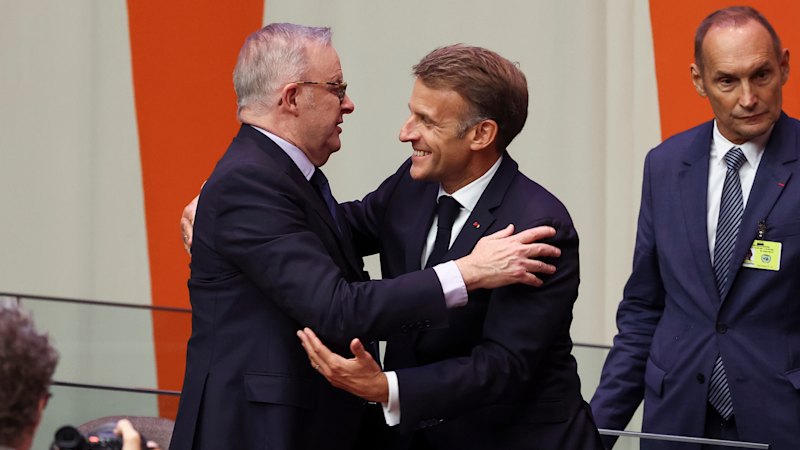
New York: Anthony Albanese has never been consumed by foreign affairs.
He is not a student of geopolitics in the way some predecessors were. He does not appear particularly curious in the grand architecture of international relations.
But he does like making influential friends. He loves sitting down with other leaders, finding common ground or passions and building relationships that might be useful later.
In a world where Australia has little capacity to impose its will, that is not nothing. And it is the foundation of Albanese’s middle-power strategy.
His week in New York has brought that into a sharper focus. He argued the international order is under great strain that superpowers are increasingly prepared to bend or ignore its rules, and that countries such as Australia need to work with other middle powers to stop the system collapsing into one governed by power alone.
The political problem is that the more Albanese engages with the world, the more carefully he must explain why he is doing it.
There is a fine line between an Australian prime minister using international relationships to advance the national interest and one who appears to be spending too much time overseas while Australians are struggling with the cost of living.
Albanese over the next few months he will travel to a G20 in Florida, potentially a Commonwealth Heads of Government meeting in Antigua and Barbuda, APEC in Shenzhen, a “G’day Namaste” event in Chennai plus COP Climate trips.
And waiting for him on the other side is One Nation’s Pauline Hanson, who understands something populists everywhere understand. That complicated problems are politically useful precisely because they can be made simple.
Just look at her social media output this week. The UN has become a globalist plot. International agreements have become a surrender of sovereignty and climate pacts are men in suits in far-off lands telling Australians how to live.
The government’s efforts to tackle the algorithm are now a plot to curb speech and political association. You do not need to engage in nuance. You ask why the prime minister is in New York when people at home are struggling to pay their bills?
That is the populist challenge Albanese and many of his fellow leaders across the West, in particular, face.
Albanese cannot defeat it merely by saying the UN is important. He will have to explain why it matters to Australians.
There’s no doubt that the international order was never perfect, but for decades it provided a framework in which countries could at least argue about the rules. It has ensured relative peace and held the world back from the brink on more than one occasion.
Russia shattered the principle of territorial sovereignty in Europe in 2014 when it annexed Crimea and – with next to no consequence – went back for more in 2022.
China and the United States are locked in strategic competition. Donald Trump’s America has shown diminishing patience with many of the institutions and alliances that underpinned the postwar system. Beijing’s assertiveness in our backyard frightens the hell out of many.
Trump’s war in the Middle East sent our fuel prices higher and trade wars have hit Australian exporters and consumers.
The revelation of an AI agent gaining access to an Australian government Medicare system gave the argument an immediate local dimension. Suddenly, an esoteric debate about AI safety had found its way into one of the most familiar institutions in Australian life.
This is where Albanese’s international agenda has substance. He was not simply collecting selfies for his Instagram, he was trying to build co-operation around problems that will eventually land on Australian soil.
But the substance is not enough, he must prosecute the case again and again.
That has sometimes been Albanese’s weakness. He spends months building a policy or diplomatic initiative and then muddles the moment it arrives. A critic will find a simpler line and the government ends up explaining itself rather than making the case.
Hanson does not need to win the argument about the UN in all its complexity. She needs to make Australians feel Albanese is worrying about the wrong things.
Inflation and increased economic insecurity has ensured there’s already a constituency asking why the prime minister is travelling so much.
Why he is meeting foreign leaders? Why taxpayers should care about an institution in New York when household budgets are under pressure?
They are not inherently unreasonable questions but the danger is allowing the answers to be dictated by the lowest common denominator.
The world comes home whether Australians are interested in it or not. Jobs depend on trade. National security depends on alliances and diplomacy. AI will change Australian workplaces.
That is the case Albanese needs to make. And he will need to make it with greater conviction.
Cut through the noise of federal politics with news, views and expert analysis. Subscribers can sign up to our weekly Inside Politics newsletter.

KioskNews shows a cleaned-up reading view extracted from the publisher’s page — the original always lives on their site, not ours.