RLPO/Hickox review – a made-to-measure clarinet collaboration two decades in the pipeline
Twenty years ago, a teenager called Mark Simpson won both the BBC Young Musician of the Year and BBC Proms/Guardian Young Composer of the Year; he commissioned a short piece for clarinet from Gavin Higgins, another young composer. It was Higgins’s first paid work and he promised to thank Simpson by writing him a clarinet concerto. Fast forward two decades: both men have forged award-studded careers, Simpson continues to combine composition and performance – and Higgins has finally delivered that concerto.
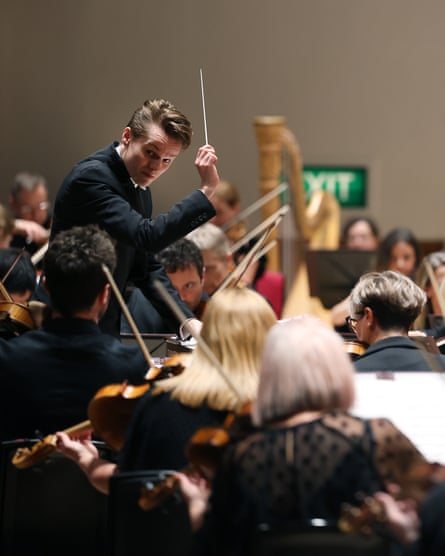
Marking the end of Simpson’s tenure as the Royal Liverpool Philharmonic Orchestra’s artist in residence, its premiere featured the kind of intense splashes of musical colour that leave an afterimage. Climaxes came in slow-burn waves and paroxysms of frenetic activity. Simpson’s solo line – sometimes keening, expressive vocalise; sometimes a wild assemblage of rapid blips and riffs – weaved through the shifting orchestral textures, here haloed by muted brass, there soaring over a low hum of gong and double bass. In one exquisite passage, Simpson’s clarinet was a fine, luminous gauze. Elsewhere he punched through the vast orchestral surge through sheer focus of tone. Certain passages seemed haunted by John Adams at his most maximalist, others by Aaron Copland’s celebrated clarinet concerto. But Simpson inhabited the score as a work made to measure, the physicality of this virtuoso performance unmistakable as soloist and orchestra hurtled ecstatically to its close.
The rest of the programme was just as driven, from the vicious timpani strokes that opened Britten’s Suite on English Folk Tunes to the quasi-mechanical power of Stravinsky’s Rite of Spring. Conductor Adam Hickox drew out the dark undertone of Britten’s late suite, the string articulation always on the nose, the woodwind solos served with an acid bite. After the interval, the Rite was thrillingly direct in the Philharmonic Hall’s bright acoustic. The woodwind solos of the opening were solid rather than atmospheric but Hickox’s tightly controlled pacing cast its own spell: striking jagged poses like a cubist figure, he revelled in the work’s play of slackness and momentum. The orchestra was on fine form – and Hickox lived up to his reputation as a major rising star.
KioskNews shows a cleaned-up reading view extracted from the publisher’s page — the original always lives on their site, not ours.