TAIEX plunges as technology stocks hit
SELLING INTENSIFIES: Shares fell across Asian stock markets as technology firms plunged on worries about the outlook for the artificial intelligence investment boom
Staff writer, with CNA and AFP


Shares in Taiwan tumbled nearly 961 points yesterday, tracking an overnight sell-off in US technology stocks after a Houthi attack on a Saudi Arabian airport sent crude oil prices soaring.
South Korean and Japanese shares also led losses across Asian stock markets as technology firms plunged on fresh worries about the outlook for the artificial intelligence (AI) investment boom.
The TAIEX closed down 960.65 points, or 1.95 percent, at 48,341.31, with leading chipmaker Taiwan Semiconductor Manufacturing Co (台積電) down 1.97 percent.
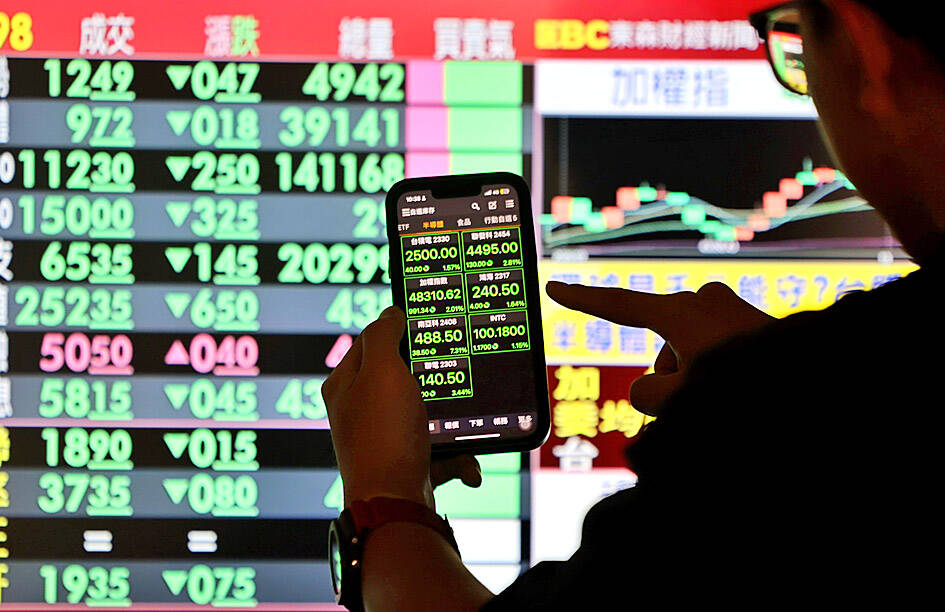
A person looks at a mobile phone in front of an electronic stock board in Taipei yesterday.
Photo: CNA
Turnover on the local main board totaled NT$1.125 trillion (US$35.22 billion), compared with NT$894.52 billion on Monday, Taiwan Stock Exchange data showed.
The three major institutional investors sold a combined net NT$198.446 billion, of which foreign investors sold a net NT$165.342 billion, the third-largest net sell-off on record, exchange data showed.
“The initial losses came after heavy losses among US semiconductor stocks overnight after attacks on a Saudi airport, sending oil prices higher,” Moore Securities Investment Consulting Co (摩爾投顧) analyst Adam Lin (林漢偉) said, referring to the Philadelphia Semiconductor Index’s 2.67 percent decline.
“Selling intensified as investors were stunned by falling technology stocks in Seoul this morning amid speculation about several developments, including a delay in shipments of Nvidia Corp’s Vera Rubin platform,” Lin said. “The expanded turnover showed that investors appeared to be panicking and scrambling to trim their positions.”
Memory supplier Nanya Technology Corp (南亞科技) slid 7.4 percent, tracking heavy losses by South Korean counterparts Samsung Electronics Co and SK Hynix Inc.
South Korea’s KOSPI tanked more than 6 percent at one point as Samsung and SK Hynix took a beating following reports that China’s CXMT Corp (長鑫存儲) had made progress on new technology to boost memory density, which other firms have been working on.
The firm was looking at releasing a new server-memory product based on the structure by the end of the year, the reports said.
Seoul closed down 5.5 percent, with SK Hynix off 10 percent and Samsung more than 7 percent down.
Japanese stocks were also sharply lower, with the Nikkei 225 losing 1.8 percent as chipmaker Kioxia Holdings Corp tumbled more than 13 percent, while Tokyo Electron Ltd was down more than 7 percent and Advantest Corp more than 8 percent.
Adding to the unease among traders were comments from Broadcom Inc CEO Hock Tan (陳福陽), who likened the recent investor AI buying frenzy to gambling.
“A lot of investors have no clue what they are investing in,” he said, adding that they “set very extreme expectations only to find out that it’s almost like they are in a casino.”
Tan also said that the industry had not yet found a sustainable model, pointing out that ChatGPT-maker OpenAI reported billions of dollars in losses.
“For now it’s still losing money, because they’re spending a lot on training,” Tan said. “So frankly, it doesn’t tell anything at this point except that there is a lot of potential revenue growth out of providing frontier generative AI models.”
KioskNews shows a cleaned-up reading view extracted from the publisher’s page — the original always lives on their site, not ours.