Unearthed church sheds light on Greenland’s past
The discovery of a medieval church in Greenland has unveiled important clues about how Viking society on the island was organized more than 800 years ago, the National Museum of Denmark said yesterday.
Probably dating back to the 13th century, the church was built when the Vikings founded a colony on the vast arctic island, which ceased to be in the 1400s, under circumstances that remain mysterious.
“This is a sensation, it’s shedding light on the significance of this whole area,” said archeologist Christian E.K. Madsen, who led the research at Qinngua near Narsarsuaq in the south of the Danish autonomous territory.
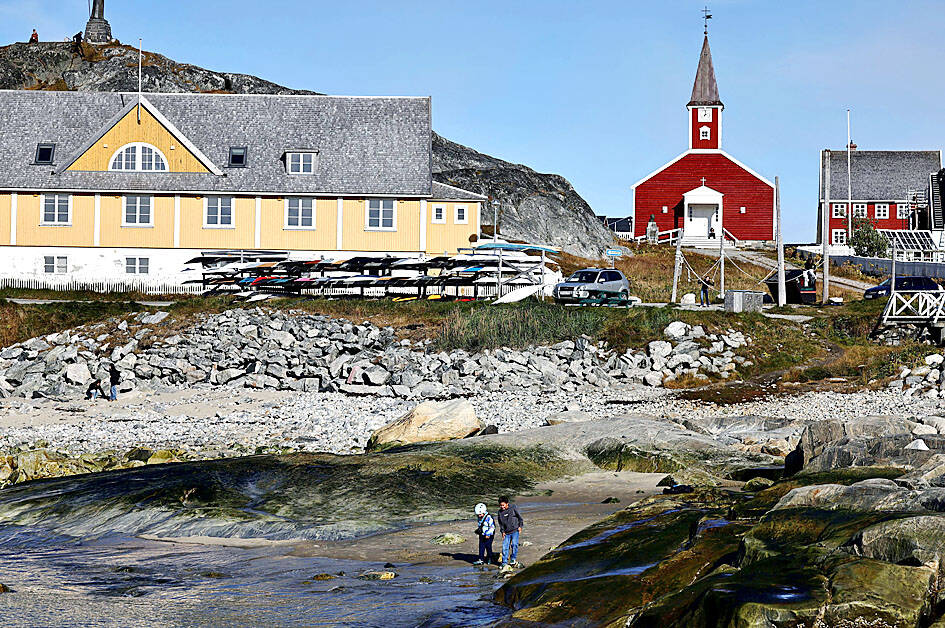
Children play on a beach in the old harbor area of Nuuk on Tuesday.
Photo: Reuters
After the Vikings converted to Christianity from paganism, “churches were vital in Norse society,” Madsen said.
“When you build a church, you are making a claim for religious power, [which] is also part of your economic power, because then you get access to the church revenues,” he added.
The Vikings first colonized Greenland in the 10th century, several millennia after the island was populated by the Inuit of the arctic at least 3,000 years ago.
Having likely been built sometime before 1450, the church is believed to predate Denmark’s modern colonization of Greenland in the 18th century by nearly 300 years.
At least one grave lies next to the church, which measures about 8m to 10m long and 3m to 4m wide.
Surrounded by three farms, the building long eluded archeologists, but a clue found in the last hours of excavations carried out last year led to its discovery.
“It’s how villages started in Greenland: This is a proto village,” Madsen said, adding that the three farms probably shared fields and resources.
The settlers did not live solely from agriculture, he said.
“It’s a very marginal area for farming and the settlement was also about accessing the arctic resources,” he said, adding that they would have hunted for the teeth of walruses and narwhals alongside polar bear skins.
The resources would then be fed “back into the European markets and all the way to the Middle East and central Eurasia,” he said.
“Essentially the farms become a base for marine hunting in this area,” he said.
The discovery “should allow us to approach the story of how this particular settlement developed over time, how it was built and collapsed,” Madsen said.
“According to written sources, which turned out to be very reliable, the church was part of a network with smaller Catholic churches. They were the first Catholic churches on the North American continent,” he said.
“It’s telling us how people took Christianity there and kept and tried to hold up a life in the roughest place they could find to live in,” he added.
KioskNews shows a cleaned-up reading view extracted from the publisher’s page — the original always lives on their site, not ours.