‘Important and consequential’: Nvidia’s Jensen Huang on US-China AI race, risk management
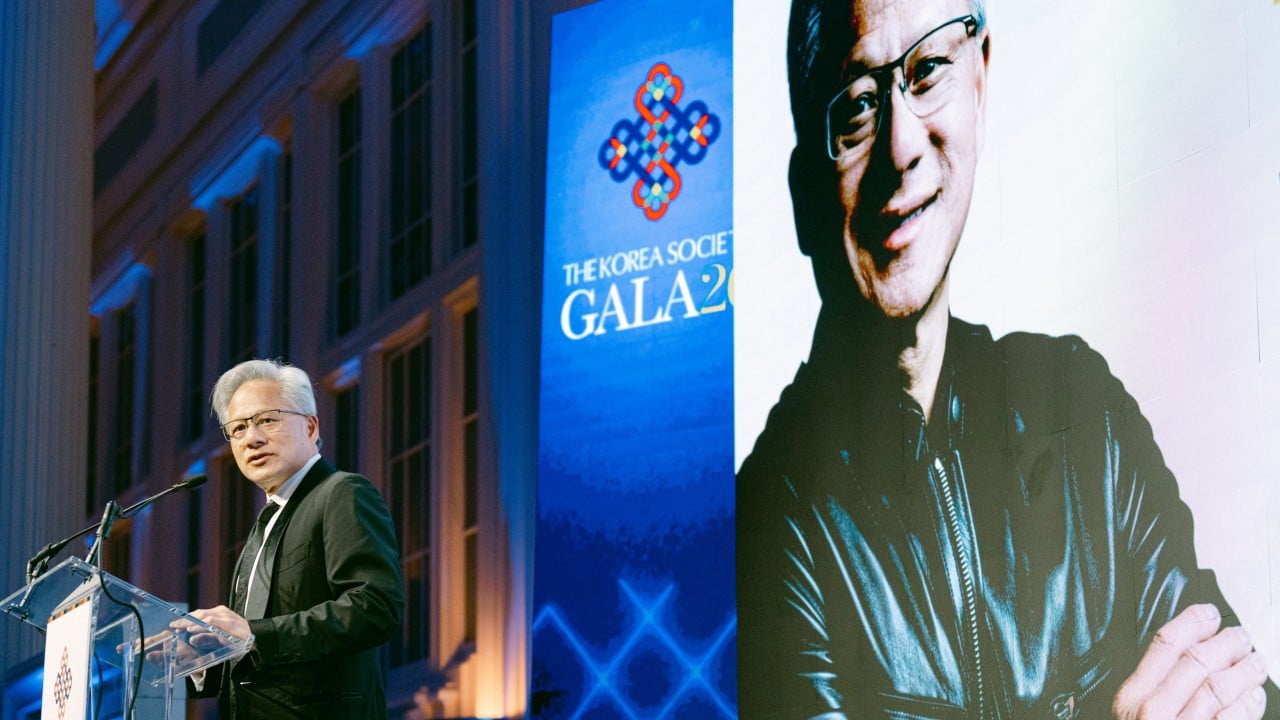
The US and China need to improve communication, work together more closely and more fully embrace technology to stem risks associated with artificial intelligence, the founder of Nvidia said on Monday.
“We should recognise that we’re competitors, and competitors are still able to collaborate,” said Jensen Huang, head of the world’s most valuable company, with a market capitalisation of about US$5.5 trillion.
“This is such an important and consequential technology. It has the incredible opportunity to do good. And we have to keep it from doing harm. And so we have to do that by collaborating, by talking.”
00:50
‘I love China,’ says Nvidia’s Jensen Huang during Beijing summit tour
This follows comments by US President Donald Trump before the United Nations General Assembly last week in which he rejected any attempts to subject US technology to international regulatory frameworks or global oversight and subsequent comments over the weekend rejecting any joint US-China AI safety framework.
“The US is not going to be putting on brakes for AI,” he told reporters on Saturday. “We are way ahead of China with AI.”
The 63-year-old entrepreneur met reporters hours after Nvidia announced authorisation to buy back US$150 billion of its own stock, a global record, and proposed a new software platform to address concerns that AI agents could “go rogue” and operate outside human control.
The Taiwanese-American spoke at the Korea Society where he received this year’s Van Fleet Award for contribution to US-South Korea relations. Former recipients include US presidents George H.W. Bush, Jimmy Carter and George W. Bush as well as former South Korean president Kim Dae-jung.
On Sunday, The Information reported that China’s Ministry of Industry and Information Technology was considering allowing China’s largest tech companies to buy Nvidia chips again after blocking them in a bid to bolster China’s tech self-sufficiency and make the country less vulnerable to US export controls.
“On the one hand, I think the Chinese government has an interest in providing an opportunity for the Chinese companies to flourish without competition from Nvidia, and so that’s an understandable situation,” Huang said.
“On the other hand, it is also important to realise that in the world of AI, compute is revenues … so, without compute capacity, the economy of the digital economy will be suppressed in China.
“That’s where the tension is. I don’t know how it’s going to work out, but I think over time, the important thing for our industry is this: we would like to be able to compete globally, and the US administration, President Trump, would like us to be able to compete globally so that the American companies can go deserve its growth, and so we have to go compete for it.”
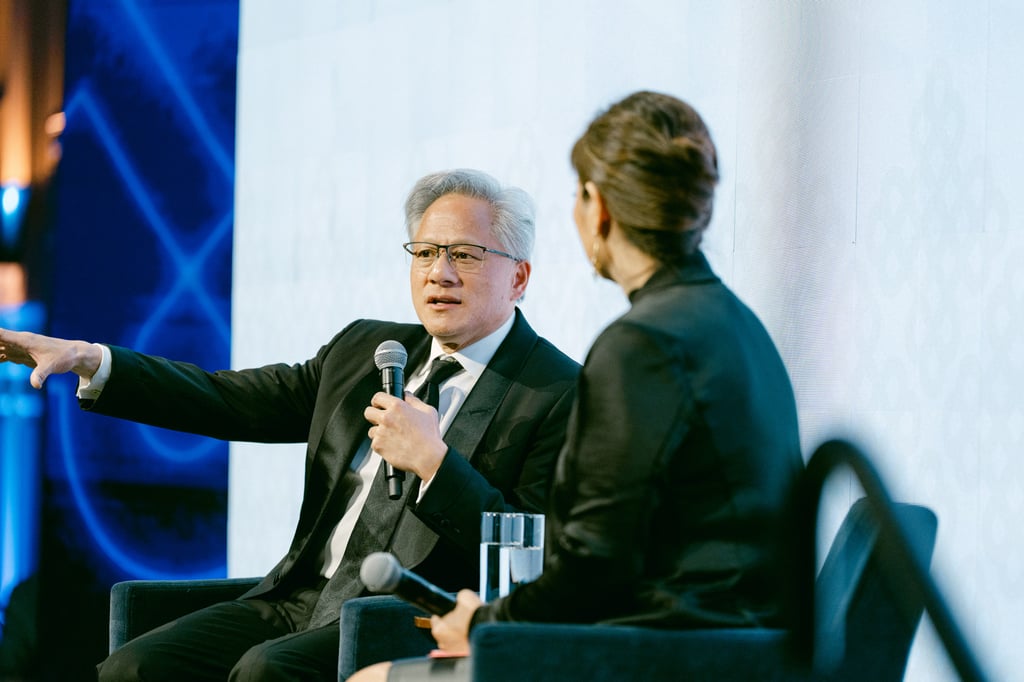
Huang said the answer to AI concerns did not rest in constraining technology but rather in using technology to better control and shape its use, citing automobiles that were far more dangerous 100 years ago but now had airbags, sensors and anti-collision systems.
“We need to embrace and we need to accelerate the development of AI technology for safety,” he said. “It’s not just when you think about AI. It’s not just capability, but it’s also AI technology for safety. They go hand in hand.”
Earlier in the day, he announced on social media a proposed new industry safeguard.
“Today, with over 100 industry partners, we introduced the Nvidia Open Agent Safety Platform,” Huang wrote on X, adding that the technology would let companies monitor every action undertaken by an AI agent as well as enforce policies.
Political analysts say the US president, known for channelling and reacting quickly to public opinion, is out of step with the American public as control over AI becomes an increasingly heated issue leading up to the midterm election on November 3.
A poll released last week by PBS News/NPR/Marist found 65 per cent of registered voters opposed the local construction of data centres.
“If you want to be poor, have no jobs and watch other countries do great, or other states do great … if we kill the Golden Goose, you will only have yourselves to blame,” Trump said earlier this month after calling those who opposed them “stupid people”.
Huang conceded that the industry had fallen short in bringing the public along and gaining its support for the need for data centres amid rapid change.
“With respect to all the communities and data centres that are cropping up all around it, we really could have done a better job being a guest, a new neighbour, to engage the communities,” he said, dressed in a suit instead of his trademark leather jacket.
“Let them know what the plans are and invite them to be part of the success and the prosperity of our industry.”
01:52
Xi says China and US have responsibility to ‘manage AI for good’
His company’s shares closed at US$228.86, up 1.68 per cent.
“Nvidia is a strange company because Nvidia is already the largest company in the world. We’re also still one of the fastest-growing companies in the world, and so it’s unnatural for a company of our size to grow as fast as we are growing,” he told reporters.
“As a shareholder, I would encourage you to hang on to your stock. Buy some more. Buy some more. Nvidia is quite inexpensive right now.”
KioskNews shows a cleaned-up reading view extracted from the publisher’s page — the original always lives on their site, not ours.