After years of robust growth, a tough 2027 ahead for Singapore banks: Analysts

The three Singapore banks reported a mixed bag of earnings this week, with DBS and UOB missing analysts' expectations.
New: You can now listen to articles.

This audio is generated by an AI tool.

07 Nov 2026 09:03AM
SINGAPORE: Despite the prospect of higher interest rates, Singapore banks may face a tougher environment in 2027, analysts told CNA.
“The boom years did a lot of the work for Singapore’s banks,” said Mr Eric Xiao, head of sales in Asia for CMC Markets. “In 2027, they’ll have to do it themselves.”
He said it appears to be more difficult to cash in on the wealth boom than expected, noting that DBS took in a record S$15 billion (US$11.7 billion) of net new money for the third quarter of the year and still saw wealth fees fall 6 per cent because clients traded less.
Banks will eventually benefit from higher interest rates, he said, but margin income could get squeezed initially because rates on deposits tend to rise more quickly than rates on loans.
Overall, he does not expect the banks to see a “down year” despite the difficult conditions ahead.
Mr Ritesh Ganeriwal, group head of investment and advisory at Syfe, said the banks’ core business held up in Q3, but “the problem is that interest rates are no longer doing the heavy lifting”.
Even with interest rates in the US rising, Singapore rates have stayed low, and banks are competing harder for deposits, so margins are getting squeezed.
“That points to slower growth in 2027, driven by loans and wealth fees, rather than a downturn,” he said.
Their comments came after the three local banks reported earnings for Q3 2026, with the financial results for DBS and UOB falling short of expectations.
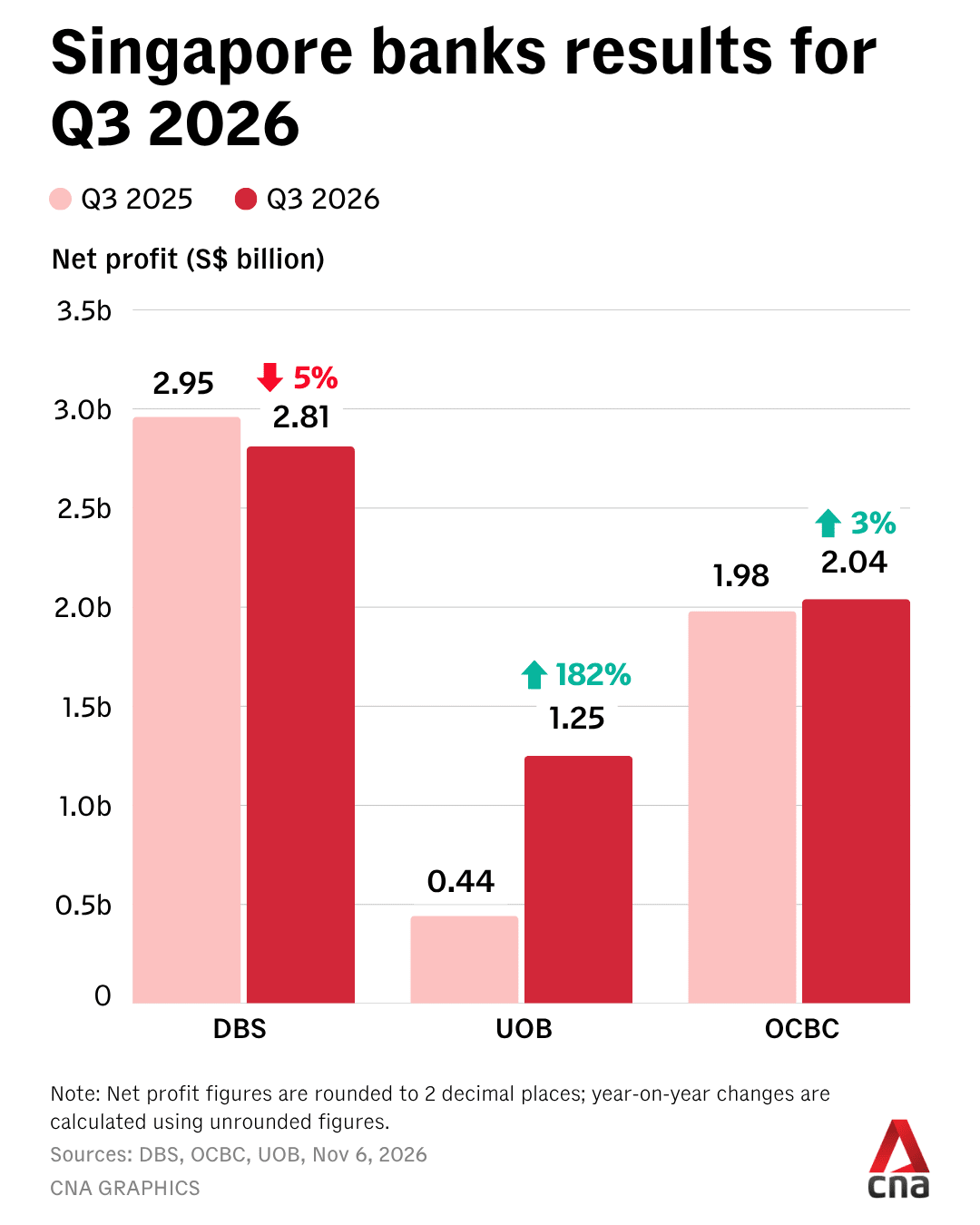
OCBC’s net profit, reported on Friday (Nov 6), grew 3 per cent to S$2.04 billion, beating analysts’ estimates of its performance.
DBS saw its net profit for July to August fall 5 per cent from a year ago to S$2.81 billion, while UOB’s net profit increased 182 per cent to S$1.25 billion, but missed expectations.
The spike in UOB’s net profit came off a low base, as the bank set aside S$1.36 billion in allowances for credit and other losses in the third quarter of last year.
The banks’ share prices have also been under pressure in recent weeks, along with the broader Singapore market, after climbing rapidly in the earlier part of the year.
“The recent sell-off appears to reflect a combination of earnings disappointment and weaker macroeconomic sentiment,” said an analyst from digital brokerage MooMoo.
Further earnings weakness, deteriorating credit conditions or prolonged macroeconomic pressures could weigh on performance and share price, they added.
However, credit quality, loan growth and wealth management remain key factors in the medium-term investment outlook, said the analyst.
DIVERGING PATHS?
Looking ahead to 2027, analysts also noted that the banks are not in equal positions.
“DBS has the steadiest outlook,” said Mr Cheng Chye Hsern, head of investment at Providend. The bank’s management said net interest income has bottomed out, with mid-single-digit growth of total income expected next year.
It has the highest profitability, but its share price is nearly three times its book value, compared with its historical average of 1.6 times.
Mr Xiao of CMC Markets said DBS and UOB have different reasons for missing analysts’ expectations.
For DBS, the shortfall came from markets trading income plunging 65 per cent, signalling a rough quarter on the desks rather than any deeper issues, he said.
However, UOB's problem is harder to fix, he said: “Margins are thinner, and costs keep rising into 2027."
OCBC said it expects loan growth to be in the low double digits for this year, and that it is well placed for higher rates. But its insurance arm, Great Eastern, will keep group earnings lumpier whenever bond markets move sharply, said Mr Cheng of Providend.
Ms Joanna Cheah, ASEAN research analyst at Jefferies, said earnings drivers are becoming more differentiated between the local lenders.
UOB faces greater earnings pressure from persistent net interest margin compression, while DBS and OCBC’s net interest margins started to recover at the end of the third quarter, she said.
ARE BANKS AFFECTING THE BROADER MARKET?
Analysts said that while the three local lenders form a very large part of the Straits Times Index and will affect its direction significantly, the recent decline in the index is not purely a bank story.
Ms Cheah attributes the current weakness partly to a global risk-off sentiment, and partly to some domestic profit-taking after a strong rally.
The US midterm elections outcome earlier this week accelerated the sell-off amid concerns that greater regulatory scrutiny could slow investment into artificial intelligence and data centre industries.
“That has spilled into Asian markets, including Singapore,” she said, noting that the decline locally has broadened beyond financials.
“We would distinguish this market volatility from Singapore fundamentals, which remain relatively defensive, supported by resilient earnings, a strong currency and healthy corporate balance sheets,” she said.
KioskNews shows a cleaned-up reading view extracted from the publisher’s page — the original always lives on their site, not ours.