Maritime issues need framework for a crisis: experts
By Esme Yeh / Staff reporter


Experts at the International Conference on Sea Lane Security on Wednesday called for early preventive measures, including the establishment of international maritime cooperation mechanisms, to safeguard shipping routes through the Taiwan Strait against Chinese maritime coercion.
China’s maritime quarantine operations would more likely come in the form of “law enforcement,” “maritime governance,” or “rights protection” instead of a formal quarantine, Institute for National Defense and Security Research associate research fellow Lee Jyun-yi (李俊毅) said at conference hosted by the Ocean Affairs Council.
While most studies assumed that the China Coast Guard (CCG) would be deployed in the vicinity of Taiwan, the institute’s research showed that a quarantine could enforce an outright termination of maritime traffic to and from Taiwan, he said.
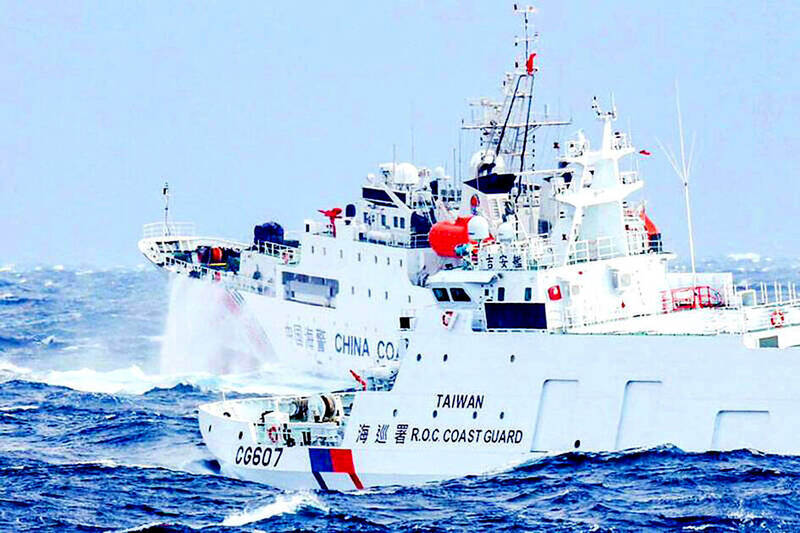
A Coast Guard Administration ship, front, monitors a China Coast Guard ship near Taiwan’s northeast coast in an undated photograph.
Photo: Coast Guard Administration via AFP
“Taiwan might find it difficult to do anything if the CCG operates in waters well beyond Taiwan’s jurisdiction,” Lee said.
Lee considered maritime quarantine a political and military attack involving the CCG — a paramilitary force — that China would use to test Taiwan’s sovereignty and jurisdiction or disrupt energy and food imports.
He called for preventing such efforts from snowballing into a crisis in which Taiwan might be forced into negotiations on terms favorable to China.
Taiwan should improve communication with the shipping and commerce industries to sustain their confidence in sailing through the Strait, Lee said.
British Royal Navy retired vice admiral Duncan Potts said the international maritime community requires confidence to trade.
“We want the global trading community to continue coming to Taiwan,” he said, adding the global trading community is not an entity that can be summoned or a partnership that can be formed without regional countries.
Potts called for building maritime security architecture and partnership before a crisis breaks.
“Understand the triggers and what time you would have to deal with things,” he said, adding that early preparations like preplanning or tabletop exercises would make it easier to respond to emergencies.
Chisako Masuo, associate professor of Kyushu University’s Graduate School of Social and Cultural Studies, presented a photo of a transcontinental cargo train with more than 50 containers running from Europe to China.
China not only continued to build such railways heading to Europe, but also has many gas or oil pipelines linking to Russia, Pakistan and Myanmar, she said.
“If quarantine happens on the maritime side, our economic life would be stopped,” Masuo said of not only Taiwan, but of Japan and South Korea as well.
However, China can survive with the help of its continental neighbors thanks to the economic corridors it has built, she said.
Most discussion about Chinese President Xi Jinping’s (習近平) maritime strategies focused on military and overlooked his attempt at hybridizing civil and military deployments, Masuo said, adding that Xi sought to dominate the economic side of maritime governance as well.
She called for surveillance of the Chinese maritime safety agency’s activities, which has the authority to initiate maritime quarantine.
Masuo cited the Chinese National Cultural Heritage Administration’s participation in a maritime law enforcement meeting in March, saying that China might be building a new mechanism for “underwater law enforcement.”
Korean Institute for Asian Strategy Studies president Lee Changhyung said a maritime quarantine is different from a military blockade, and such a crisis could embroil all of northeast Asia instead of Taiwan alone.
Maritime quarantine would be more difficult to define than military blockade, as the CCG and Chinese maritime authorities or militia could stand in for the Chinese military in disrupting shipping operations, he said.
Navigational warnings, exercise zones or shipping inspections could be applied to pressure global businesses into rerouting their ships around the Strait, Lee said.
That would increase the costs of transportation and insurance, he said, adding stability in the Strait is an issue of economic security for South Korea.
“China also benefits from safe and open sea routes in East Asia,” Lee said. “Peace and stability in the Taiwan Strait are not only in the interest of Taiwan, South Korea, Japan or the US, but also in China’s interest.”
KioskNews shows a cleaned-up reading view extracted from the publisher’s page — the original always lives on their site, not ours.