Taiwan urged to boost defense spending
‘FRONTLINE’ NATIONS: ‘Vilnius and Taipei are not two separate stories ... whichever of us folds first makes taking the other one cheaper,’ a Lithuanian lawmaker said
By Hollie Younger / Staff writer, with CNA


Lithuanian lawmaker Dovile Sakaliene over the weekend urged Taiwan to prioritize its defense budget, saying that national security cannot be compromised for other public policies, during a joint conference of Taiwanese associations in Helsinki.
She made the comments at this year’s Joint Annual Meeting of the World Federation of Taiwanese Associations and the European Federation of Taiwanese Associations, which took place from Friday to Sunday.
The event, themed “Democratic Resilience and Trusted Democracy,” drew more than 330 participants, including politicians and human rights advocates from Taiwan, Finland, Lithuania, Poland and the UK, to discuss how democratic societies can resist legal, diplomatic and military coercion by authoritarian states.
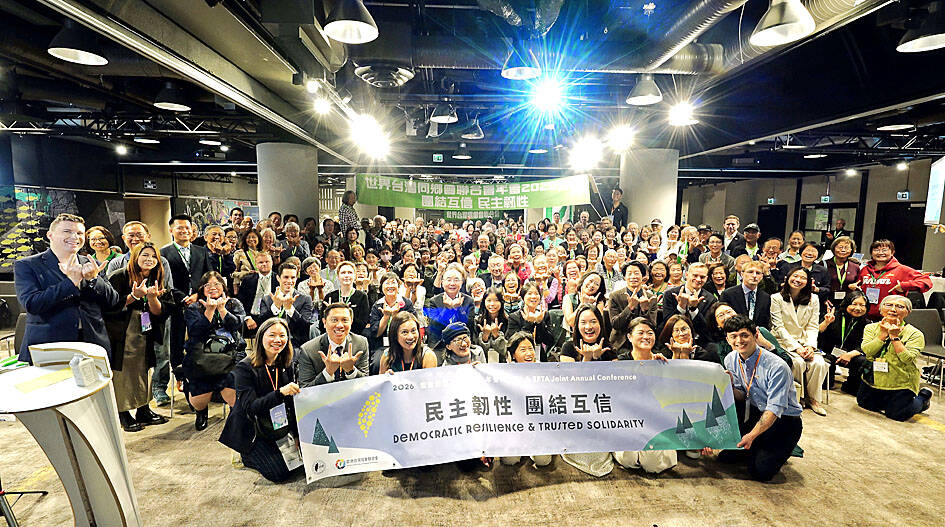
Attendees pose for a photograph in front of a banner reading “Democratic Resilience & Trusted Solidarity” during the joint annual conference of the World Federation of Taiwanese Associations and the European Federation of Taiwanese Associations in Helsinki over the weekend.
Photo: CNA
“Taiwan and Ukraine are the structural safety pins of global stability. Pull them and the whole transatlantic system unzips,” Sakaliene wrote on social media yesterday.
“Vilnius and Taipei are not two separate stories. Russia and China are one problem working two fronts, and whichever of us folds first makes taking the other one cheaper,” she added.
Sakaliene served as Lithuania’s minister of national defense from December 2024 to October last year, when she stepped down following disputes over increasing defense spending.
She gave a presentation over the weekend titled: “Resilience Under Pressure: Lessons from Lithuania and NATO’s Eastern Flank,” and participated in the panel “Frontline Democracies — Geopolitical Resilience in an Era of Authoritarian Pressure.”
Taiwan must invest sufficient resources to maintain its self-defense capabilities, as China’s military aircraft and exercises have become the “new normal,” she said.
If you cannot protect your country, then who would be left to benefit from education spending, she asked, adding that if nations do not strengthen their own military, they are only strengthening that of the enemy.
As cooperation grows between China, Russia, Iran and North Korea, Taiwan faces a similar situation to Europe, she said.
There are no shortcuts to democratic resilience; it is built day by day through strengthening social trust, maintaining defense capabilities and ensuring that democratic institutions can continue functioning during a crisis, said Atte Harjanne, member of the Finnish parliament and First Vice Chair of the Taiwan Friendship Group.
Since China enacted the Law on Promoting Ethnic Unity and Progress in July, concerns are growing that Beijing’s domestic laws could be applied outside of China, and Taiwan must now be on even higher alert, Overseas Community Affairs Council Minister Hsu Chia-ching (徐佳青) said.
Taiwanese officials, civil servants, those involved in religious exchanges and those working in technology with access to sensitive information are now high-risk groups when traveling to China, she said.
Luke de Pulford, cofounder and executive director of the Inter-Parliamentary Alliance on China (IPAC), said that the alliance has faced continued interference from the Chinese government since its establishment, including members being sanctioned or denied visas, having their identities impersonated or being targeted with sexual images generated by artificial intelligence.
Before IPAC held its summit in Taipei, Beijing obtained the list of delegates and pressured politicians from 11 countries to prevent them from attending, he said.
The meeting also focused on economic cooperation between Taiwan and Finland.
Finland’s exports to Taiwan rose 67 percent in the first half of this year compared with the same period last year, reaching 150 million euros (US$173 million), Finnish legislator Ville Kaunisto said.
Meanwhile, Finland imported about 724 million euros worth of goods from Taiwan, he added.
If the current pace continues, bilateral trade could reach 1.8 billion euros this year, he said.
KioskNews shows a cleaned-up reading view extracted from the publisher’s page — the original always lives on their site, not ours.