Why has Rick Stein thrived in Australia while other famous chefs have failed?
Rick Stein’s wife, Sarah Stein, tells a story about a BBC event they attended some years ago honouring her husband as a legend of the television industry. The room was filled with people celebrating the chef, a fixture of British dining since 1975 for his unerring love of simple, produce-driven food. That night, the only person he was interested in speaking to was Frank, who was there to fix the photocopier. “He was just an ordinary person,” says the chef who, according to his wife, spent most of that evening hiding on the balcony from a room full of British Broadcasting Corporation royalty. “That conversation’s more interesting. You know, I quite like talking about technical things, like photocopiers.”
In fact, he would almost always rather be in the company of craftspeople, producers, grafters and technicians. “I just like talking to farmers and fishermen,” he says, plainly. “I find them grounding.”
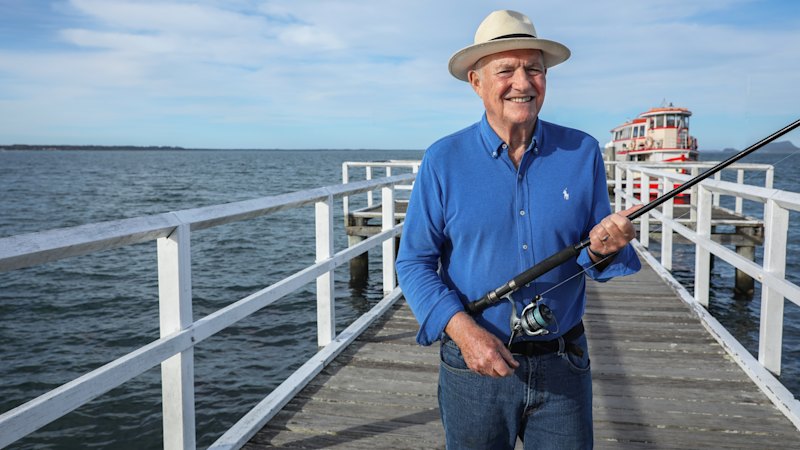
That’s the thing about Stein. On paper he’s a businessman, public figure and chef who turns 80 next month, with an estimated net worth in the tens of millions. He grew up posh. Read English at Oxford. He’s written 33 cookbooks and a memoir. He’s opened 13 restaurants, nine of which are still operating today, three of them in Australia. You’ll find his name on baseball caps and crockery, wine labels (his white burgundy, produced with his son Charlie, is excellent), the sides of restaurants, and even supermarket shelves, after recently launching a line of fish dinners with UK supermarket chain Waitrose. He’s won a stack of awards, including an Officer of the Order of the British Empire for services to Cornish Tourism in 2003 and a Commander of the Order of the British Empire in 2018 for services to the economy in hospitality and tourism. He is very, very famous. And he’s been very, very famous for a very, very long time.
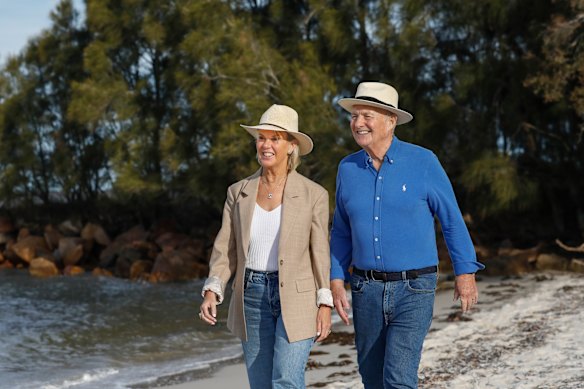
I’ve been invited to Port Stephens, two hours’ drive north of Sydney, to talk to him while he’s in town hosting a two-day event at one of his mid-north coast restaurants, Rick Stein at Bannisters. It’s not the first time I’ve interviewed him, either. Back in 2019, I visited Stein at his Mollymook venue of the same name for Good Food, but a lot of history has passed in those seven years, including a pandemic and devastating bushfires.
He likes catching up with people. A few times a year, Rick and Sarah Stein run a meet-and-greet culinary series at their restaurants in Mollymook and Port Stephens, allowing fans to get up close and personal with the chef. The event starts with a dinner showcasing a menu of Rick Stein favourites (steamed pipis bathed in white wine and garlic, then Moreton Bay bug tagliatelle or a simple fillet of grilled blue eye trevalla). In between courses, the chef gives his audience what they’re here for: a few moments of shared time, a short story or two and the chance for diners to have their menus signed. He knows how to hold a room, and the room loves it.
In between speaking, the chef – to borrow a term from Generation Z – conserves his aura. That is, when the spotlight’s off, he’s quiet, thoughtful and more interested in how things work than who people are.
He’s not the only international chef to be taken with Australia, of course. American chef David Chang loved the country so much he opened a Momofuku here (the celebrated clutch of restaurants had not, at the time, even made it out of Manhattan). Then there was Northern Irish chef Clare Smyth’s Oncore – an offshoot of her Michelin-starred restaurant Core by Clare Smyth. Both were heavily awarded while they were operating here; neither lasted. Having first arrived in Australia six decades ago, Rick Stein probably has had the longest and closest relationship with this place of any foreign chef, but what keeps him here?
Over tacos, corn ribs and beers by the pool (Stein is an avid swimmer, doing an hour a day of languid breaststroke while listening to podcasts), he describes his childhood as idyllic. He grew up in an upper-middle-class family of artistic intellectuals in rural Oxfordshire, spending holidays by the sea in Cornwall. His older brother, a professor of neurophysiology, had excelled academically and Stein talks about the pressure of his father’s expectation of him to do the same. But, he says, “I just couldn’t ever live up to what my brother was doing. And I just got more and more despondent about it, thinking I was stupid. I really suffered from it.”
One of the ways he dealt with those perceived inadequacies was to “become a bit of a local. So I would sort of go off with the kids from the village,” says Stein. “I actually picked up an Oxfordshire accent, which is why some people think I should [sound] posher.”
The chef is no stranger to the challenges of mental health. His father suffered from bipolar disorder, a condition that was little talked about in the polite circles of the upper-middle-class Cotswolds. In his 2013 memoir, Under a Mackerel Sky, Stein writes, “as a child, I was embarrassed by my dad’s effusive episodes; I honestly don’t think I had much awareness of his depressed episodes. He was just terribly low, and I suppose I got used to living with someone who was intermittently sad.”
When Stein was 18, his father took his own life by jumping off a cliff near the family’s holiday home in North Cornwall. A year later – almost 60 years ago now – Stein landed in Australia for the first time. He’d been reading a lot of Hemingway, Steinbeck and Orwell and had the idea that a trip like this would act as a sort of masculine coming of age/rite of passage. “I was thinking, ‘I just want to be me,’ you know, and I did find that when I got here,” says Stein. “I think I’ve always been fighting against my background in some sort of way.”
When he was younger, he’d also been taken with the Aussie lifeguards the local Cornish council were employing at the time to deal with that rough stretch of English coast. “It made sense,” he says, “because nobody had the knowledge of how to save people’s lives in the surf like the Aussies did.” Their displays of physical prowess – delivered with an Aussie swagger – left a mark on the young Stein. “I just loved their ‘laconicness’, their sportiness, their accent. Wonderful people being parachuted in from another universe, in a way.”
And so, Stein ran to a place that represented new opportunities, adventure, wanderlust. It was also a chance to carve a life outside his family’s high -academic expectations – to discover who he was and what he could do. “I think if you’ve had that turbulence in your younger life, it does affect you, and you’ve got to make something of yourself,” says Stein, who suffered panic attacks himself through his 20s. “I’m quite aware of why I did what I did, you know. And why I felt I had to prove to myself.”
Among the many jobs he drifted between during his time in Australia in the late ’60s – including -working in an abattoir, as a railway labourer and a vegetable-picker – it was working as a gaffer for Channel 10 on several projects, including chef Graham Kerr’s culinary series, The Galloping Gourmet, that helped pique his interest in media.
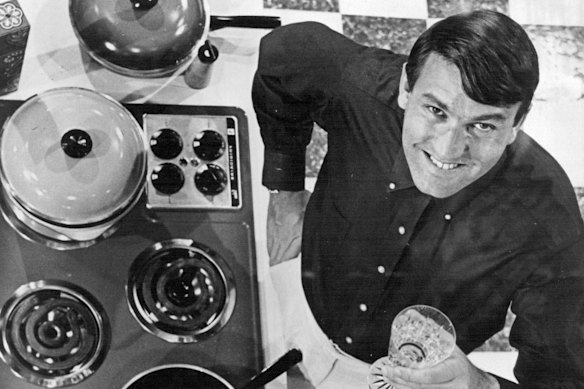
“It was very relaxed,” says Stein. “I mean, he used to turn up with his wife in his Karmann Ghia – it’s like a sporty version of the old VW. And he’d open the boot, which was in the front, and pull out the stuff he was going to cook, and loads of wine,” he says. “In those days, it was German riesling. He’d give glasses to all the crew. And it was just this idea of actually enjoying a cookery program,” says the chef. “You can see why he was really successful. He liked what he did, you know? I was pretty influenced by that.”
Stein eventually came back to England and was accepted to Oxford to read English. He graduated in 1971. During that time, he met his first wife, Jill. The pair married and settled in the Cornish fishing village of Padstow. At the time, Stein was running a mobile nightclub called The Purple Tiger, where he would DJ. The Great Western club followed, but it became such a popular spot for local fishermen to get into fights, they lost their licence and had to shut it down. In its place Rick and Jill opened The Seafood Restaurant, which still stands to this day and is still family-owned. “It was just a fishing port, really,” says Stein. “We’re just very lucky it worked, and I think the reason it worked is you start off as one good restaurant in one place.”
After opening that first restaurant, launching his television career and then opening subsequent venues in the same town (the Rick Stein Group operates six restaurants, accommodation, a cooking school, deli and gift shop), the place was actually given a divisive nickname: “Padstein”.
The pair divorced in 2007, but still run the business of the Rick Stein Group together with their sons, Jack, Charlie and Ed. (The three children -manage the menus, wine and building projects, respectively.) They also recently co-authored a cookbook – The Seafood Restaurant Cookbook – which was released in June this year, marking 50 years in business together. They even collaborated with a local Cornish brewery to make a wheat beer called Purple Tiger to mark the event, featuring the original psychedelic disco artwork inspired by Stein’s old speaker covers.
It’s been 31 years since he debuted his first BBC series, Taste of the Sea, and looking at it now, there’s a softness to it that feels lacking in much of contemporary cooking and travel TV. There he is, on a Cornish fishing boat, gently admitting to his audience that he and his crew were all just horribly seasick while catching conger eels. Even as he’s saying it, he looks like he’s having the time of his life. Later, he’s back in his kitchen making a rustic seafood stew. Maybe it’s the nostalgia speaking, but it’s television that feels just as cosy and engaging today as it did in 1995.
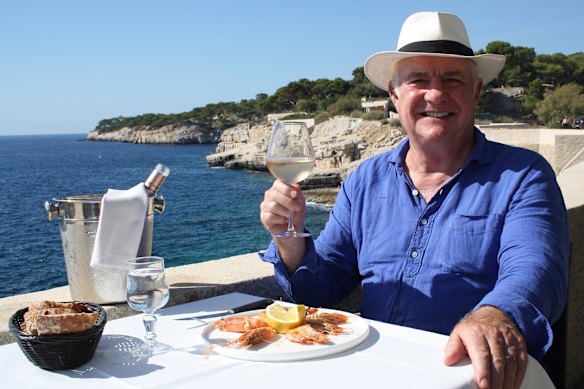
When I was growing up in the country in the 1990s, with just four television channels to choose from, Rick Stein’s adventures were transportive. And while there’s no shortage of content to engage with now, Stein still holds his audience. There’s a zest, a fearlessness and a sense of adventure in him that’s contagious. He seems comfortable wherever he goes, too, whether it’s making mole in an open market in Oaxaca, Mexico, grilling fish on the beach in Bilin Zal, Croatia, or digging for clams on the English coast with his terrier, Chalky (RIP), who became famous in his own right for menacing the production crew on shoots. “His adventurousness and his thirst [for travel] is just inbuilt in him,” says Sarah Stein. “And I don’t know many people like that.”
“He’s just a really beautiful human,” says Sydney chef and longtime friend, Neil Perry. “The nice thing about Rick is that he really invites you into the conversation. You feel relaxed and comfortable, listening to him talk about food. And as a matter of fact,” says Perry, “it’s not really about him cooking. It’s more about the enthusiasm and the general love that he has for food, and the pace at which he communicates. And that’s a very unique thing. I mean, it’s just such incredibly engaging TV.”
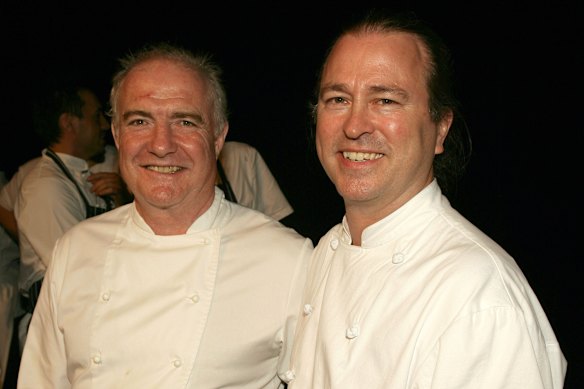
The pair first became friends in the mid-’80s when Stein visited Perry’s Bondi restaurant, The Blue Water Grill. Perry’s simple, produce-driven approach to cooking really appealed to the English chef, who had long been an advocate for seafood cooking where the ingredient was the focus. “I find a lot of modern food too bitsy,” says Stein. “You know, there’s just too many notes, too much stuff going on.
“I was filming with Neil Perry the other day [for the BBC production of Rick Stein’s Australia, currently streaming on SBS]. He’s just the same. He just really likes a piece of fish, olive oil, maybe a bit of lemon juice – and that’s it. I’m quite pleased about that.”
Food personality Lyndey Milan has known the English chef since 1995. Milan, a fixture of Australian television herself since the 1980s, describes Stein’s filming style as lovely and laidback. “It’s this relaxed delivery that he’s got,” she says. “It’s beautiful, absolutely beautiful. He’s got this lovely way of speaking and describing things that really works.” In 2012, Milan won the Good Food Guide Legend Award but was unable to attend the event as she was overseas on business. Stein accepted the award on her behalf.
Rick met his second wife, Sarah Burns (now Stein) in 1997 while he was in Australia as a guest judge for Gourmet Traveller’s restaurant awards. Burns was managing the publicity for the magazine’s then-publisher, Australian Consolidated Press (ACP), and was tasked with accompanying the chef on his dining journey around Australia. At the time, he was a relative unknown here. He was actually a stand-in for fellow English chef of note, Simon Hopkinson, who couldn’t face the flight.
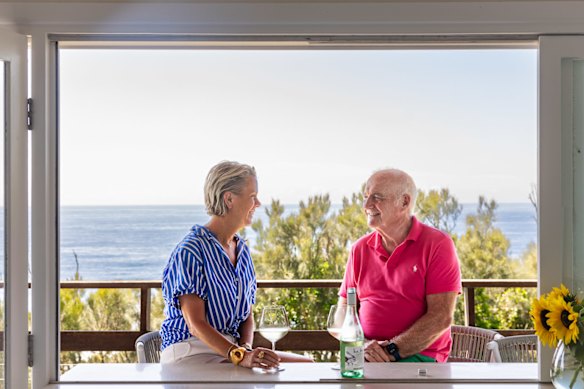
“He’d done, like, one series, but no one knew him,” says Sarah Stein, who turns 60 next month. “I remember watching the VHS of Rick Stein’s Taste of the Sea with a friend going, ‘Oh, are you joking? All he’s doing is putting butter on stuff and he’s got parsley in his teeth.’ ”
Before Stein flew out, Sarah would regularly field calls from him, making small talk. At the time, she was working on several other large-scale events for ACP and didn’t have a lot of bandwidth for a chef she hadn’t even met who couldn’t stop nervously asking about the weather in Sydney. “I’m thinking, ‘Mate, you’ve been to Australia before, are you nervous about the event? Feeling a bit unconfident?’ ”
She finally met him face-to-face, and it was on that trip that the first blush of romance presented itself. “We started talking, we just found out we were both from big families, both loved music, both loved reading, food – obviously – and, I don’t know, I felt like I’d come home,” says Sarah Stein.
In the coming years, the pair would travel back and forth to see each other, in a five-year, long-distance affair that eventually ended in a public divorce for Rick Stein in 2007. Sarah’s own divorce was finalised in 2003. “I sometimes look back and go, ‘How did we do that?’ ” she says. “My children were always my priority, and the same with Rick. And he’s been the most unbelievable stepdad.”
Despite the challenges of navigating new lives (in 2006, Jill Stein made UK headlines when she slapped Sarah and then Rick across the face after bumping into them holding hands in Padstow), the three have managed to operate the various arms of the business with relatively little blood spilled.
Sarah and Rick Stein, who eventually eloped in 2011, run the Australian arm of the business together including Rick Stein at Bannisters Mollymook and Port Stephens, Rick Stein at Coogee Beach (which opened last year), and Rick Stein Productions. Sarah Stein is the executive producer of Rick Stein’s current television series, Rick Stein’s Australia, which features heavy-hitting local cultural icons such as artist Ken Done, chefs Neil Perry and Mark Olive, musician Jimmy Barnes and his wife Jane. Sarah also works on Rick’s books.
Sarah had spent her early life holidaying with her family on the NSW South Coast and the original idea of opening restaurants there was hers. She remembers driving there with Rick in 2003, and saying to him, “‘Mate. This is my favourite place. If you don’t like it here, it’s all over.’ And, of course, he loved it, because the South Coast is quite like Cornwall, you know, on the beaches. It was still undiscovered there.”
She describes her husband as the kindest person she’s ever met, and “so clever”. That said, she doesn’t understand why he doesn’t back himself more. “Every day I go, ‘You’re amazing,’ ” she says. “It’s unbelievable, he’s almost 80, I’ve known him for 29 years, and he still tells me stories I’ve never heard. But he lacks confidence.”
In his memoir, Rick Stein opens with a quote from James Thurber: “All men should strive to learn before they die what they’re running from, and to, and why.”
He once ran away to find himself. What is he running to? “Well,” he says, “that’s the question. I suppose it’s sort of trying to sort of come to terms with death, you know? But even when it gets closer and closer,” he says, “you don’t worry about it. I think what you’re running to is a sort of acceptance of everything that you’ve been through, and a sort of slight peacefulness, because you’ve been through it, and you’ve probably got answers to it.”
Next year will mark the chef’s 60-year love-in with Australia. A country that captured his heart from his first schooner of Toohey’s New and burger with the lot at Sydney’s Newport Arms, and continues to do so to this day. You don’t meet too many almost-octogenarians making cross-continental commutes several times a year. But then, you don’t meet too many people like Rick Stein: a toff wrapped in a chef’s jacket, inside a TV celebrity, who would rather be talking to a tradie.
Read more from Good Weekend magazine:
- Some teachers saw him as a delinquent. Now Hugh Allen is a three-hatted chef
- ‘He’s very nice. The only problem is ...’: chef Marco Pierre White on Jock Zonfrillo
- From degustation to delivering lasagnes: how Ben Shewry crash-tackled a crisis
Get the best of Good Weekend delivered to your inbox every Saturday morning. Sign up for our newsletter.
KioskNews shows a cleaned-up reading view extracted from the publisher’s page — the original always lives on their site, not ours.