What if your cooking gas came from water? Meet India’s hydrogen stove
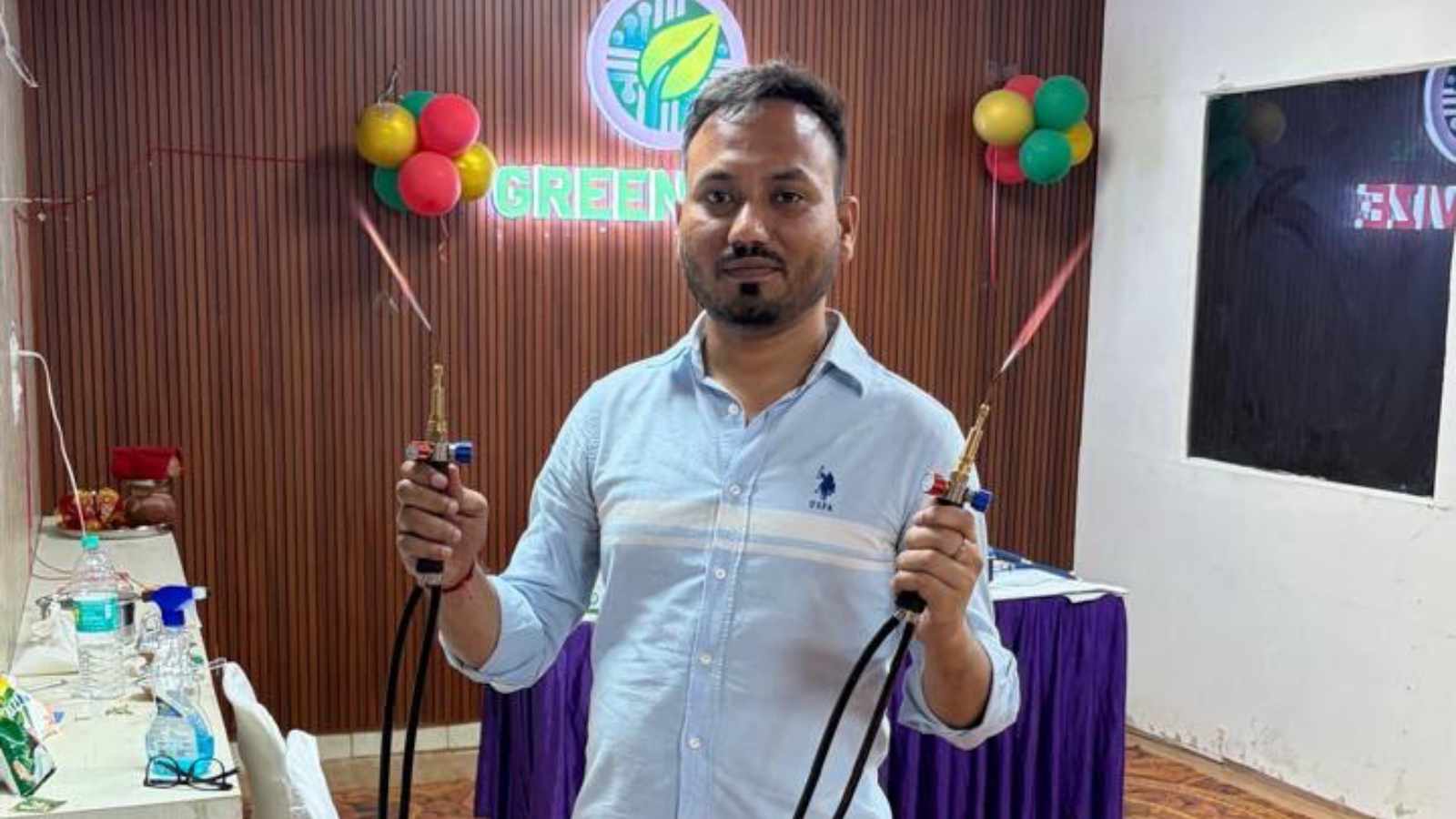
Vikash Kumar grew up in a house where cooking was always cumbersome – it meant either getting bundles of firewood or cow dung arranged, or running around for LPG cylinders. For the 33-year-old’s household in Bihar’s Vaishali district, the LPG crisis in the aftermath of the West Asia conflict magnified the problem severalfold: the family had to shell out Rs 8,000 per cylinder.
“We had to stand in a queue for hours,” he says. “So, I thought of a solution — let me make a one-time investment so that we don’t have to stand in line for gas again and again every month.”
That’s when he came across hydrogen stovetops on Instagram and YouTube from a Faridabad-based, research-driven company that aims to revolutionise carbon neutrality with cutting-edge green technologies. The stovetop uses water and separates H2O into hydrogen fuel, which can then be used for cooking roti sabzi every day.
The stovetop is one of several experimental products that strive to optimise hydrogen – the most abundant element in the universe. Companies hope to push hydrogen as a clean-energy replacement for fossil fuels – not only because of the ongoing climate crisis and the decarbonisation problem that electricity and batteries can’t easily solve, but also, more recently, the West Asia conflict, which has caused cooking gas prices to spiral.
For millions of Indians like Vikash, the technology could be significant — the country imports almost 60% of its LPG, with over 90% coming via the Strait of Hormuz. The West Asia conflict significantly impacted LPG supply — India’s monthly imports dropped from two million tonnes to less than a million, a decline of over 50%.
Globally, approximately 2.1 billion people still cook using biomass, coal, or kerosene, with severe health consequences, particularly for women and children. LPG, while cleaner than solid fuels, remains dependent on fossil supply chains with volatile pricing. Hydrogen cooking — where the only combustion product is water vapour — eliminates indoor air pollution and carbon emissions, provided the hydrogen source is renewable.
For companies exploring this avenue, the possibilities are immense – but so are the challenges. At the World Hydrogen Summit in Rotterdam in May 2026, Indian deep-tech company Vision Mechatronics and Netherlands-based HyCooker BV signed a strategic cooperation agreement for international commercial sales of hydrogen-burning cooking stoves. The agreement positions India as the manufacturing base for hydrogen cookstoves under the Aatmanirbhar Bharat programme, with the partnership targeting industrial-scale production to bring costs down.
Story continues below this ad
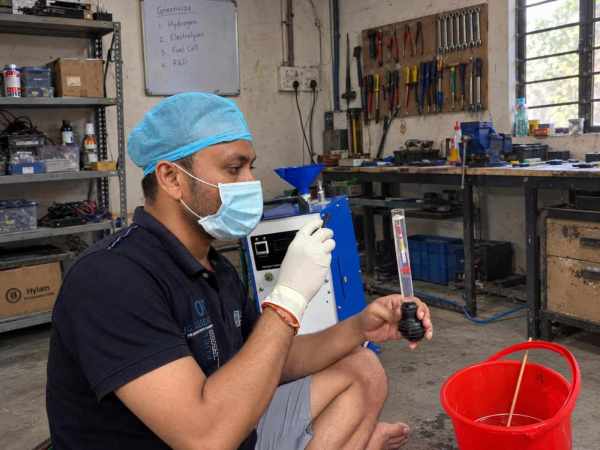 Sanjeev in his lab, testing the water conductivity for the hydrogen cooking stove
Among those exploring the field is Prakash Chandra Ghosh, a professor in IIT Bombay’s Department of Energy Science and Engineering, who is collaborating with Powai-based Zest Clean Power Pvt. Ltd to take hydrogen cooking stoves to villages using indigenously developed and internationally patented technologies.
Ghosh, who has a PhD in hydrogen technology from Germany and over two decades of experience, is developing hydrogen cooking systems using alkaline electrolysis, with a focus on community-scale solutions.
“A 25 kW solar-powered green hydrogen production unit was demonstrated at IIT Bombay during the recent West Asia crisis. We showed that it was capable of producing 2.5–3 kg of green hydrogen a day to prepare 200–250 meals. IIT Bombay’s canteen relied on the system for daily meal preparation,” Ghosh says. “Strategically, this technology reduces dependency on imported fossil fuels and strengthens national energy security. Our research highlights that this technology eliminates indoor air pollution, reduces heat stress by lowering cooking temperatures, and advances gender equality.”
Users believe that while these products are somewhat pricey at the moment, the investment could be worth it. Vikash bought the domestic double-burner model from GreenVize a few months ago – and believes the investment was worth it. “Its design and operation are very simple. It’s not bulky and doesn’t take up space. I don’t have to worry about gas running out or becoming expensive,” he says.
Story continues below this ad
How it works
Hydrogen is the most abundant element in the universe, but on Earth, it exists almost entirely bound to other atoms — most commonly in water. It is an energy carrier, not an energy source, meaning it must be produced. When produced using renewable electricity, it is called “green hydrogen,” and when burned, its only by-product is water vapour.
It’s this that GreenVize hopes to leverage through its hydrogen cooking stove, which uses an integrated on-site generation process. Co-founder Sanjeev Kumar, a mechanical engineer by qualification with an M.Tech in design engineering, says he began looking for a sustainable alternative to standard cooking gases, and that search led him to hydrogen energy-based products.
“As you see nowadays, there is a huge dependency on LPG, fossil fuels, and Gulf countries, so we were looking for an alternative for a long time. Two years ago, we started with the thought that nothing needs to be imported and we shouldn’t be dependent on foreign countries,” Sanjeev says over a call on a sunny Monday afternoon. “We wanted to build a practical hydrogen-based system so that we could easily adopt things and wouldn’t need to source things from anywhere else.”
The mechanics are fairly straightforward. You add water to the stove’s internal tank, which a built-in Proton Exchange Membrane (PEM) electrolyser splits into hydrogen and oxygen using electricity. Hydrogen then passes through safety and conditioning stages, including a bubbler, a buffer tank and a multi-stage flame back arrestor, before reaching the catalytic burner, where it combusts to produce a clean, smokeless flame.
Story continues below this ad
Electrolysis, the process at the heart of the stove, typically operates at 62–86% efficiency depending on the technology used. PEM electrolysers use a polymer membrane to split water and are known for their compact design and ability to operate at varying loads, though they require high-purity water.
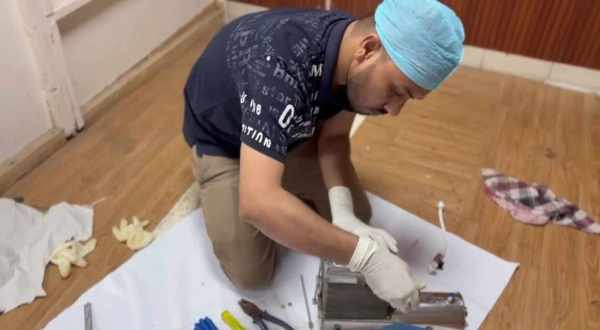 Sanjeev giving a demo of the hydrogen welding and cutting machine to customers at his office
Once the system is switched on and the required operating conditions are reached, hydrogen generation starts within 30 seconds.
The only by-product of this combustion is pure water vapour, says Sanjeev. “Oxygen is also released into the air, which is good for indoor air quality improvement,” Sanjeev says, adding that the company also has other variations, the Hydrooxy and Alkaline electrolysers, which serve the same purpose.
Sanjeev says he first conceived the idea of a company in 2024. But why hydrogen? He says it was because of its versatility.
Story continues below this ad
“We wanted to explore how hydrogen could be converted from an emerging clean-energy concept into a usable solution for everyday energy applications. Cooking and industrial heating are two areas where LPG, PNG and other conventional fuels are still used. If hydrogen can be used as a clean fuel (here too), why should it be limited to large industrial plants, laboratories or mobility applications?” he asks.
The device is expensive at the moment — a domestic model with a 3-litre tank costs Rs 1,05,000 for a single burner and Rs 1,50,000 for a double burner, while the commercial stove is priced at Rs 3,50,000. For an average user like Vikash, the 3-litre tank lasts about a month. GreenVize estimates this translates to approximately 3 tons of CO₂ savings per year and eliminates the need for external hydrogen storage or LPG cylinders.
The company was officially registered in January 2025. Two years and several safety trials later, GreenVize made its first sale of the stove in March 2026 — to the Indian Army. “The army’s stove is being used in the high altitudes of Jammu right now,” says Sanjeev. They also sell hydrogen dispensers, hydrogen fuel-cell systems, biomass power plants, and pressure swing absorption (PSA) oxygen and nitrogen generators.
Future of hydrogen cooktops
Under its National Green Hydrogen Mission, India aims to produce 5 million tonnes of green hydrogen by 2030, install 10–100 GW of electrolyser capacity, and create 5 lakh new green jobs. The Centre has allocated Rs. 17,490 crore until 2030 to incentivise electrolyser and green hydrogen production.
Story continues below this ad
GreenVize has also applied for the Biotechnology Ignition Grant Scheme (BIG), which supports young start-ups in biotechnology innovation and research. Sanjeev believes the grant will help the company scale up as well as improve quality.
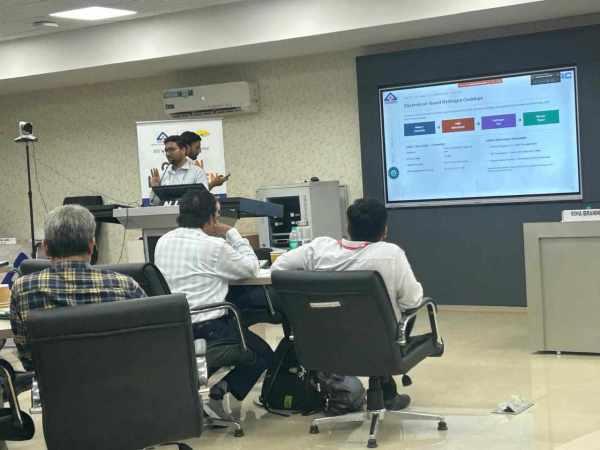 At a workshop organised by the Bureau of Indian Standards (BIS) in collaboration with Standards Australia (SA) under the Australia-India Standards Trade Enabling Project (AI-STEP) in August, GreenVize’s hydrogen cooktops were presented as a case study.
“We aim to integrate smart tech and AI to make a smart stove. That would mean your stove could be connected to your Wi-Fi network, controlled by your phone via an app, and even have voice integration,” he says.
At a workshop organised by the Bureau of Indian Standards (BIS) in collaboration with Standards Australia (SA) under the Australia-India Standards Trade Enabling Project (AI-STEP) in August, GreenVize’s hydrogen cooktops were presented as a case study. The company is also planning to distribute the hydrogen stovetop across other countries, starting with the Maldives.
For now, however, there are limitations, chief among them the high cost. Sanjeev knows that this could be a challenge but believes there’s some way to go. “If anything is exclusive, it tends to be expensive. To make it affordable, we need to make it non-exclusive. Once it goes into mass production, we will bring the cost down,” he says.
Story continues below this ad
Then there are the repair and replacement costs. While the company says that it depends on individual products, there’s no data on long-term use yet.
Sanjeev understands he has a long way to go, especially if he wants to scale up production. “The company has still not broken even yet,” he says. “The priority right now is to establish it as a commercially viable product first, and then scale up manufacturing.”
His clients agree. At their restaurant in Khliehtyrshi, a small town in Meghalaya’s West Jaintia Hills, Alpana Bareh and her husband, Marphalangki Chyrmang, have been using GreenVize’s commercial hydrogen stove for the last few months and now swear by it. “This stove is quicker than the LPG one we had before, and the safety of the valves is built into the system itself, which is a plus. We bought two commercial single-burner cooktops after the LPG crisis hit, and found it to be very cost-effective,” Alpana says.
KioskNews shows a cleaned-up reading view extracted from the publisher’s page — the original always lives on their site, not ours.