Hall and Woodford win Nobel prize in economics
US-born economists Robert E. Hall and Michael Woodford yesterday won the Nobel memorial prize in economics for their work on models that have helped governments and central banks manage economic shocks.
The Royal Swedish Academy of Sciences announced the winners in Stockholm, saying the winners were being honored “for microeconomic foundations of macroeconomic stabilization.”
“The laureates have helped us smooth out the economy’s peaks and troughs,” the academy said in a statement.
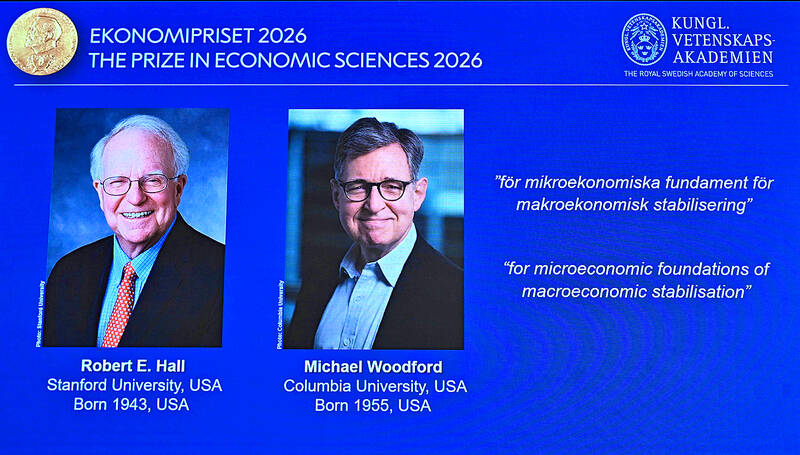
The winners of this year’s Nobel memorial prize in economics Robert E. Hall, left, and Michael Woodford are displayed on a screen at the Royal Swedish Academy of Sciences in Stockholm yesterday.
Photo: AFP
Hall is affiliated with Stanford University in California, and Woodford with Columbia University in New York.
Woodford yesterday spoke to the committee by phone from New York, saying: “It’s a tremendous honor, it’s a surprise.”
“The laureates’ work has provided us with a stable theoretical foundation for the models that are now used by central banks and governments around the world,” Committee for the Prize in Economic Sciences chairman John Hassler said in a news release. “With them, we are better equipped to deal with shocks in the economy, such as energy crises or sudden changes in how much households consume.”
The economics prize is formally known as the Bank of Sweden Prize in Economic Sciences in Memory of Alfred Nobel. The central bank established it in 1968 as a memorial to Nobel, the 19th-century Swedish arms manufacturer and chemist.
Nobel purists say that the economics prize is technically not a Nobel Prize, but it is always presented together with the others on Dec. 10, the anniversary of Nobel’s death in 1896.
KioskNews shows a cleaned-up reading view extracted from the publisher’s page — the original always lives on their site, not ours.