[Puso at Diwa] When AMLC’s financial intelligence speaks
- The AMLC's testimony before the Senate impeachment court is crucial as it presents financial intelligence that is legally mandated to be analyzed and disclosed, countering claims that it is politically motivated.
- The AMLC's findings reveal ₱4.4 billion in covered and suspicious transactions involving Vice President Sara Duterte and her husband, raising questions about the legitimacy of these financial activities and their reconciliation with declared income.
- The impeachment court must focus on the evidence provided by the AMLC, examining the financial trail and ensuring accountability, rather than dismissing the findings due to political implications.
This is AI-generated. Read the article for full context. Report any errors.
There is a temptation in politically charged cases to attack the messenger when the message becomes uncomfortable. That temptation was evident in the reaction to the testimony of the Anti-Money Laundering Council (AMLC) before the Senate sitting as an impeachment court, with some attempting to portray the AMLC as politically motivated, as though the financial intelligence it presented were merely another partisan accusation against Vice President Sara Duterte.
That misses the institutional character of the AMLC.
![[Puso at Diwa] When AMLC’s financial intelligence speaks](https://img.youtube.com/vi/Y3mmFNPvdAk/sddefault.jpg)
The AMLC is not a political creation of the impeachment prosecution. It is a creature of law. Created under Republic Act No. 9160, the Anti-Money Laundering Act of 2001, it is the Philippines’ financial intelligence unit, mandated to receive and analyze covered and suspicious transaction reports and to help protect the integrity of the country’s financial system. It is therefore not an optional commentator in this process but part of the country’s financial accountability architecture.
This is why Monday’s testimony is so important, and why the attempt to prevent it from being heard deserves attention.
Before examining what the AMLC found, it is worth considering what almost prevented the country from hearing it. The defense sought to exclude AMLC Secretariat Executive Director Ronel Buenaventura from testifying, invoking the confidentiality provisions of the Anti-Money Laundering Act and questioning the disclosure of financial information in the agency’s possession.
![[Puso at Diwa] When AMLC’s financial intelligence speaks](https://img.youtube.com/vi/bCbMQGwMbvo/sddefault.jpg)
The objection was significant. If accepted broadly, it could have prevented the country’s financial-intelligence agency from explaining to the constitutional court the very information it is legally mandated to collect and analyze.
The presiding officer, Senator Francis Escudero, rejected the defense position.
His ruling recognized a distinction that should be obvious but is sometimes deliberately blurred: confidentiality is not the same as immunity from lawful inquiry. Section 8-A of the AMLA protects information against unauthorized disclosure, but it cannot reasonably be interpreted to disable the AMLC from performing the investigative and litigation functions that the law itself gives it, or from complying with a lawful and particularized subpoena from the impeachment court. The Senate also recognized that the Bank Secrecy Law itself provides an exception to confidentiality for impeachment proceedings.
This is remarkably consistent with the position earlier advanced by former AMLC executive director Vicente Aquino years ago.
![[Puso at Diwa] When AMLC’s financial intelligence speaks](https://img.youtube.com/vi/3rwXnyvNVXs/sddefault.jpg)
Aquino argued that Section 8-A’s confidentiality rule is not absolute. The law itself contemplates information exchange, dissemination and access under appropriate circumstances. He specifically maintained that the prohibition does not prevent lawful disclosure to courts and authorized government agencies.
More fundamentally, Aquino reminded us why the AMLC exists in the first place. It was created to gather financial information, analyze suspicious and covered transactions, investigate money laundering and assist courts and partner agencies in proceedings involving the preservation, recovery and forfeiture of assets. Information gathered by the AMLC becomes valuable when it can be properly used by competent authorities.
The convergence between Aquino’s institutional argument and the impeachment court’s ruling is therefore significant. Confidentiality protects financial information from unauthorized disclosure; it cannot become a legal shield that prevents a competent constitutional tribunal from examining financial intelligence through a lawful process.
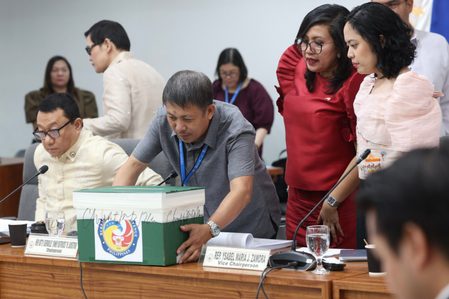
The AMLC is not an impeachment prosecutor, a political party or the court itself. It is the institution that possesses financial intelligence relevant to an allegation the impeachment court is constitutionally required to examine. Having been allowed to testify, the more important question now is what that financial intelligence means.
And what it has placed before the court is substantial.
AMLC records presented by Buenaventura showed ₱4.4 billion in covered and suspicious transactions involving Vice President Duterte and her husband, Manases Carpio, from 2007 to 2025. The records consisted of 666 covered transaction reports and 55 suspicious transaction reports.

The number is staggering, but precision matters. The ₱4.4 billion should not be described as ₱4.4 billion of personal wealth. It is the aggregate value of reported financial transactions. Money can enter and leave an account without becoming accumulated wealth. Indeed, the AMLC presentation reportedly identified approximately ₱1.63 billion in inflows, ₱1.31 billion in outflows, and about ₱1.46 billion whose direction could not be determined from the summary presented.
That qualification does not diminish the significance of the evidence.
It sharpens the question that the impeachment court now has to answer: What do these transactions represent? Where did the money come from, where did it go, who were the counterparties, what legitimate economic activities explain the movements, and can the financial flows be reconciled with the lawful income, declared assets and known sources of wealth of the persons involved?
That is what financial intelligence is supposed to help establish.
It is also why the characterization of the AMLC as merely a “political” instrument is so misplaced. The transactions did not originate from the AMLC. They originated in the financial system and were reported by covered institutions pursuant to law. The AMLC received, analyzed and organized those reports in accordance with its statutory mandate.
If a bank reports a transaction because the law requires it to do so, the bank does not thereby become political. If several financial institutions submit reports to the country’s legally designated financial-intelligence unit, those institutions do not thereby become political. And when the AMLC analyzes those reports and presents the resulting information pursuant to a lawful subpoena from a constitutional court, that does not make the agency political either.
The appropriate response to the AMLC testimony, therefore, is not to demonize the institution but to examine the numbers.
Aquino’s earlier argument is particularly relevant here. The State certainly has a duty to protect the integrity and confidentiality of bank accounts. But the same law declares that the Philippines must not be used as a site for laundering the proceeds of unlawful activities. The AMLC’s institutional purpose lies precisely at that intersection: protecting legitimate financial privacy while helping competent authorities identify transactions that require further scrutiny.
Its credibility should consequently be judged by its legal mandate, the quality of its financial intelligence and the evidence it presents, not by whether its findings are politically convenient.
Opposite errors
The impeachment court should also resist two opposite errors.
One would be to conclude that ₱4.4 billion in reported transactions automatically means ₱4.4 billion in unexplained wealth. It does not. The other, equally serious, would be to dismiss the ₱4.4 billion simply because the AMLC has been accused of being political. That would be equally unwarranted.
The proper approach is to follow the financial trail and establish what entered the accounts, what left them, who provided the funds, who received them, what legitimate transactions explain them, and whether the activity is adequately reflected in declared income and assets. The issue is ultimately one of reconciliation: whether the financial picture that emerges can be reconciled with the legitimate sources of income and wealth disclosed by the couple.
The 18-year period is particularly relevant. The court is not looking only at what happened after Duterte became Vice President. Earlier records can establish a financial baseline against which later changes in income, assets and financial activity can be measured. The question is therefore not simply how much wealth the Vice President and her husband accumulated, but how their financial position evolved over time and whether that evolution can be satisfactorily explained. (READ: IN NUMBERS: What impeachment hearings unveiled about Sara Duterte’s wealth)
Ultimately, however, the issue is larger than accounting.
Impeachment is a constitutional mechanism for determining whether a high public official remains worthy of the extraordinary trust vested in public office. The Constitution declares that public office is a public trust and requires public officers to remain accountable to the people and to serve them with responsibility, integrity, loyalty and efficiency.
The AMLC evidence therefore matters beyond banking. If the financial records ultimately demonstrate that the transactions are legitimate and adequately explainable, that should be established clearly. But if substantial portions remain unexplained, inconsistent with declared income, or otherwise raise credible questions about the accumulation of wealth, those questions cannot simply be dismissed by attacking the institution that uncovered the financial trail.
The cumulative picture is what matters: hundreds of covered transaction reports, dozens of suspicious transaction reports, billions of pesos in aggregate financial activity and 18 years of financial history. None of these facts, standing alone, establishes guilt. But taken together, they establish that there is enough financial information to require a serious explanation.
That is not persecution, and it is not automatically politics. It is the essence of accountability.
Perhaps this is the most important lesson from the AMLC testimony. The Philippines should not weaken or discredit its financial-intelligence institutions simply because, on one occasion, their findings become politically inconvenient. The AMLC was created by law to follow the money and help competent authorities understand what the financial system is telling them.
The impeachment court must now do its part: examine the evidence, test the explanations and determine what the financial trail ultimately reveals.
In the end, the issue is not whether the AMLC is political. It is whether the financial intelligence it has lawfully gathered can be explained, and what those explanations, or the absence of them, say about the integrity and fitness of a Vice President seeking to remain in public service. – Rappler.com
Diwa C. Guinigundo is the former deputy governor for monetary policy and other aspects of central banking. He was a former alternate executive director at the IMF in Washington, DC in 2001-2003. He is the author and editor of several books on political economy, regional crisis and cooperation, debt and economic growth and public policy agenda.
He serves as independent director of several corporate and financial institutions with focus on corporate governance, risk oversight and audit.
He also serves as principal advisor for New York-based GlobalSourcePartners. He remains in the advisory board of ASEAN Macroeconomic Research Office and Singapore Management University’s Sim Kee Boon Institute for Financial Economics.
He is the senior pastor of the Fullness of Christ International Ministries in Mandaluyong.
Below are related Puso at Diwa columns you may have missed:
ALSO ON RAPPLER
KioskNews shows a cleaned-up reading view extracted from the publisher’s page — the original always lives on their site, not ours.