New mRNA vaccines to be developed, produced in S’pore to develop expertise and prepare for Disease X
SINGAPORE - Singapore is looking at supporting the development and production of new mRNA influenza vaccines here.
This will greatly boost the nation’s pandemic preparedness and is key to helping it exit the next deadly contagion, said Health Minister Ong Ye Kung.
Messenger ribonucleic acid (mRNA) vaccines, which were first harnessed widely in the fight against Covid-19, played a critical role in curbing its spread.
Such vaccines probably offer the greatest flexibility in development and time to market, Ong said in an interview with The Straits Times and Lianhe Zaobao.
mRNA vaccine technology allows vaccines to be designed and produced more quickly than traditional ones, making them a good option to combat a fast-spreading outbreak.
“I think it’s useful to try out something that’s mRNA platform, and you need to produce it for peacetime and keep the facility warm, he explained.
“So let’s produce a vaccine that is commonly used, influenza is a possibility.”
On pandemic preparedness, he said Singapore is “50 per cent” prepared and that “a lot more important work needs to be done”.
Critically, this means building up vaccine manufacturing and development capability.
“I think it is the most important because when you have a Disease X kind of pathogen in the next pandemic, the only way for the world to exit it is to have an effective vaccine.”
Disease X is the name given to a future epidemic caused by an unknown pathogen.
“With an effective vaccine, we can expect a similar experience to how we dealt with the Covid-19 outbreak - vaccinate, open up, then exit.”
He pointed to Singapore-based vaccine research and development organisation Hilleman Laboratories’ efforts in developing and producing vaccines against the rare Bundibugyo ebolavirus strain spreading rapidly in the Democratic Republic of the Congo.
“I hope this effort with Hilleman brings us to 60 per cent. If we can produce an influenza mRNA vaccine, I think we move even closer,” Ong added.
He said that Hilleman’s Singapore facility will produce material for early clinical trials, and if those succeed, its annual domestic production capacity could reach 12 million doses of drug product. Depending on needs, it will make arrangements for technology transfer to a larger-scale manufacturer in the region.
“This is preparedness in action: existing science, an operating facility that is kept warm and trusted partners to scale up - all of which shorten the path from threat to a full response. It offers us a possible approach in response to Disease X in future,” Ong said.
But there is no such thing as being 100 per cent ready.
Singapore will never be fully prepared to deal with a next Disease X, he cautioned.
“There is always an unknown that you need to decide as and when things happen.”
Ong said Singapore is placing a bet based on science: to deal with the next totally new virus, the most probable vaccine platform against it will be mRNA.
“It offers the most flexible platform and fastest to market, fastest to develop, fastest to produce. And with AI technology, I think you can reiterate the solutions much faster,” he added.
Hilleman is a joint venture between MSD, the international trade name of American pharmaceutical giant Merck & Co, and British charitable foundation Wellcome Trust. In 2021, it moved its headquarters to Singapore, and its manufacturing facility was officially opened by Ong in November 2023.
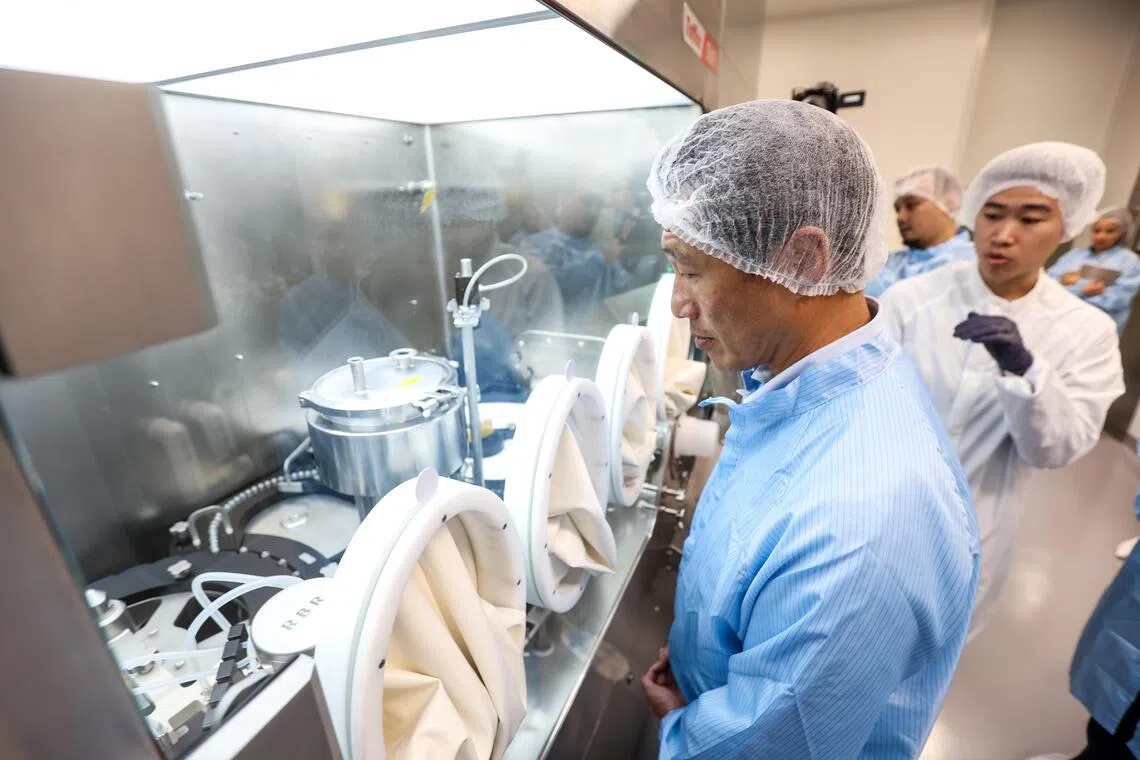
Health Minister Ong Ye Kung opened the Hilleman Laboratories’ current Good Manufacturing Practice facility in 2023.
PHOTO: ST FILE
On Sept 25, Ong, who is also Coordinating Minister for Social Policies, will attend the United Nations General Assembly High-Level Meeting in New York, the US.
He also spoke at a side event on Sept 23 organised by his ministry and Hilleman, where he similarly touched on how Singapore is preparing to support the pilot initiative to develop an mRNA influenza vaccine here.
“It serves a peacetime need, while building up our adaptable capability, and I hope Hilleman can support this,” he said in his speech.
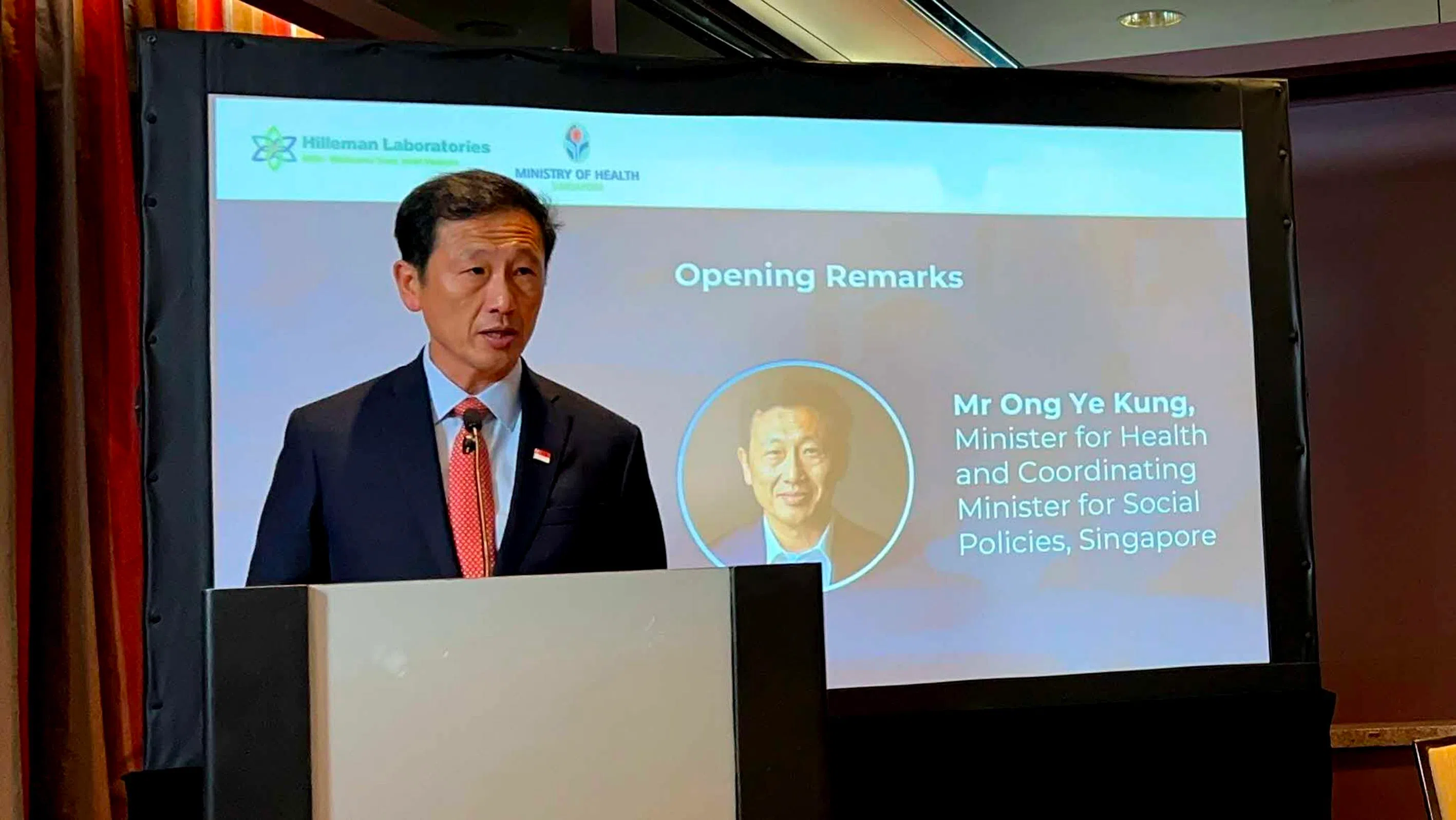
Health Minister Ong Ye Kung speaking at an event organised by his ministry and Hilleman on in New York Sept 23.
PHOTO: MINISTRY OF HEALTH
In addition, Singapore is working with companies with capabilities across vaccine platforms and manufacturing. These include Sanofi, GSK, Moderna and Thermo Fisher Scientific.
The Republic is also exploring working with Wellcome Leap – the non-profit entity founded by Wellcome Trust – and the Coalition for Epidemic Preparedness Innovations (CEPI) to establish an RNA Readiness and Response (or R3) global biofoundry here, one of the few centres around the world.
The biofoundry’s model separates product development from production – an approach common in the semiconductor industry – and explores continuous-flow RNA manufacturing to reduce bottlenecks.
Ong said in the interview that he believed that the way large pharmaceutical companies produce new vaccines would be different from the Covid-19 outbreak where Pfizer, Moderna, Johnson & Johnson and AstraZeneca all launched their own vaccines separately.
When the next pandemic hits, Ong predicts that there will be a vaccine solution put forth by CEPI and its network of laboratories.
CEPI, a global foundation based in Oslo, London and Washington that funds vaccine development, aims to develop safe and effective vaccines within 100 days of identifying a new pandemic threat.
Singapore supports CEPI’s efforts through technical exchanges and research collaborations, as well as continued contributions to the coalition.
With CEPI leading efforts in vaccine development, Ong said, “what happens is the industry becomes more like the semiconductor industry. You have companies that just design the chip, like Nvidia, and you have got companies like TSMC that just produce the chip whatever the design is, and they are called foundries”.
The biofoundry’s continuous-flow production model allows its production volume to be much larger, even though very little space is needed.
Ong said, “We are talking about hundreds of millions or billions of doses a year. It is still very preliminary, but this is a project that we are working on as a biofoundry, and it will have the ability to produce mRNA vaccines.”
Since Covid-19, Singapore has made several changes to prepare for the next outbreak.
These include converting its community care facilities that housed Covid-19 patients to transitional care facilities and bringing private general practitioners into the public healthcare network; amending the Infectious Diseases Act; and setting up the Communicable Diseases Agency.
Ong said these were the “three big pieces” of local response, but two other pieces of international work were necessary too, as a pandemic will be an international event and a global threat.
“One is global surveillance, so that when it pops up, we know in the first instance as early as possible. Second is to build up vaccine manufacturing and vaccine development capability”, he added.
As a small market, Singapore is able to host some of the world’s most advanced vaccine manufacturing capability. “The vaccine manufacturer is quite assured that putting something in Singapore means most of its vaccines can be exported to the world and the region to help the world, and we wouldn’t impose things like export control,” Ong said.
“I mean, one week of production or maybe a few days of production is enough for the whole Singapore. The rest is for the region and the world... Singapore is a good place to put your investments and your capability, and that put us in a much more secure position.”
Pointing to the next pandemic as an evolutionary certainty, he said at the MOH-Hilleman event: “We should remember that while a virus is biological, a pandemic is never only a medical event. It is also political, economic and social.
“To prepare for Disease X, we must resist denial, stigma, unfairness and the temptation to retreat behind national borders when global co-operation is most needed. Instead, we must harness the constructive power of our unity of purpose. We need to co-operate with each other, place our confidence in science and put in place overlapping and complementary plans ahead of time.”
KioskNews shows a cleaned-up reading view extracted from the publisher’s page — the original always lives on their site, not ours.