NSW artist becomes just fourth woman in 30 years to win major Sculpture by the Sea prize
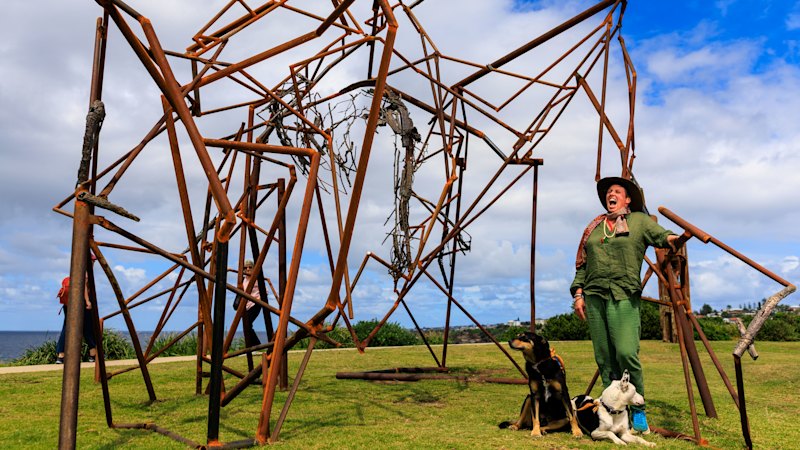
Female sculptors with powerful feminist messages have captured the zeitgeist – and the big prize – at Sculpture by the Sea in its 30th year.
NSW artist Harrie Fasher won the $70,000 acquisitive Aqualand Sculpture Award with an abstract six-metre by five-metre steel, bronze and timber artwork.
“This is for all the women, there’s a lot of us female sculptors that make work that’s really outside the square. It’s a battle. I’m the fourth (woman) to have won Sculpture by the Sea (Sydney) in its 30 years,” Fasher said.
She described her work, Unveiling the Edges of the Sky, installed adjacent to the cliffs at Marks Park, as being about female strength, the dissolution of the ego and following your intuition.
After a soggy installation week, Sculpture by the Sea is open, free to the public. There are 100 works on display along two kilometres of the Bondi to Tamarama Beach walk and Marks Park, until Monday November 2.
Reinforcing the female empowerment theme is an installation by Sydney public art collective Omi McCurdie, Matty McCarron and Philippa Lysaght.
The trio’s shockingly playful outsized Sweethearts candies are emblazoned with classic Aussie phrases like “He was drunk”, “She coulda left” and “Boys will be boys”.
Lysaght, a social justice advocate, said the trio, working together for the first time and making their Sculpture by the Sea debut, want to challenge the traditional notions of Australian masculinity that underpin the domestic violence epidemic.
“I was so appalled about the spate of domestic violence and wanted to do something that targets bystander inaction and calls out abuse,” she said.
“I want people to really experience it and there’s no better stage than Sculpture by the Sea.”
McCarron, a filmmaker, said collaborating on the project was confronting.
“I’ve said a lot of these phrases because it’s just so easy to minimise individual instances, but you have to call your mates out and say it’s not OK,” he said.
Over 450,000 people are expected to visit the exhibition, including thousands of schoolchildren, who McCurdie, a practising artist, said are an important part of the national discussion about violence against women.
Sculpture by the Sea was founded by David Handley in 1997, originally as a one-day only event because he did not have the funds at that time to pay for overnight security.
Handley was inspired by the sense of community he experienced in his 20s at the free summer concerts in the Domain, Opera in the Park and Symphony Under the Stars.
He then capitalised on the investment in the arts being made ahead of the Sydney Olympics, resulting in offshoot events staged around Australia.
Sculpture by the Sea eventually cemented itself in Sydney’s cultural calendar in October, when after the Sydney Olympics, it proved to be a masterstroke of counterprogramming that tapped into the city’s desire to keep partying after the games had packed up.
The not-for-profit stages annual an exhibition in Cottesloe, Perth and it has over the years left a legacy of sculpture trails and staged similar events around the world.
In Sydney, Sculpture by the Sea now includes an access and inclusion program; its popular school program is back; and a new Indigenous Artist Prize this year provides $20,000 for the creation and presentation of an ambitious new sculpture.
Inaugural recipient David Doyle is a Barkindji and Malyangapa artist based in Broken Hill whose cast iron and steel shields Kaaku-Kaakulinyа: Eternal Sentinels explores protection, resilience and continual presence.
Reflecting on the past 30 years, Handley said: “Sculptor Richard Goodwin was the first to say that Sculpture by the Sea (has) represented cultural change in Australia.”
“Just by the number of people turning up to an art exhibition year after year, people (through) repeat visitation are developing an eye for sculpture.”
Sydney’s long history of free public art shows dates to at least 1969, when Bulgaria and Morocco-born duo Christo and Jeanne-Claude created their Wrapped Coast environmental installation, where part of the Little Bay cliffs was swaddled in fabric.
Textile businessman and arts philanthropist John Kaldor produced that event in what became the first of his long-running series Kaldor Public Art Projects.
In 1973, Transfield founder Franco Belgiorno-Nettis launched Sydney Biennale at the Opera House, the third biennial art show in the world after Venice and Sao Paulo, and the first in our region.
Handley said Sculpture by the Sea is “created for Joe Public”, and as such, some of the artworks can be climbed on and touched; they are generously Instagramable; and they are for sale. The organisers, akin to a commercial gallery, take a cut of the sale price, now 40 per cent.
Handley’s quasi commercial model has resulted in what appears to be a permanent tussle for adequate funding to cover the enormous cost of staging the event and navigating public liability complexity.
It is supported by the NSW government, Waverley Council, philanthropy and sponsorship from backers such as the NRMA and property developer Aqualand.
NSW Arts Minister John Graham at the Sculpture by the Sea launch on Friday said: “If we’re honest about our city, we’ve made it too hard to do things outdoors.“
Last year, Handley made a last-minute public pitch for sponsorship, threatening the show might not go on. It did. “This is the year we’re not going to gripe,” Handley said.
Artists this year will receive modest exhibition fees of $3000 and installation support to the value of $1500.
Sculpture by the Sea has been life-changing for some artists, including Japan-born sculptor Koichi Ishino. The former art teacher exhibited at Sculpture by the Sea for the first time in 2001, returning each year until 2009 when he moved here permanently.
“My works nearly always sold, so I moved here and became a full-time artist,” he said.
KioskNews shows a cleaned-up reading view extracted from the publisher’s page — the original always lives on their site, not ours.