Calgary company steps up to help combat screwworm in U.S.
To fight the growing risk posed by screwworm, the U.S. Food and Drug Administration granted emergency approval to a liquid ivermectin for horses product made by Calgary-based company Solvet. The product can now be sold and used for the short-term prevention of screwworm in the United States.
Solvet receives emergency approval to sell equine ivermectin product


Listen to this article
Estimated 6 minutes
The audio version of this article is generated by AI-based technology. Mispronunciations can occur. We are working with our partners to continually review and improve the results.

Calgary-based company Solvet can now sell its equine ivermectin product in the United States to help combat screwworm.
In July, the U.S. Food and Drug Administration (FDA) granted Solvet emergency use authorization for its ivermectin liquid for horses.
“It's an aqueous-based solution, not a paste, so it's a bit unique; it's a bit more concentrated and it's a lot easier to administer, ” said Lionel Gibbs, CEO of Solvet.
The business was founded in 2009 by two former University of Calgary professors, and has since grown into one of Canada's largest veterinary pharmaceutical companies.
Ivermectin, the now infamous anti-parasitic drug, is commonly used to combat a broad range of parasites, including screwworm, which is actually a species of fly native to parts of North America.
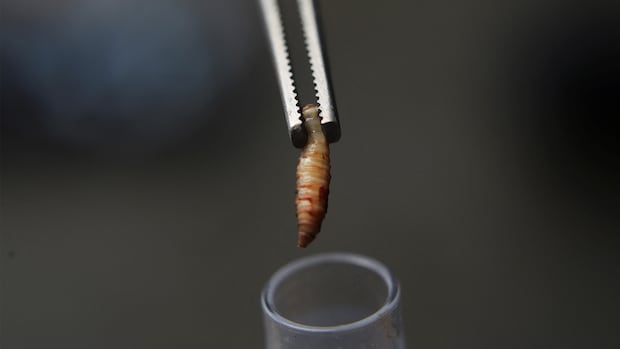
Female screwworm flies lay eggs on open wounds of mammals including horses, cattle and sometimes humans. The larvae hatch and bore into the host, feeding on tissue, giving the fly its name and also causing severe pain, secondary infections and possibly death.
Screwworm regularly cost ranchers in the United States and Mexico millions of dollars in annual losses until it was successfully eradicated from North America using what is called sterile insect technique.
The tactic takes advantage of the fact that screwworm females mate only once in their lifetime and store the sperm to fertilize their eggs. Beginning in the 1960s, fly factories were built to raise and sterilize male flies en masse.
Billions of these were released into the environment, and by mating with females eliminated subsequent generations of flies. By 2006 screwworms couldn’t be found north of the Panama Canal.
Screwworm returns
In 2024 the fly was reported in Central America, then Mexico, and has moved north, triggering alarms across the southern United States.
In June 2026 the discovery of screwworm larvae on a calf in Texas prompted the Canadian Food Inspection Agency (CFIA) to halt imports of animals from the state. In an email to CBC News, the agency said, “Animals that originate from, or were present in, the State of Texas within 21 days prior to entering Canada are not permitted entry.”
Production of sterile males has restarted in the U.S., but it will take time to produce numbers capable of eradicating the fly again.
In the meantime, authorities like the FDA put out a call for help.
“The FDA recognized that screwworm was a real risk, and they wanted to protect their food supply, their producers and everything. So they put out a call to pharmaceutical companies,” said Gibbs.
After a rigorous process assessing Solvet’s facilities, manufacturing procedures and data on their ivermectin liquid, an emergency authorization was granted.
“It's not our current label in Canada; it's one that says specifically for screwworm,” said Gibbs, meaning that while the product is labelled for broader uses against multiple parasites in Canada, in the United States it can only be sold and used for this specific labelled purpose.
Emergency use authorizations are employed as a way to quickly approve treatments by lowering the bar on the safety and efficacy data required while also limiting the scope of use to specific situations.
WATCH | Screwworm parasite returns to North America:
Human case of screwworm raises fear of parasite’s wider return
August 26, 2025|
Duration 1:59
Health officials in the U.S. are worried that New World screwworm — a flesh-eating parasite that typically feeds off livestock — could be making a comeback in North America after a rare human case was identified in Maryland.According to an FDA bulletin, the liquid ivermectin is allowed for the short-term prevention of screwworm in horses only.
“The product is authorized for use when administered within 24 hours of birth or at the time of initial wound care.”
Will it work?
John Gilleard, a veterinarian and parasitologist at the University of Calgary studying drug resistance in parasites, says the authorization makes sense given the potential risk to animals in states like Texas where screwworm is present.
“They really do cause severe tissue damage, which, if it's not caught early or noticed, can be a very significant welfare issue,” said Gilleard.
The idea is that giving horses with open wounds a dose of ivermectin could kill any larvae before they grow and harm the animal, Gilleard says.
But, he added, “this isn't so much about preventing transmission of and dealing with controlling the outbreak. It's more about protecting animals, which are at risk during an outbreak in terms of welfare and health."
The challenge, he says, will be for individual veterinarians to assess that risk and not overuse it.
“That's not good, obviously, for selection of resistance in other parasites or in terms of the environmental impacts of using these products intensively,” said Gilleard.
There are no current cases of screwworm in Canada and the risk is low.
“Canada’s climate is generally not suitable for the long-term establishment of these flies, particularly during the winter months," the CFIA said in an email to CBC News.
“The CFIA continues to monitor the situation closely and work with U.S. animal health authorities to assess developments and adjust measures as needed.”
An opportunity for Alberta
Gibbs says the company's primary focus is on animal well-being and welfare, but this situation also represents a great opportunity for Solvet and also the province as it moves to expand internationally, specifically in the United States.
“When they're scrambling and they need something and here’s this Alberta company that steps in, it just opens the door for a lot of other things,” said Gibbs, such as their pending application for a broader label use of liquid ivermectin for horses.
“It could bring a lot of dollars into Alberta, into the economy and also fund additional Alberta research,” said Gibbs.
ABOUT THE AUTHOR
Bradley van Paridon is a Calgary based journalist covering science and local news. He can be reached at bradley.van.paridon@cbc.ca
KioskNews shows a cleaned-up reading view extracted from the publisher’s page — the original always lives on their site, not ours.