Taiwan’s Wang Yan-cheng finds his footing in South Korean baseball
With 11 wins in his first South Korean season, the 25-year-old Taiwanese pitcher talks about confidence, adapting to the KBO, support from home and his next challenge with Taiwan national team
By Don Huh / Contributing reporter in South Korea


Wang Yan-cheng (王彥程) is enjoying a strong first season in the Korea Baseball Organization (KBO) League, where he has posted an 11-6 record with a 3.97 ERA, 100 strikeouts and a 1.52 WHIP. His 11 wins rank among the most by foreign starting pitchers in the KBO, while he has emerged as one of the top performers under the league’s newly introduced “Asian player quota.”
Quiet in conversation, but candid about his experiences in South Korea, Wang appeared firmly focused on his physical preparation for the Asian Games when he spoke with the Taipei Times in Daejeon earlier this month.
Wang is the second Taiwanese pitcher to play in the KBO, after Wang Wei-chung (王維中), 34, now with Taiwan’s TSG Hawks (台鋼雄鷹). Wang Yan-cheng signed on with Japan’s Rakuten Golden Eagles in 2019 and played there through last year. In Japan’s farm league, he compiled a 20-21 record with a 3.62 ERA and 248 strikeouts. Wang is currently with Taiwan’s national team at the 20th Asian Games in Japan’s Aichi-Nagoya.
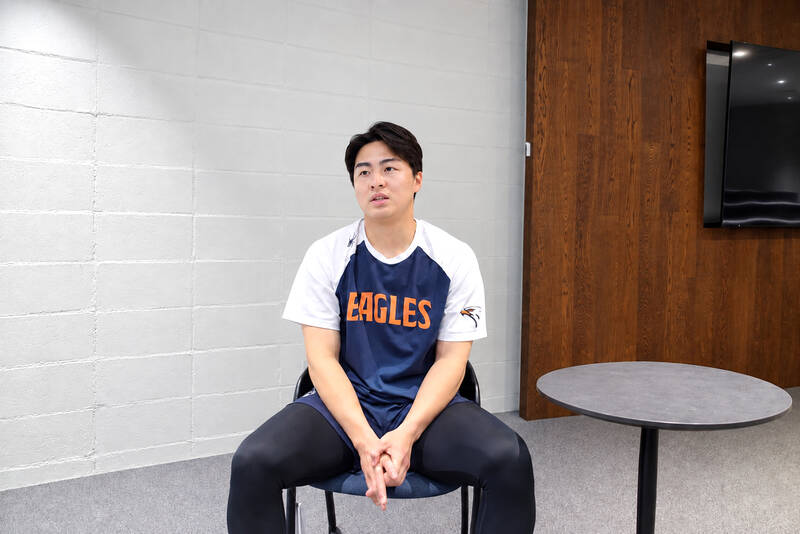
Wang Yan-cheng on Sept. 11 speaks during an interview at Daejeon Hanhwa Life Ballpark, Daejeon, South Korea.
Photo: Don Huh
Taiwan has advanced to the super round, where it is to face China today and Japan tomorrow. Wang has yet to play in the tournament; according to the Liberty Times (Taipei Times’ sister newspaper), he could start one of the two games. The medal games are scheduled for Sunday. The following interview has been condensed and edited.
Taipei Times: What is your motivation to come to South Korea to play baseball? What were you hoping to gain from the experience?
Wang Yan-cheng: During the 2023 Asian Games, we played against South Korea. I saw that their pitchers and batters were very good, so I wanted to come to this league and see how they play baseball here.
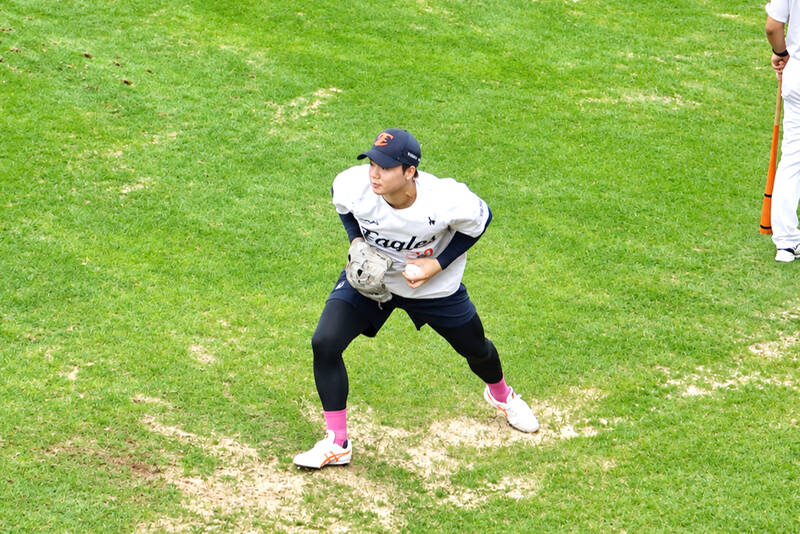
Wang Yan-cheng on Sept. 11 practices at Daejeon Hanhwa Life Ballpark in Daejeon, South Korea.
Photo: Don Huh
TT: When you first arrived in South Korea, what was the most difficult part of adapting?
WYC: I think the most difficult part was everyday life outside baseball. There were no Chinese characters around me, and everything was written in Korean. At some restaurants, even the menus did not have pictures, so it was quite difficult to get used to at first.
The cheering culture was also very different. The cheering is very loud, so that took some time to adjust to.
TT: You have played in Taiwan, Japan and South Korea. What are the biggest differences among the three in terms of baseball culture, training methods and style of play? Has your impression of South Korean baseball changed since you previously faced South Korea in international competition?
WYC: I am still observing and learning. I think I need to complete a full season before I can properly analyze the differences.
For now, the biggest difference I have noticed is the cheering culture. The batting styles are also different. However, because I have not yet completed a full season, I do not think I can make any definite comparisons.
My impression is certainly different now because my mentality is different, and the way I work with my catcher this year is also different from before.
TT: You currently have a 11 wins. How much confidence has this season given you? Was there a particular game or moment when you began to feel you could succeed in South Korean baseball?
WYC: I think confidence is something you have to build through your everyday practice.
TT: As a Taiwanese player competing in South Korea, have you had any particularly memorable experiences? How have your teammates, coaches and fans treated you?
WYC: Everyone has been very kind to me, and I get along well with everyone.
There have also been Taiwanese fans who came to South Korea to watch me play this year. I am grateful that they took the time to come and see my games.
TT: Now that you have been playing in South Korea, is there any particular experience you would like to mention about South Korean baseball or its players?
WYC: There have been Taiwanese fans who have come to South Korea to watch me play this year. I really appreciate them taking the time to come and watch my games.
TT: Is there a KBO League player who has particularly impressed you?
WYC: Doosan Bears pitcher Gwak Been has impressed me. His ability is among the best in the league. I like his pitching style, and I think he is a very talented pitcher.
(Note: Gwak leads the KBO-best a 2.26 ERA this season, with an 11-7 record and 186 strikeouts.)
TT: You are expected to compete in the Asian Games. How are you preparing for the tournament?
WYC: I am still playing here at the moment, so I am focused on how I am going to pitch in my next game and what adjustments I need to make.
TT: Apart from baseball, how have you adapted to life in South Korea? Were there any aspects of South Korean culture that took time to get used to?
WYC: My interpreter has helped me a lot with everyday life.
As for dining, drinking and other aspects of South Korean culture, I have not had any major problems.
Language can be more difficult when I am alone, but that is part of the job.
TT: Have language or communication differences made living in South Korea difficult? When you were playing for Japan’s Rakuten Eagles last year, you had several Taiwanese teammates, but here you are the only Taiwanese player; do you feel any difference? How have your South Korean teammates treated you?
WYC: I think it has been OK. When there are Taiwanese people around, I don’t feel there is much of a difference. Being on my own can be a little more difficult, but there is nothing I can do about that — it’s part of the job.
TT: Taiwan and South Korea are often regarded as sporting rivals. From your experience playing here, does that rivalry extend to players or fans? Have you ever felt uncomfortable as a Taiwanese player in South Korea?
WYC: I do not think so. Of course, we are competitors, and there will naturally be a certain degree of rivalry between competitors.
TT: What are your goals for the next stage of your professional career?
WYC: Right now, I am focused on each game. I think about what I need to do in the next game and what adjustments I need to make.
KioskNews shows a cleaned-up reading view extracted from the publisher’s page — the original always lives on their site, not ours.