10 spine-chilling places to visit in Britain for Halloween
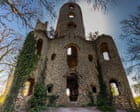
A derelict, 24-metre tall redbrick and flint folly outside Chichester, Racton Monument (known locally as Racton Ruin) is said to be one of the most haunted places in Sussex and has been the site of many paranormal investigations. George Montagu Dunk, the second Earl of Halifax, commissioned the folly, but there is no conclusive account as to why he had it built. Some say it was as a summerhouse, others a viewing point to watch ships come in from the Solent. A ghostly woman walking in the grounds and eerie sounds such as sudden manic laughter are among reported spooky happenings. Now completely gutted and roofless, it’s on private land and unsafe to enter, but still easily seen from nearby footpaths.
‘The event horizon of a black hole’ in Bannau Brycheiniog
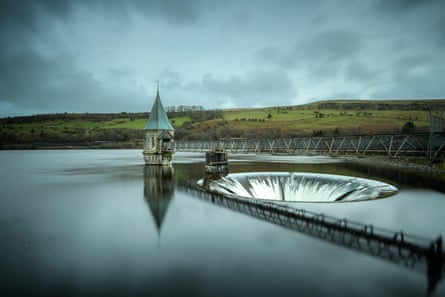
Completed in 1927, the Pontsticill reservoir in the Bannau Brycheiniog (Brecon Beacons) national park supplies water for much of south Wales, holding up to 15.5 billion litres (3,400 million gallons). Like other reservoirs of its time, such as Ladybower in Derbyshire, Pontsticill was built with a bell-mouth spillway, which looks like an eerie giant plughole – or the event horizon of a black hole. Created by flooding a valley, ghostly remains of the submerged village, including a 15th-century church, can resurface during droughts when water levels drop. Richard Ayoade used its terrifying presence with great effect in his 2010 film, Submarine.
Shipwrecks in the Kent marshes
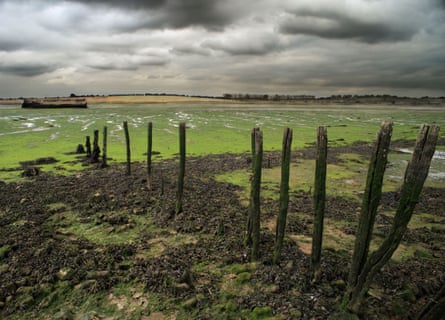
With place names such as Deadman’s Island, Slaughterhouse Point and Bedlam’s Bottom, Chetney Marshes needs no introduction. This forgotten, marshy outpost on the fringes of north Kent, with a limited palette of greens and greys, is home to a collection of slowly decaying, old barges and boats. Such is their level of deterioration, it can be hard to distinguish between the rotten hulks and the marsh itself. Information on the wrecked vessels is hard to come by and contradictory, with Historic England claiming they are former Thames barges. Yet on older maps, they are marked as the more tantalising Victorian prisoner transport ships. An atmospheric place for an otherworldly wander.
A nuclear bunker in Essex
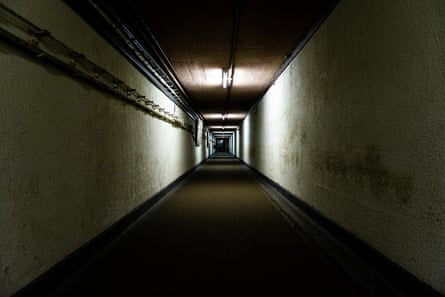
Growing up on terrifying visions of nuclear war, such as 1980s films Threads and Where the Wind Blows, bunkers have always held a certain macabre mystique. Kelvedon Hatch was one such bunker, built in the early 1950s to house up to 600 military personnel and civilians, as well as the prime minister. In this worst-case scenario, it would have become the seat of power in a post-apocalyptic Britain. Above the surface, it looks like an unremarkable bungalow, but, like a Bond villain’s lair, this leads to a three-storey underground shelter equivalent in size to 25 average British homes. Today, the bunker is home to one of the world’s largest cold war museums.
A wailing, windswept tree on the Lancashire moors
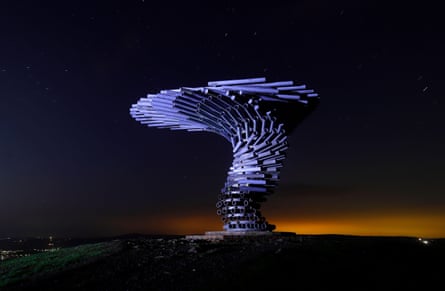
On a Pennine hill overlooking Burnley, the Singing Ringing Tree is an eerie sound sculpture created by architects Mike Tonkin and Anna Liu. It is three metres tall and designed to look like a brutalist windswept tree. The sculpture comprises a series of galvanised steel pipes tuned to various pitches over a range of different octaves. On a gusty day, as the wind blows through the pipes, it creates a weird, somewhat discordant harmonic. The artwork is one of four Panopticons, but rather than embodying the original concept – a circular prison with a single guard at its centre – they are far more benign, designed to be seen by many rather than as a symbol of oppressive surveillance.
The Lake District’s ‘skull cave’
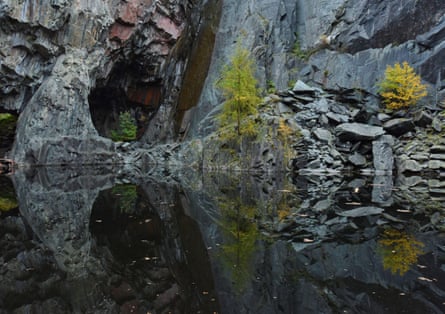
Tucked away in the Tilberthwaite valley, between Coniston and Langdale, Hodge Close is an abandoned slate quarry on National Trust land. In the right conditions, its cave tunnel openings and dark pool resemble a skull, which fans of the hit Netflix series The Witcher will recognise – though it’s much harder to see in real life than in the scenes starring Henry Cavill (Geralt of Rivia) and Kim Bodnia (Vesemir). Abandoned in the 1960s, industrial remains litter the site, giving it an edgy, post-civilisation feel.
after newsletter promotion
London’s paupers’ graveyard
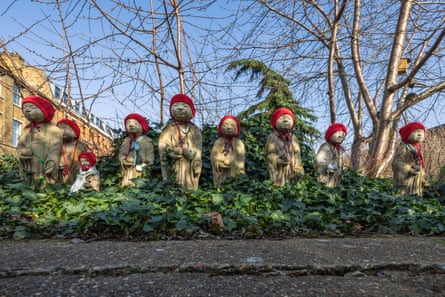
Crossbones graveyard, just south of the River Thames near Shakespeare’s Globe theatre and the Shard, was once outside the city’s boundaries (and laws) in an area known as “The Liberty of the Clink”. A pauper’s graveyard, it was the final resting place of medieval sex workers and souls not deemed suitable for Christian burial. More than 15,000 people are estimated to have been unceremoniously buried here. Today, it’s been reclaimed as a garden of remembrance, both mystical and macabre with its own special beauty, and is open to the public at certain times for guided walks and talks.
A smugglers’ cave in Northumberland
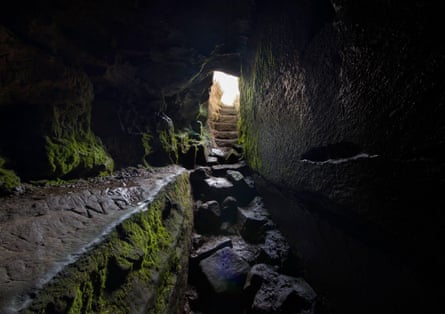
Hundreds of years ago, Cateran Hole was used by bandits to hide smuggled contraband. Found in the middle of Bewick Moor, about four miles north of Eglingham, it feels as far away from civilisation as you can get, and the steps leading down to its 35 metre-long, dark underground chamber are notoriously difficult to find – making it all the more thrilling when you finally do. You can walk into increasing darkness if you’re brave enough, before the tunnel tapers to a narrow point, but be cautious: there are no safety barriers, lighting or warning signs.
Stony stares from a drystone wall in Dumfries and Galloway
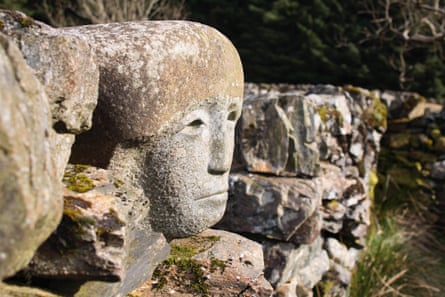
We all know that strange feeling of being watched – then turning round to find nobody there. If you wander just off the Old Edinburgh Road in a beautiful, isolated corner of the Galloway Hills, not far from Newton Stewart, you’ll find a whole bunch of faces staring out at you from the confines of a drystone wall. Artist Matt Baker carved Quorum – the Stone Faces in 1997 as part of a residency in the Galloway Forest. The heads have since become part of the landscape and have even formed new eyebrows out of lichen. The artwork is a stone’s throw away from another impressive piece called The Eye, a 10-metre tall cone sculpture on the banks of Black Loch.
The church ‘floating’ on Rutland Water
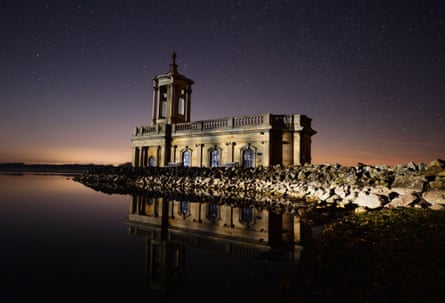
Arrive on a cold morning as the mist shrouds St Matthew’s church in Normanton, and it appears as if it is rising up from the depths of a lake. Normanton Church, as it is also known, stands on a small, boulder-strewn promontory on the vast expanse of Rutland Water. Built in the 1820s on the site of a medieval chapel, the church was scheduled for demolition when the man-made lake/reservoir was built in the 1970s. Thankfully, a last-minute public campaign saved it from this watery fate. Easy to view from the shoreline, it is open on scheduled days and for private events.
Dave Hamilton is the author of Weird Guide and Wild Ruins, published by Wild Things Publishing
KioskNews shows a cleaned-up reading view extracted from the publisher’s page — the original always lives on their site, not ours.