Mexico in Numbers: How does Mexico’s education system compare to other countries?
Last week, we published Part 2 of the MND Mexico Well-being Series, which focused on eight education indicators, including expenditure on education as a percentage of GDP, average class sizes in primary and secondary schools and Mexico’s scores in the 2025 PISA tests.
This “Mexico in Numbers” article is a condensed version of that report — a concise presentation of the key data, complemented by visual features.
As we have previously noted, the MND Mexico Well-being Series — a collection of articles on a range of topics related to well-being — draws on the most recent internationally comparable data, as well as data from the past decade, to assess the state of well-being in Mexico today, and to see what has changed in Mexico during the eight years that the ruling Morena party has been in office.
Without further ado, let’s take a look at the key data from Part 2 of the series.
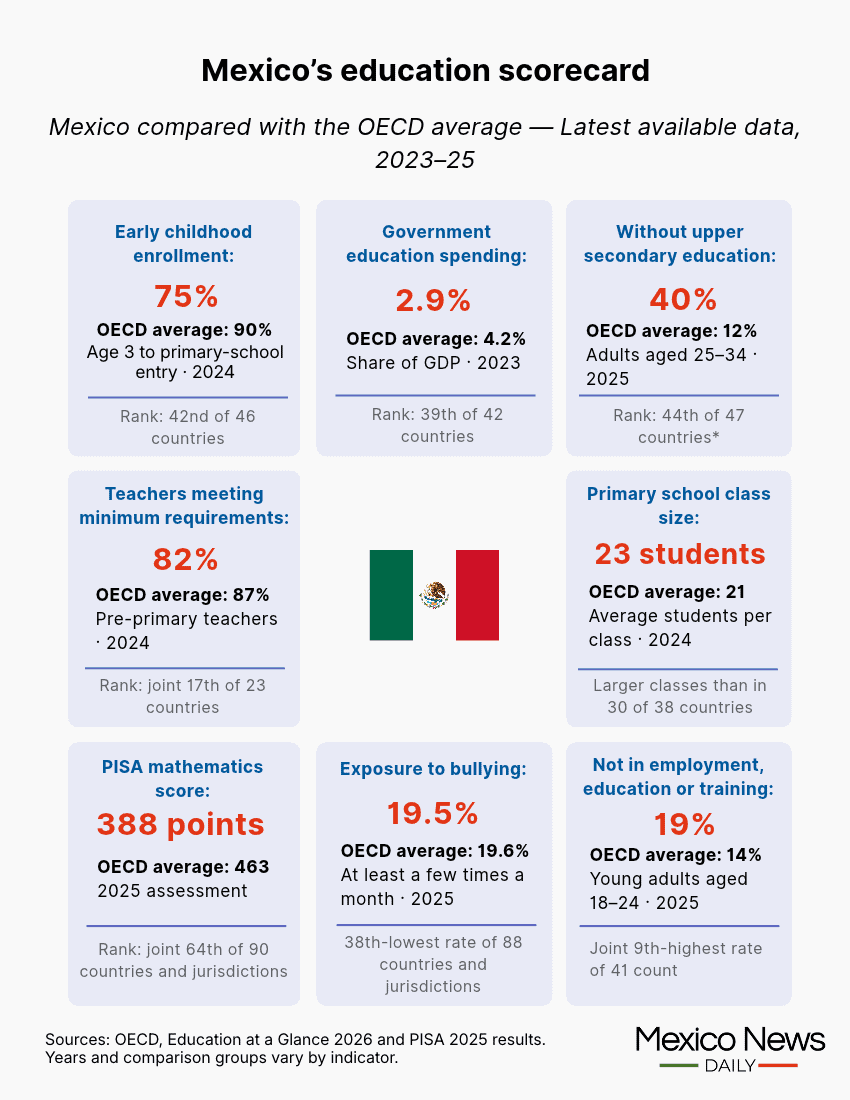
* The data in this article comes from the Organization for Economic Co-operation and Development’s Education at a Glance 2026 report and the OECD’s PISA 2025 Results report.
Early childhood education enrollment rates
Just 4% of two-year-olds in Mexico were enrolled in early childhood education programs meeting International Standard Classification of Education (ISCED) criteria in 2024, compared with an OECD average of 50%, placing Mexico last among 30 countries assessed.

Enrollment among children aged 3 to primary-school entry was 75%, versus an OECD average of 90%, ranking Mexico 42nd of 46 countries.
Both rates declined from 2015, when they stood at 5% and 79%, respectively, widening Mexico’s gaps with the OECD averages.
Expenditure on education as a percentage of GDP
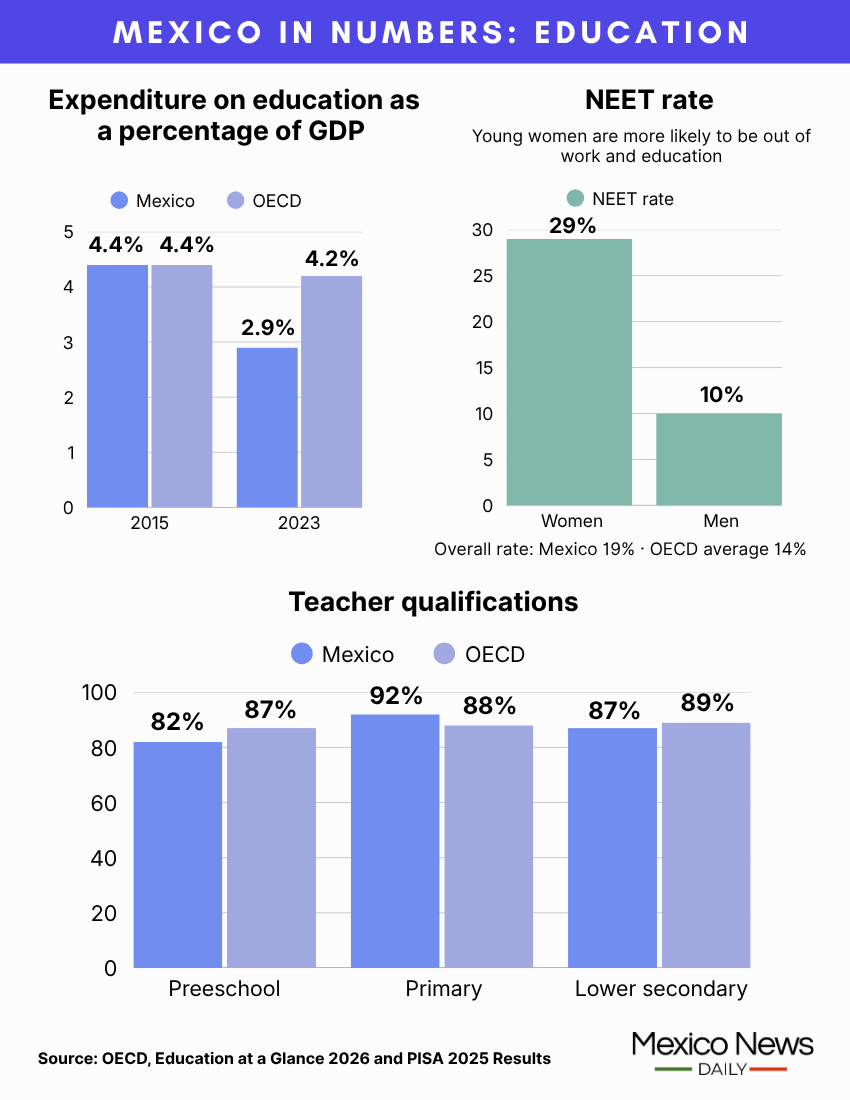
Mexico’s government spent the equivalent of 2.9% of GDP on education in 2023, below the OECD average of 4.2%, ranking it 39th of 42 countries, or fourth-lowest.
Mexico’s spending on education fell from 4.4% of GDP in 2015 — when it matched the OECD average — a decline of 1.5 percentage points.
Educational attainment rates
In 2025, 40% of Mexicans aged 25–34 lacked an upper secondary qualification, down from 55% in 2015 but still well above the OECD average of 12%, leaving Mexico fourth-worst among 47 countries.
Tertiary attainment among the same age group rose from around 21% to 29% over the decade.
In 2025, 28% of young men and 30% of young women held tertiary qualifications — 12 and 24 percentage points below the respective OECD averages — ranking Mexico 39th of 45 countries for both sexes.
Teacher qualifications
In 2024, 82% of preschool teachers, 92% of primary teachers and 87% of lower secondary teachers in Mexico met national minimum educational attainment requirements. Mexico exceeded the OECD average only at primary level, by four percentage points, while trailing it by five points at preschool level and two points at lower secondary level.
All three rates declined between 2017 and 2024, falling by five, five and six percentage points, respectively.
Average class sizes in primary and lower secondary education
Mexico’s primary school classes averaged 23 students in 2024, while lower secondary classes averaged 25 — both two students above the respective OECD averages. Mexico’s classes were larger than those in 30 of 38 countries assessed at primary level and 27 of 38 at lower secondary level.
Since 2015, average primary class sizes increased by one student, while lower secondary class sizes fell by three.
PISA scores
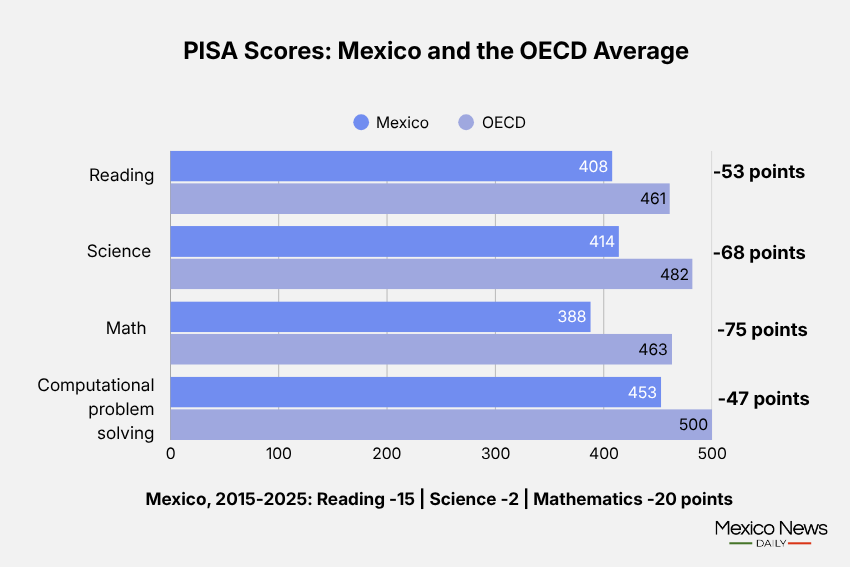
Mexican 15-year-olds scored below OECD averages in all four areas assessed in PISA 2025: reading (408 points), science (414), mathematics (388) and computational problem solving (453), with gaps ranging from 47 to 75 points.
Mexico ranked equal 52nd of 90 countries and jurisdictions in reading, equal 63rd of 91 in science and equal 64th of 90 in mathematics.
Since 2015, Mexico’s average reading score fell by 15 points, its math score declined 20 points and its science score dropped two points. Nevertheless, the gaps between Mexico’s scores and OECD averages narrowed as OECD scores declined more sharply between 2015 and 2025.
Students’ exposure to bullying
In 2025, 19.5% of Mexican students aged 15 and 16 reported being bullied at school at least a few times a month, just below the OECD average of 19.6%. Mexico had the 38th-lowest bullying rate among 88 countries and jurisdictions.
Mexico’s bullying rate declined from 20.2% in 2015 — a fall of 0.7 percentage points — allowing it to move from above to slightly below the OECD average.
NEET rate
In 2025, 19% of Mexicans aged 18–24 were neither employed nor in education or training (NEET), five percentage points above the OECD average of 14%, giving Mexico the joint ninth-highest rate among 41 countries. The rate was 29% for young women, compared with 10% for young men.
Mexico’s overall NEET rate fell from 23% in 2015, narrowing its gap with the OECD average from seven to five percentage points.
KioskNews shows a cleaned-up reading view extracted from the publisher’s page — the original always lives on their site, not ours.