Pig farms urged to heed rules about feed
KITCHEN WASTE: Twenty-two fines have been issued for illegal transport of kitchen waste as officials seek to keep Taiwan’s status of being free from African swine fever
By Esme Yeh / Staff reporter


Twenty-four cases of illegal transportation of kitchen waste have been identified so far this year, the Central Emergency Operation Center for African swine fever (ASF) said on Thursday, calling on pig farmers to abide by epidemic prevention regulations.
The government continued to clamp down on the illegal use or transportation of kitchen waste by pig farms after the Mid-Autumn Festival break to prevent ASF, the center said.
As of Wednesday, 24 cases of illegal kitchen waste transportation had been detected so far this year, 22 of which resulted in fines, it said.
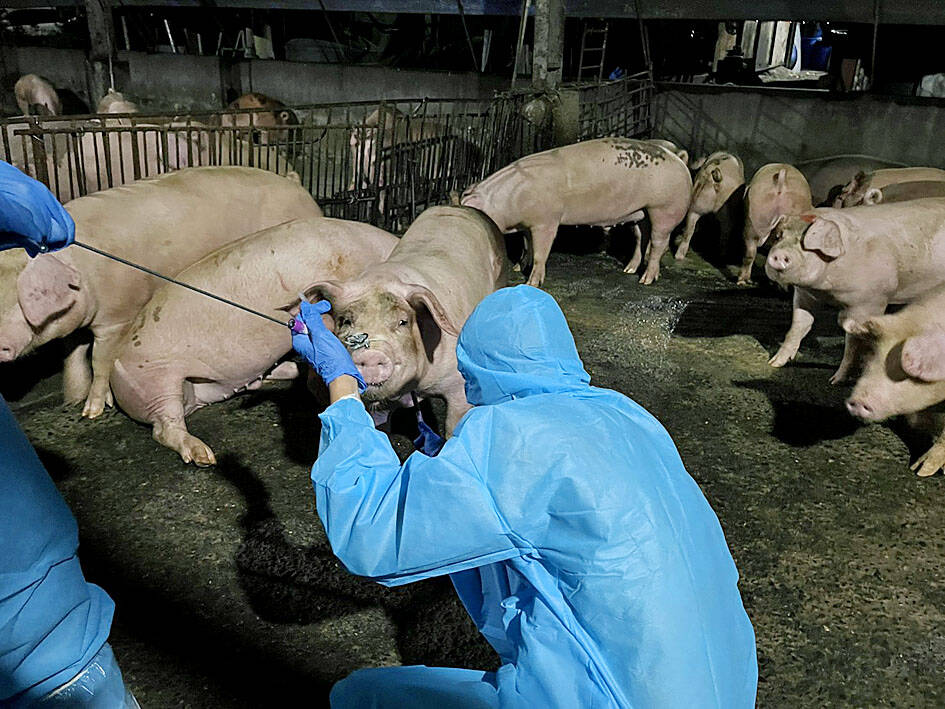
Personnel from the Pingtung County Animal Disease Control Center at a farm in May collect blood samples to test for African swine fever.
Photo courtesy of the Pingtung County Government
The two other cases — in Taichung and Miaoli County — are under investigation, it said, adding that penalties would be issued according to the results.
The 24 cases involved 23 pig farms, with one of the farms caught twice, the center said.
Of the 23 pig farms, six had 200 or more pigs, while 11 had 20 to 199, it said.
The six other farms had 19 pigs or fewer, the center said.
That means 17 non-compliant farms had 199 pigs or fewer, accounting for about 73.9 percent of all non-compliant farms, it said.
Eight non-compliant farms had 20 pigs or more without livestock farm registration, accounting for 34.8 percent, the center said.
The center said it would ask local authorities to conduct follow-up inspections and penalize the eight farms for failing to register in accordance with the Animal Industry Act (畜牧法).
Farms that are not big enough to register should be listed for epidemic prevention management, it said.
Registered pig farms with non-compliance records should be listed for high-risk site inspections based on their kitchen waste sources, transportation routes, operational scale and registration status, it said.
Real-time temperature and video monitoring systems have been installed at 243 pig farms that have permission to feed pigs with kitchen waste, the center said.
GPS trackers have also been installed on 453 vehicles to monitor kitchen waste disposal, it said.
The Taichung City Government during a joint inspection on Friday last week found that a farm with 23 pigs in Longjing District (龍井) was having kitchen waste illegally transported to it, the center said.
The farm also illegally mixed pig feed with rice, ham and large bones, it said.
The Taichung Animal Protection and Health Inspection Office has collected blood samples from three pigs at the farm and confirmed that the samples tested negative for ASF, the center said, adding that a 15-day movement ban has been imposed on the farm.
Since the beginning of this year, transporting kitchen waste to pig farms without prior approval has been subject to a fine of NT$200,000 (US$6,275) for the first offense, NT$500,000 for the second offense, and NT$1 million for the third offense and each subsequent offense as stipulated in revised penalty guidelines issued pursuant to the Act on the Prevention and Control of Infectious Animal Diseases (動物傳染病防治條例), it said.
Farms that feed pigs kitchen waste without prior approval would face fines of NT$200,000 for the first offense and increased fines for subsequent offenses, capped at NT$3 million, as stipulated by penalty guidelines for the Feed Control Act (飼料管理法), the center said.
Those who illegally transport kitchen waste to a pig farm and illegally feed it to pigs would be fined according to the two pieces of legislation, or NT$400,000 for the first offense up to a maximum of NT$4 million for subsequent offenses, it said.
KioskNews shows a cleaned-up reading view extracted from the publisher’s page — the original always lives on their site, not ours.