The death of the South Indian family hero—and why Suriya might be the last one left
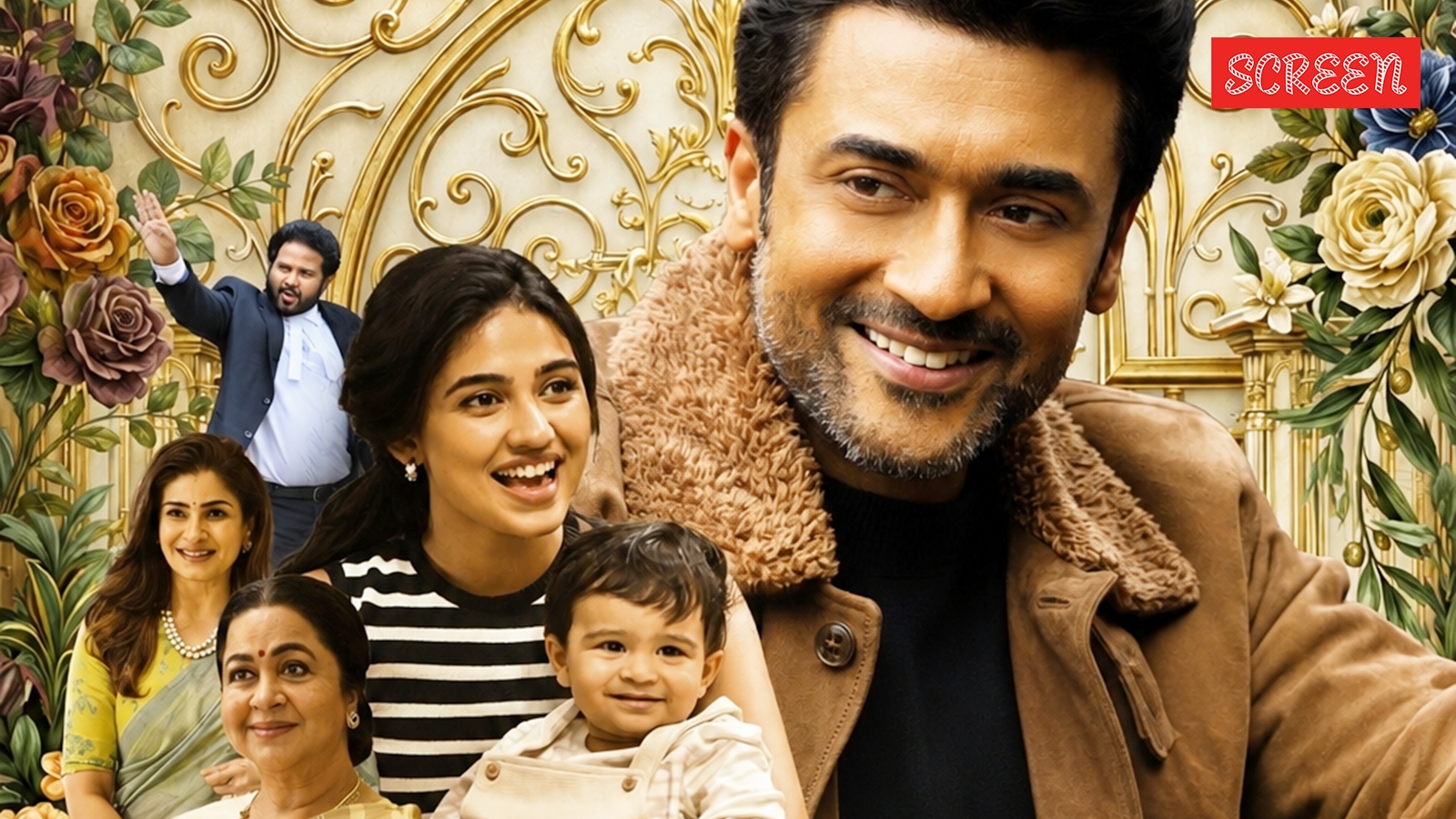
The biggest stars in South Indian cinema can break bones, lift trucks, fight armies and save nations. What most of them cannot do anymore, or will not, is sit in a room with a woman, look her in the eye and talk about love without a background score telling you how to feel. Suriya just did it in Vishwanath and Sons, and he had not explored in several years. And it might be the bravest thing any A-list star in the industry has done all year.
Three months ago, he was a deity. In Karuppu, he played the human avatar of Karuppusamy, smashing through walls, and delivering mass dialogues. In Vishwanath and Sons, he is a 40-year-old single father sitting in a hospital room, holding his infant son’s hand and wondering if he is allowed to fall in love with someone 20 years younger to him. Yet neither performance feels like a departure from who Suriya is on screen. And that, in 2026, is a rarer quality than it should be.
There is a simple test for a male star in South Indian cinema right now. Can he make a family film? Not produce one or do a cameo in one. Can he carry a two-and-a-half-hour film where the biggest set piece is a conversation between a man and his mother, and still make people buy tickets? The list of actors who can do that in 2026 is shorter than you think. And after watching Vishwanath and Sons, it is hard to argue that Suriya is not at the very top of it.
Also Read: ‘Tears, smiles can’t be put in balance sheet’: Suriya calls out industry’s box office obsession
The problem with leading men and family films
South Indian cinema’s biggest stars have, over the past decade, drifted almost entirely toward action spectacles, franchise films and larger-than-life heroism. The reasons are obvious: A mass entertainer opens bigger, It travels across languages more easily, it generates the kind of opening-weekend numbers that make headlines and justify budgets. Family dramas, romantic films and character-driven stories, the genres that built the careers of many of these same actors, have been pushed to the margins.
The result is a generation of leading men who are commercially powerful but creatively boxed in.
Take Ram Charan: Early in his career, he showed genuine range. Chirutha was a competent action debut, but it was Orange, that showed a different side of him, a carefree, emotionally available young man navigating love and loss. The film flopped at the time, but has since become a cult favourite. He followed it with Govindudu Andarivadele where he played a grandson caught between two feuding sides of his own family, a warm, well-received film that proved he could hold a story without throwing a single punch. But after Rangasthalam and RRR turned him into a global name, the family entertainer lane closed. His recent films Game Changer and Peddi were both firmly in action-spectacle territory. The market expects Ram Charan to fight, not to sit across from his grandmother and talk about forgiveness.
Story continues below this ad
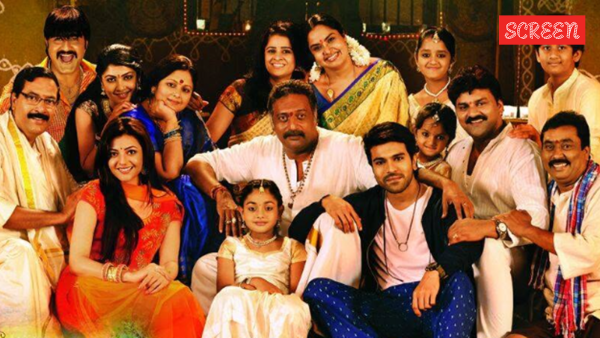 A still from Ram Charan’s Govindudu Andarivadele (Photo: Ram Charan/Facebook)
Prabhas is an even more harder case to think about because he made good family entertainers. Before Baahubali changed everything, he was one of Telugu cinema’s most natural romantic leads. Darling was a blockbuster family entertainer where Prabhas played Prabha, a loveable, easygoing young man in a one-sided love story set partly in Switzerland. The film was so warmly received that “Darling” became his permanent moniker, the way fans and even colleagues address him to this day. A year later, Mr. Perfect had him playing a commitment-averse video game developer who learns the value of compromise and family. It was a clean, funny, emotionally grounded family drama with a DSP soundtrack that is still played at weddings. Both films worked because Prabhas had a lightness about him, a natural warmth that made you want to have lunch with the guy, not run from him.
Then came Baahubali. And everything changed. The franchise turned Prabhas into a mythological action figure, and every film since, Saaho, Radhe Shyam, Adipurush, Salaar and Kalki 2898 AD, has tried to keep him in that space. His one attempt at returning to something lighter, Radhe Shyam, a period romance directed by Radha Krishna Kumar, was a commercial and critical disaster. The audience that Baahubali built simply did not want to see Prabhas in a love story. He tried to do a breezy The Rajasaab, but between a simple story and an actor with big stardom, the movie just remained a disaster.
And the same holds true for Mahesh Babu, Jr NTR, Allu Arjun, Chiranjeevi and Nagarjuna. The only actor who is consistently making family-oriented films is Venkatesh Daggubati, but that is not enough for the audience who grew up watching their favourite heroes living lives in the films that resembled theirs.
Also Read: Vishwanath and Sons movie review: Suriya’s charm holds together a warm film with weak plot
Story continues below this ad
In Tamil cinema, the vacuum is just as visible. Vijay, who delivered some of the finest family entertainers of the 2000s and 2010s with Ghilli, Sachein, Theri and Mersal, retired from acting to enter politics. Ajith has been splitting his time between action films and a racing career. Dhanush, who is capable of extraordinary range, has leaned into intense, dark roles in recent years with Raayan and Captain Miller. Vikram’s filmography has been almost entirely action and thriller-driven since Iru Mugan.
Why Suriya is different
What makes Suriya unusual is not just that he can do family films. It is that he can do family films and mass entertainers, sometimes back to back, without losing credibility in either space. And he has been doing this for 28 years.
His career has always moved in cycles. In the early 2000s, he established himself as a romantic lead with Kaakha Kaakha, where his chemistry with Jyothika was so convincing that audiences could not separate reel from real. Sillunu Oru Kadhal deepened that reputation, with Suriya playing a married man caught between duty and desire in a film that featured one of A.R. Rahman’s most beloved soundtracks. Vaaranam Aayiram, with Gautham Vasudev Menon, pushed him further, asking him to play a character from age 20 to 40 and deliver some of the most emotionally demanding scenes of his career.
 Jyotika and Suriya in Sillunu Oru Kaadhal.
Then he pivoted. The Singam franchise turned him into a mass hero. Soorarai Pottru and Jai Bhim won him a National Award and international attention. His cameo as Rolex in Vikram became the most talked-about five minutes in Tamil cinema that year. Kanguva was a fantasy experiment and Retro was a stylish Karthik Subbaraj collaboration. Karuppu was a mythological mass entertainer that crossed Rs 300 crore worldwide.
Story continues below this ad
And now, barely three months after Karuppu, here he is in Vishwanath and Sons. Playing a 40-something single father. Trying not to fall in love with a woman half his age. Sitting across from Radikaa Sarathkumar and talking about his mother’s dreams for him. Telling Mamitha Baiju’s character that he is not sure if love at his age is even allowed.
The entire movie felt like Suriya returning to a part of himself that was always there but had been waiting for the right material. And that is the difference between him and his contemporaries. Prabhas left the Darling behind. Ram Charan left the Orange behind. Mahesh Babu left the SVSC behind. Suriya never fully left the Sillunu Oru Kadhal behind. Even when he was swinging a sword in Kanguva or channeling a deity in Karuppu, that emotional register was still active, maintained through films like Soorarai Pottru and Jai Bhim that required vulnerability alongside intensity.
The charm that refuses to fade
There is something else at play here, something harder to quantify than box office numbers or genre versatility. Suriya, at 51, still has the kind of screen presence that makes a romantic film feel believable. When he looks at Mamitha Baiju’s Maddy in Vishwanath and Sons, hesitating before responding to her confession, you believe the hesitation. When he sits by his son’s hospital bed, you believe the fear. When he dances, reluctantly, at a family gathering, you believe the joy.
Many actors who were compelling romantic leads in their 20s and 30s lose that quality as they age, either because they stop trying or because the audience stops accepting them in that space. Suriya has maintained it for a specific reason: he looks after himself. He is, by most accounts, one of the fittest actors in Indian cinema, with a discipline around training and diet that has kept his physical appearance remarkably consistent over two decades. But more importantly, he has kept the emotional fitness too. He has not hardened into a one-note action persona. He has not become the guy who only knows how to look intense and throw punches. He can still sit in a room with a woman and make you care about what happens next between them.
Story continues below this ad
His fans have always known this. They call him a “walking green flag,” a term the younger generation uses for men who are emotionally available, respectful and genuine. It is a reputation built not just on his on-screen roles, but also on his off-screen conduct, his marriage to Jyothika, his public support for her career, his interviews where he speaks about love and family without performing masculinity. That authenticity transfers to his performances. When he plays a romantic lead, you believe him because he does not seem to be pretending.
What Vishwanath and Sons proves
Vishwanath and Sons is not entirely flawless but what the film proves, beyond any argument, is that the audience for family entertainers still exists. It just needs a star willing to serve it.
Suriya himself said it best at the movie’s success meet on Saturday. “Success can’t be measured with number of tickets sold. What happens to the conversations after the film? What happens to the emotions people carry after the film? All these emotions can’t be put in a balance sheet.” He also credited Venky Atluri directly: “Once again, you are reminding everyone that family-oriented films are important and that this art form still has a special place in people’s hearts.”
Also Read: Vishwanath and Sons Box Office Collection Day 2 Updates
Story continues below this ad
In an industry where the biggest names have picked a lane and stayed in it, Suriya’s willingness to move between mass entertainer and family drama, between deity and father, between spectacle and stillness, makes him something increasingly rare. He is not the only talented actor in South Indian cinema. But he may be the only one left who is genuinely comfortable in both worlds.
KioskNews shows a cleaned-up reading view extracted from the publisher’s page — the original always lives on their site, not ours.