Aftershock rattles Gippsland as experts warn of larger quakes to come
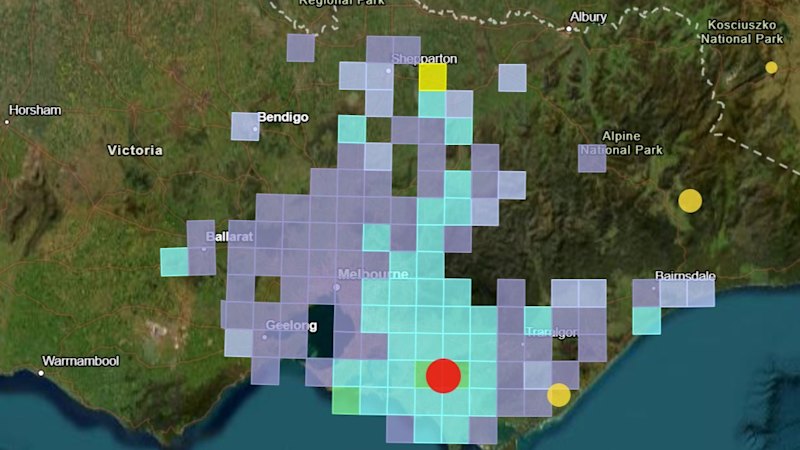
Victorians should brace for further significant earthquakes, experts warn, after a 3.2 magnitude aftershock shook Gippsland residents awake on Wednesday night just days after a 4.8 magnitude quake rattled the state.
More than 2000 people reported feeling the latest tremor, which had an epicentre near Leongatha, about 135 kilometres south-east of Melbourne, according to Geoscience Australia.
Victoria’s State Emergency Service received one request for assistance.
It comes less than a week after last Saturday morning’s quake, which was the biggest across Victoria in the past four years.
The 4.8 magnitude tremor was recorded by Geoscience Australia just after 2am on October 3.
The epicentre was six kilometres north-east of the Gippsland town of Korumburra, about 15 kilometres from Wednesday night’s aftershock.
There were no reports of building damage or requests for State Emergency Service assistance.
But while the quake may have been short-lived, Seismology Research Centre chief scientist Adam Pascale said people close to the epicentre of the recent quakes should prepare for the increasing possibility of another.
“In the short term, after an event, there is an increased likelihood of an equivalent or larger event,” Pascale told The Age on Thursday morning. “The longer we go on, the lower the likelihood becomes.”
Pascale said a magnitude 4.6 earthquake rocked the Korumburra region in March 2009. Two weeks later, a quake of the same size happened again.
“As we saw back in 2009, two weeks later, there was the same size magnitude again, and potentially depending on how the stress build-up was and how strong the rocks were, that could have been a larger event,” he said.
“In these first few weeks [after the initial earthquake], this is the critical time when people need to be aware that a larger event can happen.
“So, particularly for people in the local area, they need to tie back their bookshelves and anything that might fall to just make their environments a bit safer in case there is a stronger event.
“Australia does have earthquakes. They are less frequent than in other parts of the world, but they can be just as damaging. We could potentially have a magnitude 7 in Australia. It’s possible.”
He said it was crucial for people – particularly those who live near the epicentres of the recent quakes – to know what to do to keep themselves safe if another event occurs.
“[A] few seconds of strong shaking can be pretty devastating,” he said.
“Get under a table. Drop, cover and hold on. It can be hard to stand during strong shaking and most injuries and deaths occur when things fall on people. That’s what you need to try to protect yourself from, the falling objects during that initial strong shaking.
“Do not run outside. Do not run to doorways. These are old myths that are just not true and not safe.”
Seismic activity has spiked in Victoria since a magnitude 5.9 earthquake in September 2021 damaged buildings in Melbourne and was felt across south-eastern Australia.
A 3.8 tremor centred in Sunbury in May 2023 was the largest earthquake with an epicentre recorded within metropolitan Melbourne for 120 years.
KioskNews shows a cleaned-up reading view extracted from the publisher’s page — the original always lives on their site, not ours.