Democrats formally nominate Hakeem Jeffries for speaker of the House
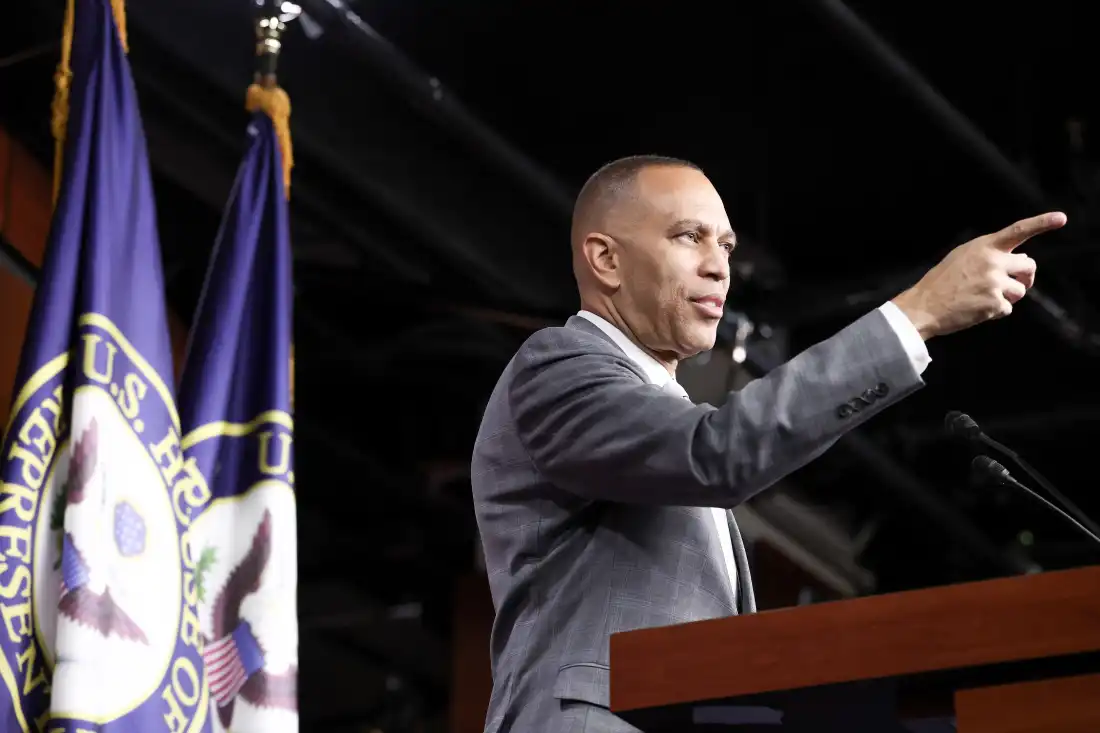
Hakeem Jeffries, D-N.Y., speaks during a news conference in the U.S. Capitol on Nov. 17, 2026. Anna Moneymaker/Getty Images hide caption
Anna Moneymaker/Getty Images
House Minority Leader Hakeem Jeffries has been nominated by House Democrats to serve as Speaker of the House when the party retakes the majority in the new year.
Wednesday's vote by House Democrats kickstarts the formal selection process for Speaker, which will take place at the start of the new Congress on January 3 with a vote on the floor of the House. If successful, as is widely expected, Jeffries will make history as the first Black lawmaker to serve in the job.
The New York Democrat ran uncontested, winning a closed-door vote by a tally of 251 to 11. His victory comes just over a week after House Republicans selected Rep. Jim Jordan of Ohio to be the conference's minority leader; in the Senate, Republicans tapped South Dakota's John Thune for a second term as party leader.
Jeffries, who's led House Democrats since 2023, will need just a simple majority of member votes in a Congress where Democrats are poised to control at least 257 seats, with several remaining races still to be decided.
It's a vastly different reality from what awaited House Republicans four years ago when they regained the House majority. Facing extremely narrow margins, GOP leaders struggled to unite the conference around a speaker and were forced to negotiate with a handful of far-right party holdouts in order to reach consensus. After multiple candidates failed to secure a majority, the party ultimately coalesced around the now outgoing Speaker Mike Johnson, R-La.
While Jeffries will still have to navigate intraparty divides, the size of Democrats' majority affords him room to weather some dissent.
He's faced resistance from some within the party's left-most flank, who argue Democrats should prioritize advancing a more progressive agenda next year, lobbying for votes on Medicare for All and legislation that would stop the transfer of offensive weapons to Israel. However, given that Democrats will hold double digit margins in the chamber — an edge propelled by the success of more moderate candidates in districts President Trump carried in 2024 — it's unclear how much leverage the left wing of the party will have in the speaker's vote.
Divides inside the party may prove more pronounced in the Senate, where some Democrats are more publicly questioning whether current Minority Leader Chuck Schumer of New York is best suited to deliver on voter demands for change.
Schumer faces a challenge from Maryland's Chris Van Hollen, who announced his candidacy last week and is pitching himself as an alternative to the status quo, echoing much of the progressive populist messaging that several successful Senate candidates ran on this cycle. Like Schumer, Van Hollen has also served in Congress for decades.
Schumer, the top Democrat in the Senate for nearly a decade, contends that he still has the needed votes to be elected majority leader. However, Van Hollen's challenge comes as a handful of current and incoming members have declined to back Schumer for the job.
Both sides still have time to shore up votes, with leadership elections set for early December.
KioskNews shows a cleaned-up reading view extracted from the publisher’s page — the original always lives on their site, not ours.