Fed’s Paulson says more rate hikes may be needed
Federal Reserve Bank of Philadelphia President Anna Paulson on Thursday joined the chorus of policymakers saying additional interest-rate increases may be needed to ensure inflation returns to the central bank’s 2 percent goal.
“Looking ahead, if conditions evolve as I expect, some modest further tightening may be warranted,” Paulson said on Thursday at an event in Philadelphia.
Earlier on Thursday, New York Fed President John Williams said he and his colleagues “still have a lot of work to do” in dealing with lingering inflation risks.
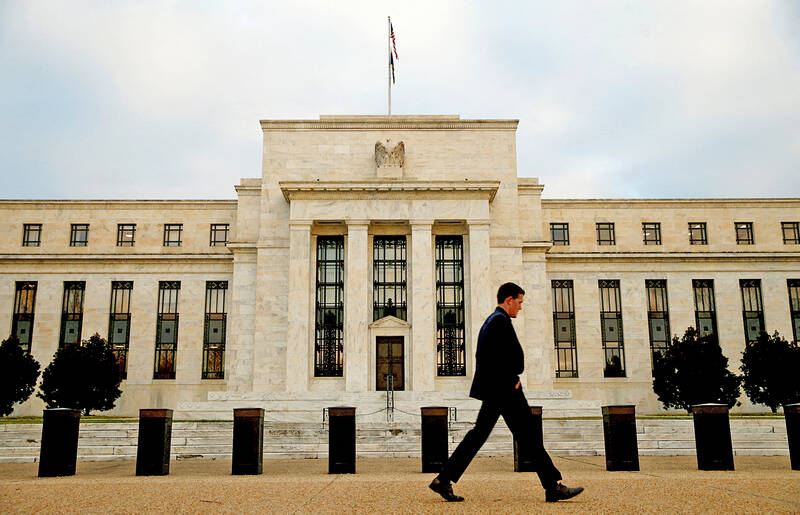
A man walks past the Federal Reserve in Washington on Dec. 16, 2015.
Photo: Reuters
Several other officials have aired similar comments, in line with the signal given last week when policymakers voted unanimously to raise their benchmark rate by a quarter percentage point and issued projections pointing to at least one more rate hike this year.
Investors, reacting to solid economic data and policymaker remarks, have lifted expectations for a rate increase next month to about 65 percent from 53 percent at the end of last week. The Fed’s next policy meeting concludes on Oct. 28, six days before congressional mid-term elections.
The comments are likely to increase tensions developing between the Fed and the White House. On Wednesday National Economic Council Director Kevin Hassett criticized policymakers for their views.
“A lot of the people who weren’t appointed by President Trump are giving speeches over the last couple of days, saying we need a lot more hikes,” Hassett said.
Paulson, who votes on policy decisions this year, said the move was needed because underlying measures of inflation, which strip out energy and food prices, remain “stubbornly elevated.”
“This recalibration brings policy closer to what I believe is needed to return inflation to 2 percent at a pace that balances inflation with risks to the labor market,” she said.
Paulson said the US economy has been resilient to shocks, with output growth solid and the labor market near full employment. She said she sees signs of “increased momentum.”
While tariff-related effects on consumer prices have eased, price pressures grew from the conflict in the Middle East and the build-out of data centers related to artificial intelligence. Wage growth, on the other hand, remains modest and signals that labor costs are not adding inflationary pressures, she added.
“The best I can say about underlying inflation this year is that it hasn’t gotten worse,” Paulson said.
The Philadelphia Fed chief said underlying inflation has shown little to no progress. She said measures are running in a range of 2.5 to 3 percent, showing little signs of easing to the Fed’s target.
Also speaking on Thursday, Cleveland Fed President Beth Hammack said the US economy is facing a series of supply shocks, increasing the risk that an inflationary mindset takes hold.
Richmond Fed President Tom Barkin, in Washington, said a broad range of persistent cost pressures this summer — from tariffs and tech price increases, to rising fuel and healthcare expenses — raised the risk that inflation in the US could become entrenched, making tighter policy necessary.
KioskNews shows a cleaned-up reading view extracted from the publisher’s page — the original always lives on their site, not ours.