2026 Elections: Taichung mayoral candidates propose divergent policies
Democratic Progressive Party’s Taichung mayoral candidate Ho Hsin-chun (何欣純) proposed bus service reforms yesterday, while her Chinese Nationalist Party (KMT) rival Johnny Chiang (江啟臣) outlined an artificial intelligence (AI)-assisted public safety network.
Ho’s proposals focused on increasing passenger capacity, upgrading the city’s official bus app, reorganizing routes and improving drivers’ working conditions.
Ho, who took a Route 301 bus as part of a campaign event, said the replacement of articulated buses with smaller electric buses had reduced passenger capacity without sufficient increases in services or driver staffing.
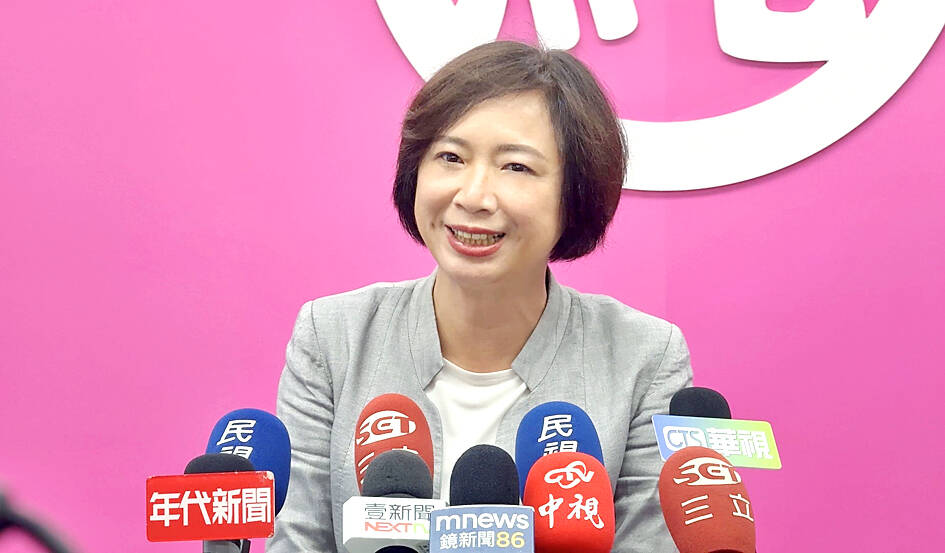
The Democratic Progressive Party’s Taichung mayoral candidate Ho Hsin-chun addresses the media in Taichung on Wednesday last week.
Photo courtesy of Ho’s campaign office via CNA
Articulated buses can carry up to 141 passengers, compared with about 60 on a conventional electric bus, she said.
As a result, passengers at intermediate stops, including those serving Taichung Veterans General Hospital and Tunghai University, struggle to board crowded buses, she said.
Ho pledged to ride on public transportation periodically if elected to assess services from the perspective of commuters and address problems.
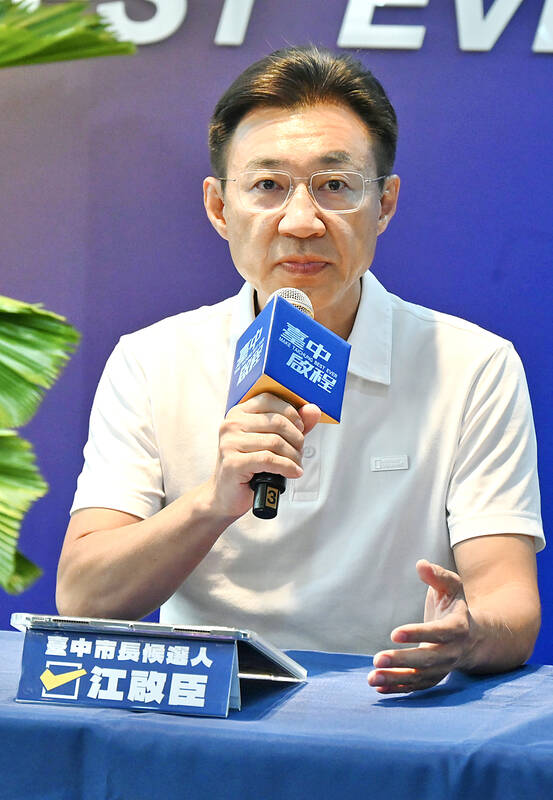
The Chinese Nationalist Party’s (KMT) Taichung mayoral candidate Johnny Chiang speaks at a news conference in Taipei on Wednesday last week.
Photo: Liao Yao-tung, Taipei Times
At a separate policy presentation, Chiang proposed a “Taichung smart safety network” covering policing, social welfare and disaster resilience.
His plans include enhancing coordination through the city’s smart city development committee and establishing a sovereign AI and big data center to integrate data and analyze risks while complying with legal requirements and protecting privacy.
AI sensors could help detect unusual activity patterns among older people living alone, he said. The proposed network would integrate information on the finances, childcare needs and mental health of families considered at high risk.
Chiang pledged to give frontline social workers and nursing personnel a greater role in decisionmaking, address staffing shortages and protect their rights.
Other proposals include enhancing disaster prevention and response cooperation through a regional governance platform in central Taiwan, expanding AI-assisted water management and introducing smart noise monitoring.
KioskNews shows a cleaned-up reading view extracted from the publisher’s page — the original always lives on their site, not ours.