People receive first flu vaccines as cases rise
STOP THE SPREAD: More than 601,000 doses of flu vaccines have been administered in the first two days, a higher number than the program last year, the CDC said
By Lee I-chia / Staff reporter


More than 601,000 people received a flu vaccine in the first two days since public-funded vaccination began on Thursday, the Centers for Disease Control (CDC) said yesterday, adding that flu activity is at a peak in Taiwan and increasing in Japan, a popular travel destination for Taiwanese, so getting vaccinated is encouraged.
The first phase of this season’s public-funded flu and COVID-19 vaccination began on Thursday, with elderly people, young children, students and several high-risk groups eligible for the vaccines.
More than 601,000 doses of flu vaccines and more than 209,000 doses of COVID-19 vaccines have been administered in the first two days, both higher than the first two days of the program last year, CDC Deputy Director-General Lin Ming-cheng (林明誠) said yesterday.
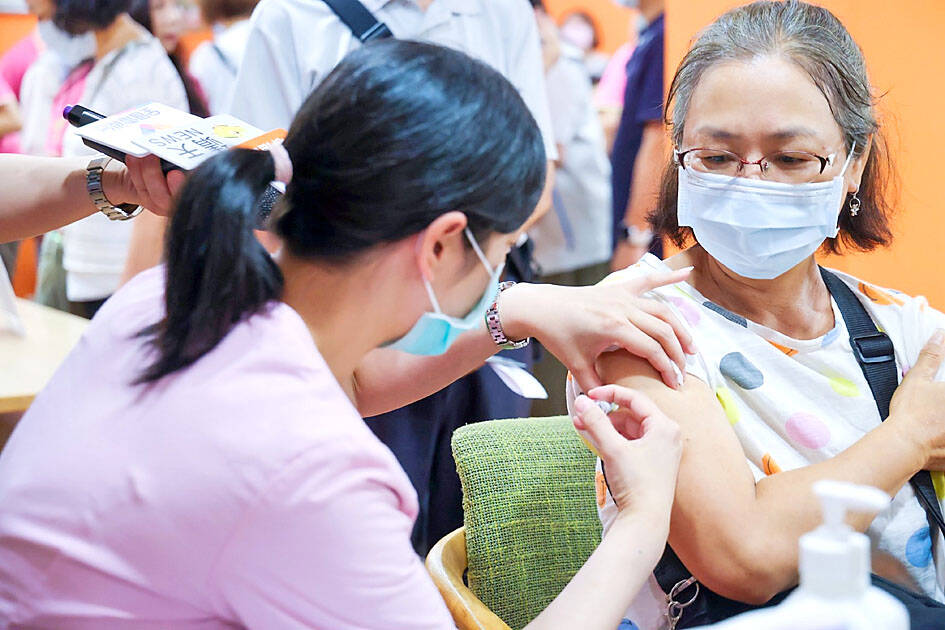
A medical worker administers a vaccine in New Taipei City on Thursday.
Photo courtesy of the New Taipei City Government’s Department of Information via CNA
The number of flu and COVID-19 vaccines given was 9 percent and 19 percent higher, respectively, than those given on the first two days last year, he said.
On Friday alone, more than 335,000 people received a flu vaccine. That is the highest daily number since the program began offering the vaccines in two phases in 2021, he said.
Meanwhile, the CDC last week said that flu cases in Taiwan are still in the epidemic stage and weekly cases are predicted to remain at high levels in the next few weeks. Lin yesterday said that the latest data from Japan’s Ministry of Health, Labor and Welfare last month show that flu activity is also rising in Japan.
Japan’s data showed that the average number of flu-like illnesses reported per sentinel site (designated hospitals and clinics) was 8.48 during the week between Sept. 14 and Sept. 20, which was 53.1 percent higher than the week before, and 10 times the number of the same week last year, he said.
Among the cases reported that week, patients aged 70 years or older accounted for 47.5 percent, he said, adding that 98 percent of the cases were caused by the influenza A (H1N1) virus, which is also the current dominant strain spreading in Taiwan.
The data also show that 44 prefectures among Japan’s 47 prefectures reported an increase in flu-like illnesses, with the highest average case numbers in Okinawa, followed by Tokyo, Aichi, Kanagawa and Chiba, Lin said.
Weekly cases have increased for nine consecutive weeks until Sept. 20 in Japan, he said, adding that aside from Japan, flu activity in other countries, including China, Hong Kong, South Korea, Singapore and the US, are also rising.
The CDC encourages people to get vaccinated as soon as possible for better protection, either locally or if while traveling abroad, Lin said.
KioskNews shows a cleaned-up reading view extracted from the publisher’s page — the original always lives on their site, not ours.