Is this world-class, free gallery Cambridge’s best-kept secret?

Museum shows can be expensive. Commercial galleries intimidating. And as for Cambridge colleges? They’re usually marked with signs saying things like “Closed to visitors” and “Keep off the grass”. Murray Edwards College, though, has a magnificent art collection that’s free to visit and open to the public all year round. And Harriet Loffler says you can do whatever you like on the lawn.
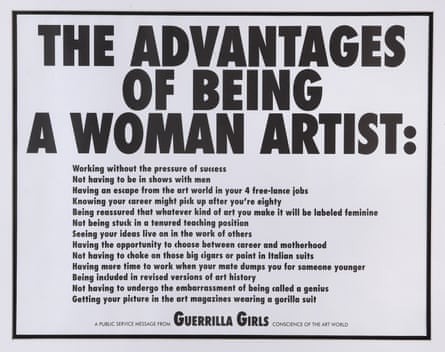
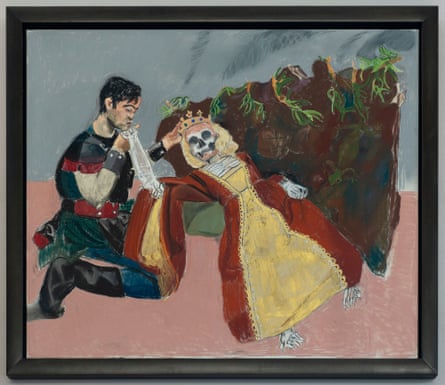
She’s the director of the Women’s Art Collection, a permanent fixture of modern and contemporary works by female artists at Murray Edwards, and one of the best-kept secrets in Cambridge. By the time she’s greeting me in the porter’s lodge of the college, I’ve already clocked two Tracey Emin lithographs. In the cafe is a screen print by the Guerrilla Girls and a charmingly clumsy canvas by Rose Wylie. In the corridors and rooms in between we pass pictures by Leonora Carrington, Faith Ringgold, Barbara Walker – and, astonishingly, we’re the only ones around.
It all began, Loffler tells me, with Mary Kelly, the first artist in residence at the college, which was established by a group of strong-minded women as New Hall over on Silver Street in 1954. (Women may have been admitted to the University of Cambridge towards the end of the 19th century, but they weren’t issued with degrees until the middle of the 20th century; when they were finally allowed into Magdalene College in 1988, apparently a bunch of the male fellows wore black armbands.) In 1965, New Hall moved to its current location off Huntingdon Road, a landmark building designed by Chamberlin, Powell and Bon. Commissioned by the college’s founding president Rosemary Murray, the architects, who designed the Barbican, envisioned it as a manifesto for women’s education, with open walkways, an altar-like staircase in the library, and a soaring dome.
During her time at New Hall (the name changed to Murray Edwards in 2008), Kelly created Extase (1986), a series of screen-printed images of her clothes in disarray, which she paired with snippets of conversation she’d overheard from women involved in 1970s feminism – an exploration into the components that make up modern womanhood, the things we wear and the words we say. It was acquired by the college and displayed in the dining hall, where it planted the seed of having other art by women on the walls.
So, a few years later, the college president Valerie Pearl, with the curator Ann Jones, reached out to others and invited them to donate works of their own – works, they wrote, that would not be sold but “remain on view as a source of inspiration to students, researchers and visitors”. Among those who received that letter were Maggi Hambling, Paula Rego, Bridget Riley and Eileen Cooper, all of whom said yes (Sonia Boyce’s letter got lost in the post, but happily a piece she made in the early 1990s is about to join the fold). Within two years, the college had been sent more than 70 artworks, and the collection was well on its way.
“There are lots of artists you might recognise, but there are also lots you won’t have heard of,” Loffler tells me. It’s a level playing field – in the spirit of learning, as much space is given to lesser-known names as art world elite. “The other thing we always think about is reciprocity,” she says. “We never want a donation to be an empty gesture. We want it to be part of a relationship.”
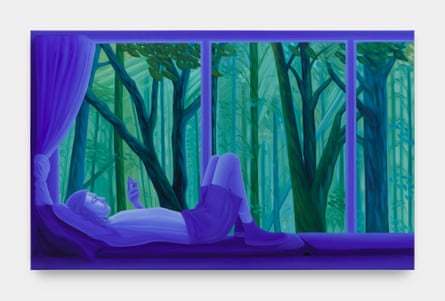
Today, it’s Europe’s largest publicly accessible collection of modern and contemporary art by women, with over 600 works by more than 300 artists. New acquisitions occur sporadically, as and when artists are prepared to donate works, or the college has the funds to buy them. Unlike nearby Kettle’s Yard and the Fitzwilliam Museum, which are part of the university and therefore eligible for university funding, the Women’s Art Collection is run by the college, so has to find money elsewhere. In 2024 it partnered with the art philanthropists Spirit Now London to acquire three works by young female artists from China, South Africa and the US. At this year’s Frieze London it’s working with Female Artists of the Mougins Museum to buy a piece by a female artist not yet in a UK public collection.
It’s been four decades since the college acquired Extase; to celebrate, a new exhibition, What Remains, will bring together archival materials (including Kelly’s application for the artist residency) and works by contemporary artists who are engaged with similar feminist concerns. Just as her predecessors wrote to Hambling, Rego and Riley all those years ago, Laura Moseley, the curator, has invited women from outside the Women’s Art Collection to take part. Among them are Ellen Lesperance, who pays homage to female activism through painted knitting patterns, and Sadé Mica, who’s making a new embroidered chest binder in response to Extase.
after newsletter promotion
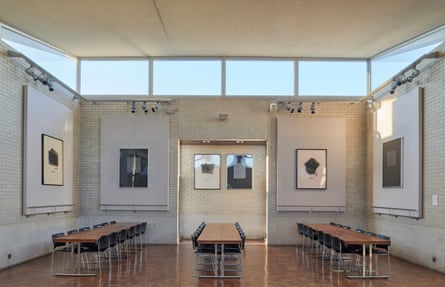
After a stroll through the garden – keep your eyes peeled for Emma Darwin’s greenhouse (Emma was Charles Darwin’s wife) – we head back to the porter’s lodge, and Loffler tells me that the “long-term, blue-sky thinking” is to create a new gallery space right here at the entrance. The existing rooms within the college aren’t environmentally controlled, so there are limits when it comes to museum loans. “But we’ve got the materials. We’ve got the ambition.” All they need is the backing. “What really motivates me is trying to unlock something of the university for a general public,” says Loffler with a smile. “I love the idea that local residents walking down Huntington Road could just pop in.”
KioskNews shows a cleaned-up reading view extracted from the publisher’s page — the original always lives on their site, not ours.