Joseph Wu urges Europe, Taiwan to work together
STRONGER TOGETHER: That which threatens Taiwan threatens Europe too, said the head of the National Security Council at a European Parliament meeting
By William Hetherington / Staff writer, with CNA


National Security Council Secretary-General Joseph Wu (吳釗燮) has called on Taiwan and Europe to deepen cooperation to safeguard Taiwan’s security and Europe’s prosperity, saying peace in the Taiwan Strait is vital to European security and economic interests.
Wu made the remarks at the Taiwan Forum in Berlin on Thursday, appearing alongside European Parliament Committee on Security and Defence Chair Marie-Agnes Strack-Zimmermann. The forum, hosted by Germany’s Friedrich Naumann Foundation for Freedom, was titled “Taiwan Security, German Prosperity.”
Wu delivered a keynote address and joined a panel discussion with Strack-Zimmermann and Gudrun Wacker, a German specialist on Asian affairs.
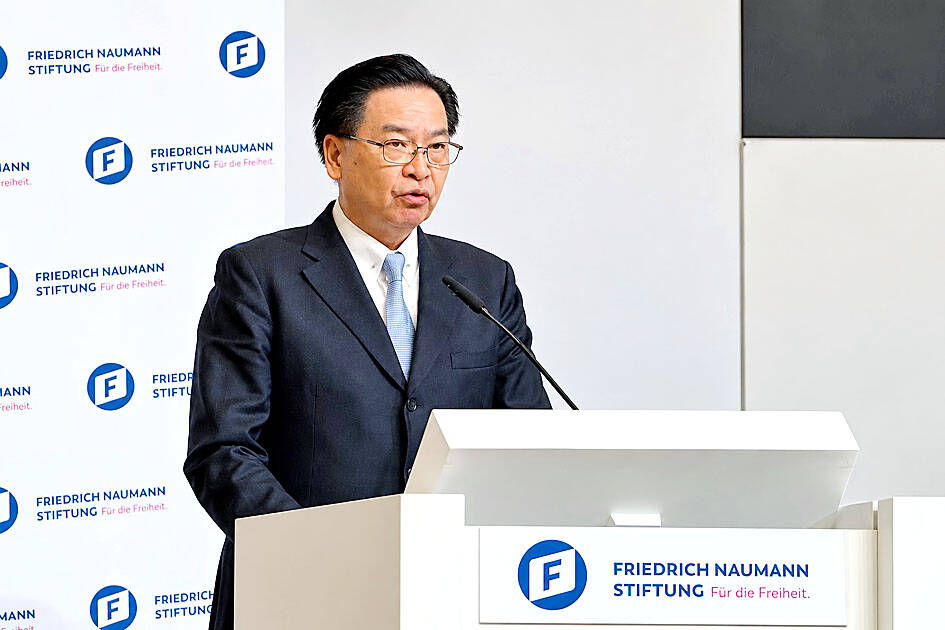
National Security Council Secretary-General Joseph Wu speaks at the Taiwan Forum in Berlin on Thursday last week.
Photo: CNA
Russia’s invasion of Ukraine and China’s threats against Taiwan show that European and Indo-Pacific security are closely interconnected, Wu said. A conflict in the Taiwan Strait would threaten regional peace and disrupt European industries and global supply chains.
He called for greater Taiwan-Europe cooperation in semiconductors, artificial intelligence and cybersecurity to deepen economic resilience.
However, European concern about Taiwan Strait security has yet to translate into a unified policy toward China. Strack-Zimmermann said the EU adopted a recommendation addressing Taiwan’s security and the bloc’s policy toward China. Most member states supported Taiwan during the deliberations, she said, but their approaches differed.
Germany’s past reliance on inexpensive Russian energy, US security guarantees and access to China’s vast market had shaped its approach to foreign policy, Strack-Zimmermann said. Its economic dependence on China had made Germany more cautious on Taiwan-related issues, she added.
Against this backdrop, Wu said Beijing has sought to change the “status quo” in the Taiwan Strait through military exercises, maritime operations and hybrid warfare. China has used its “one-China principle” to wage legal warfare internationally, seeking to justify military action against Taiwan, he said.
Asked how Taiwan could respond to Chinese provocations without escalating tensions, Wu said the government faced difficult choices. Countermeasures could heighten tensions, while failing to respond could encourage Beijing to push harder.
Taiwan must carefully weigh the need for a response against possible consequences, while maintaining communication and coordinating actions with like-minded countries, Wu said.
Strack-Zimmermann likewise described the EU’s response to China as “walking a tightrope,” saying that inaction would allow Beijing to tighten its grip on the bloc. China was watching how Europe responded to Russia’s invasion of Ukraine and whether democracies had the resolve to defend themselves and support Taiwan, she said.
Wu praised Germany for supporting peace in the Taiwan Strait and Taiwan’s international participation. His public visit to Berlin demonstrated that Germany had not allowed Beijing’s claims over Taiwan to dictate the boundaries of engagement between Taiwan and Germany, he said.
Wu said that Taiwan would not entrust its security to other countries. Defending its freedom, sovereignty and democratic system was Taiwan’s own responsibility, he said.
Taiwan would continue reinforcing its defense capabilities and working with democratic partners to deter geopolitical conflict and maintain peace in the Taiwan Strait, he said.
Founded in 1958, the Friedrich Naumann Foundation for Freedom is affiliated with Germany’s Free Democratic Party and promotes democracy, human rights and international exchange. In 2021, it established a Global Innovation Hub in Taiwan focused on digital transformation and democratic innovation to deepen cooperation with Taiwan.
KioskNews shows a cleaned-up reading view extracted from the publisher’s page — the original always lives on their site, not ours.