Nobel-winning UK scientist launches programme to develop hepatitis C vaccine in Hong Kong
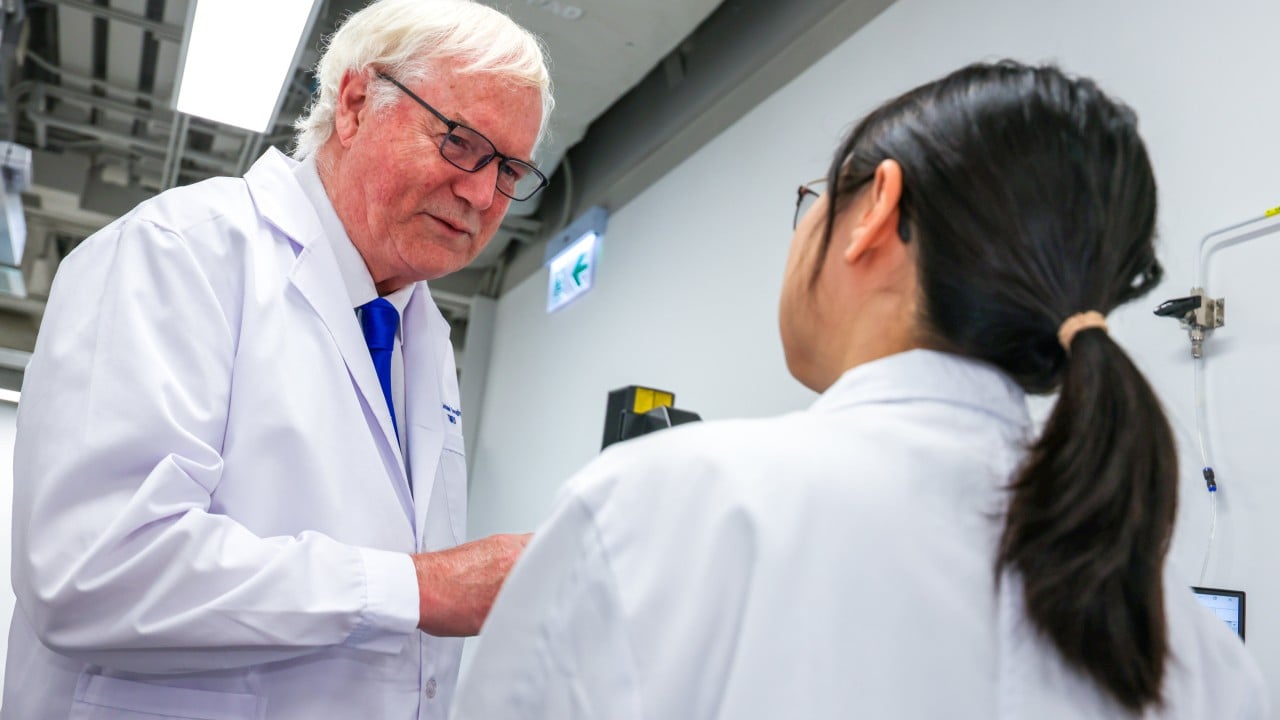
A British Nobel-winning virologist has launched a programme to develop the world’s first hepatitis C vaccine after joining a university in Hong Kong, tapping the city’s research funding, access to Chinese strains of the virus and partnerships with mainland drug-makers.
Sir Michael Houghton, who won the 2020 Nobel Prize in Physiology or Medicine for the co-discovery of the hepatitis C virus, said he joined Baptist University after more than four decades in North America, as the United States and Europe had cut their science spending.
“President Trump and his ministers have really damaged the National Institutes of Health, and my research grant was cut. In Europe, economic problems because of inflation also mean less money goes to research,” Houghton, who also leads the University of Alberta’s Li Ka Shing Applied Virology Institute in Canada, said.
Houghton was appointed Chair Professor of Biology and named a co-founder of Baptist University’s Frontier Translational Medical Research Institute in 2025. He arrived in Hong Kong in October for a two-month stay to lead the vaccine work, and said he planned to spend more time in the city going forward.
No vaccine for the virus currently exists. Houghton said the jab, when developed, could finally end a disease that often showed no symptoms for decades before causing liver scarring and cancer.
“Hepatitis C is a very bad virus. Some people can be infected for many years without knowing it. But once we have a vaccine, the virus can be eliminated, starting with newborns and other high-risk groups,” he said.
Acute hepatitis C is usually asymptomatic and rarely life-threatening, and while about 30 per cent of those infected usually recover on their own within six months, the remaining 70 per cent will develop chronic hepatitis, which can progress to cirrhosis and liver cancer.
About one in 200 people in Hong Kong carries the virus, most without symptoms, and infection through blood often becomes chronic when the body cannot clear it.
Globally, an estimated 47 million people live with chronic hepatitis C, according to the World Health Organization.
Houghton first connected with Baptist University during its bid to establish Hong Kong’s third medical school. The proposal was unsuccessful, but Houghton was drawn to the institution’s biomedical research vision and the chance to reunite with Professor Choo Qui-lim, who discovered the virus with him in 1989. Choo is currently a chair professor at the university’s biology department.
“We have already discovered the North American and European strains, but the Chinese strain is very different, so that is where we start,” he said.
“The funding for medical research and translation here is also very good, and Shenzhen and Shanghai already have the industrial partners to translate the research into products.”
The hepatitis C virus is highly variable, and Houghton said the ultimate goal was a vaccine that would work worldwide, starting with China and expanding from there.
“If I were a 20-year-old starting again, I would want to come to Hong Kong and China, because you are thriving and you are spending a lot on research,” he said.
The team aims to begin phase one trials in 2028 at sites in Hong Kong, Shanghai and Beijing, testing safety and dosage before phase two efficacy trials in 2029. Houghton said the team should know whether the vaccine works by 2030.

The university said Houghton would bring decades of industry experience to its team, adding that there were many world-class scientists in the city but few who had turned discoveries into products.
“This part of experience is very important to Hong Kong when we want to develop an innovation-driven economy and translate university research output to real-world applications,” Terrence Lau Lok-ting, Baptist University’s interim chief innovation officer, said.
Houghton said the vaccine, when developed, would first go to those most at risk, including healthcare workers, newborns and people with multiple sexual partners. He estimated that it would initially cost about HK$1,600 (US$204) per dose per person.
“We work hard to help people, so we do not want a vaccine that the majority cannot afford,” he said.
Apart from Baptist University, both the University of Hong Kong and the Chinese University of Hong Kong also have Nobel laureates on faculty.
KioskNews shows a cleaned-up reading view extracted from the publisher’s page — the original always lives on their site, not ours.