Singapore parents increasingly value holistic development, but academic concerns persist: IPS study
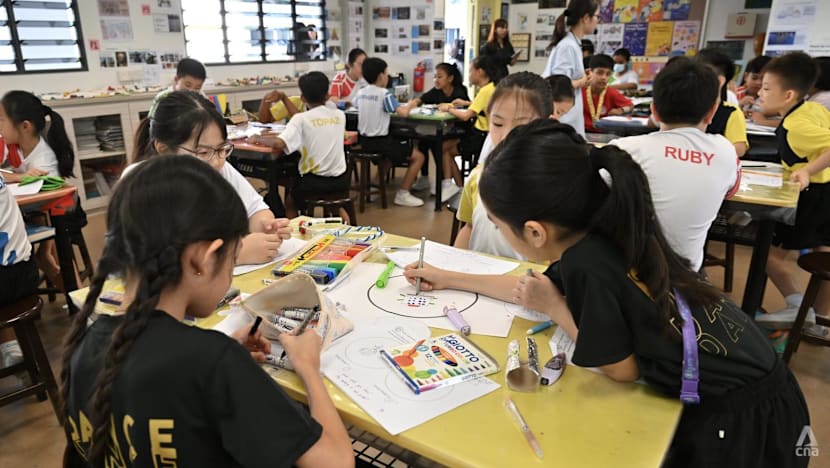
SINGAPORE: More parents in Singapore are embracing a holistic approach to their children's education, but academic signals remain important, with families spending more on tuition, a new study by the Institute of Policy Studies (IPS) has found.
Besides valuing happy learning environments and social-emotional development in schools, they also rely on markers of academic school standing, such as cut-off points and branding.
Published on Friday (Sep 25), the study examined parents' attitudes towards their children's education across four broad areas: the education system, schooling choices, educational stress and tuition or enrichment, as well as education policies.
Conducted by IPS Social Lab researchers Dr Mathew Mathews, Dr Melvin Tay and Dr Teo Kay Key, the study surveyed a nationally representative sample of 1,500 Singaporean and permanent resident parents with children attending local primary schools.
Fieldwork was done from May to August 2026. The survey, which took about 30 minutes to complete in a single sitting, was done either online or in person with a surveyor during a household visit.
The report compared selected findings with an IPS survey conducted in 2016. The two surveys are independent cross-sectional surveys of parents, rather than following the same parents over time.
The latest survey found that parents' broad confidence in Singapore’s education system has remained high, and views of the system as highly competitive have remained broadly stable.
At the same time, 68.7 per cent of parents in 2026 agreed that the education system caused unnecessary stress to children, down from 76.3 per cent in 2016.
Speaking to reporters on Friday, Dr Mathews said parents reported less stress and anxiety over their child’s homework or being there for exam preparation, but greater concern about whether their child was reaching his or her full potential.
He added that parents’ behaviour is often driven by concerns about their child’s future and there is a perception that missing out on the “right” school or programme could put their child at a disadvantage.
“I think we do need to help parents better understand the many options and pathways that exist in Singapore,” Dr Mathews said. “One step into a particular school does not mean an end of their future.”
HOLISTIC DEVELOPMENT
According to the study, 90.2 per cent of parents continue to rate Singapore’s education system highly in 2026, similar to 90.3 per cent in 2016.
Fewer parents believed the system caused unnecessary stress to children, with the proportion falling to 68.7 per cent from 76.3 per cent in the same period.
More parents also believed children should be allowed to fail and learn from their mistakes, rising to 79 per cent from 62.2 per cent.
When choosing schools, parents’ growing emphasis on holistic development was also reflected in the factors they considered important.
For primary schools, teachers who care for students’ social-emotional development remained the highest-rated factor.
Competitive environments and alumni networks fell in importance by 19.9 and 14.2 percentage points, respectively.
For secondary schools, parents most prioritised the holistic fit of the school for their child, with character and values (95 per cent), discipline (91 per cent) and their child’s own preference (88.8 per cent) rated highly.
When comparing with the 2016 data, IPS researchers noted that the holistic features of a good primary school remain highly valued, while the importance of several traditional achievement-oriented markers has declined.
“Parents also continue to emphasise character, self-discipline and other developmental outcomes as important goals of primary education,” the researchers said.
ACADEMIC SIGNALS IMPORTANT
Despite this shift towards holistic development, academic signals are still viewed as important.
Among conventional academic or results-oriented factors, a record of good PSLE scores and a history of students enrolling in reputable secondary schools remained the most important.
However, the proportion of parents who viewed these factors as important dropped by around seven to 10 percentage points.
Parents still perceived the PSLE as a useful indicator, but desired lower-stakes assessments and broader recognition of strengths. They also remain attached to familiar markers of merit and certainty.
About 85.9 per cent of respondents indicated that the PSLE is still an important checkpoint that helps children set goals and prepare for secondary school.
Parents also felt that a national standardised exam like the PSLE was still necessary to assess students fairly.
However, most of them preferred some change to the current PSLE arrangement, with 73.7 per cent indicating so.
There was stronger support for reducing its high-stakes nature (45.6 per cent), with fewer supporting other options, such as postponing it to a later stage (12.4 per cent), removing it (10.3 per cent), or making it optional (5.4 per cent).
The remaining 19.4 per cent preferred retaining the PSLE in its current form, while 6.9 per cent did not have a view or preference.
Since the previous survey in 2016, the Ministry of Education (MOE) has introduced numerous policy changes across the primary and secondary education system.
For instance, the numerical PSLE T-score was replaced by the achievement level scoring system in 2021, mid-year examinations were progressively removed across all primary and secondary levels by 2023, and the Express, Normal (Academic) and Normal (Technical) course structure was replaced by full subject-based banding.
Around two-thirds of parents said the PSLE achievement level scoring system makes it harder for their children to get into their school of choice, and 85.6 per cent felt the system still causes significant stress.
The Direct School Admission (DSA) scheme was valued as a complement to PSLE, but most parents still preferred PSLE-based posting.
The DSA provides a pathway for students to gain admission to secondary schools based on their interests, aptitude and potential, beyond their performance at the PSLE.
The scheme was viewed positively by over four in 10 parents. Nearly six in 10 were considering DSA as a possible option for their child, while the same proportion felt that DSA better recognised their child’s strengths than PSLE.
About 78.2 per cent also saw it as a useful hedge against underperforming in PSLE.
However, 75.8 per cent indicated they would prefer their child to enter secondary school based on PSLE results rather than through DSA.
For secondary schools, markers of academic school standing remained important, including cut-off points (75.8 per cent), O- or N-Level scores (66.5 per cent), school branding (52.5 per cent) and competitive environment (50.6 per cent).
SPENDING MORE ON TUITION
Parents surveyed remained critical of excessive tuition and enrichment, but were investing more in both, the study found.
About 74.9 per cent of parents believed that parents needed to heavily invest in quality tuition to succeed in Singapore’s education system, down slightly from 78.9 per cent in 2016.
At the same time, nearly nine in 10 parents agreed that children in the country spend too much time on tuition and enrichment.
Despite this, 70.2 per cent of parents said they would spend more on tuition and enrichment if they had the resources to do so.
Tuition is viewed primarily as a means to give children an advantage in the PSLE and help them reach their potential, while enrichment is more commonly associated with developing skills outside the classroom.
Expenditure on both tuition and enrichment classes has also risen since 2016.
The mean monthly tuition expenditure rose to S$677 in 2026 from S$318 in 2016. When adjusted for inflation, this represents a rise from approximately S$386 to S$677.
Mean monthly enrichment expenditure rose to S$355 in 2026 from S$125 in 2016. When adjusted for inflation, this represents a rise from about S$152 to S$355.
PARENTAL STRESS
Although parents placed greater value on holistic development, this has not translated into less parental stress, the IPS study found.
The proportion of parents who reported arguing with their spouse over their children's education - ranging from at least once in the past year or up to once a week or more - increased to 59.7 per cent in 2026 from 42.8 per cent a decade ago.
Those who reported feeling stressed - ranging from at least once in the past year or up to once a week or more - rose to 87.9 per cent from 73.1 per cent in the same period.
Fewer parents supported disciplining children for poor exam results, down to 50 per cent in 2026 from 66.7 per cent in 2016. The factors contributing to this stress have also shifted over time, the study found.
“While concerns relating directly to examinations and schoolwork have become less prominent, parents are now more likely to worry that their children are not obtaining the grades they are capable of, may lose out in the education system in the longer run, or are not keeping up with what is taught in school.”
Parents were less likely to agree that the system causes children undue stress, but reported more frequent stress-related behaviours themselves.
“One possible explanation is that parental stress has shifted from immediate examination pressure to broader uncertainty about children’s longer-term educational prospects, especially in the ever-increasing global competition for jobs,” the researchers said.
The study further explained that while assessment reforms may have reduced the salience of specific tests, they may also have left parents managing a wider set of concerns, including whether their children are keeping up, developing holistically, building relevant skills and remaining competitive for future pathways.
“In this sense, educational competition may have diversified rather than disappeared, moving into tuition, enrichment, school choice and alternative admissions routes.”
SHIFT IN PARENTAL ATTITUDES
While the study showed that parental attitudes towards education in Singapore have moved in the past decade from academic competition towards holistic development, the study found that this shift is not necessarily linear, with a large portion of parents increasingly holding both orientations at once.
“Parents continue to value what a school’s education can provide to their child in terms of character, self-discipline, social-emotional development, and a happy learning environment, and place less importance than parents did in 2016 on several conventional markers of a ‘good’ primary school, including competitive environments, alumni networks and records of academic achievement,” said the researchers.
The study showed that parents were more willing to say children should be allowed to fail and learn, and less willing to endorse disciplining children for poor examination performance.
“Yet these attitudinal changes coexist with continued concern about academic positioning, greater use of tuition and enrichment, and rising expenditure on both.
“Educational ambition is not necessarily declining, though it is being expressed through a broader combination of academic, developmental and well-being goals,” said the researchers.
The study also suggested that the central challenge for Singapore’s education system is no longer simply to persuade parents of the value of holistic development, since parents already placed considerable value on character, social-emotional development, and child-school fit.
The harder task is to make it easier for parents to act on their holistic aspirations while managing continuing concerns about their children’s academic progress and future opportunities.
“If holistic development is to become more than an aspiration layered onto continuing competition, reforms will need to reduce the positional stakes attached to school placement, make information and support more accessible, and ensure that meaningful academic and developmental opportunities do not depend disproportionately on family resources,” said the researchers.
They added that the key question for the next phase of education reform is how to reduce the tension between the holistic development parents say they value and the strategies many continue to pursue to safeguard their children’s academic progress and future opportunities.
“Achieving that alignment would allow educational ambition to remain strong while being expressed in ways that are healthier, fairer and more consistent with Singapore’s commitment to mobility and opportunity,” they said.
KioskNews shows a cleaned-up reading view extracted from the publisher’s page — the original always lives on their site, not ours.