Why Iran could choose to escalate the war
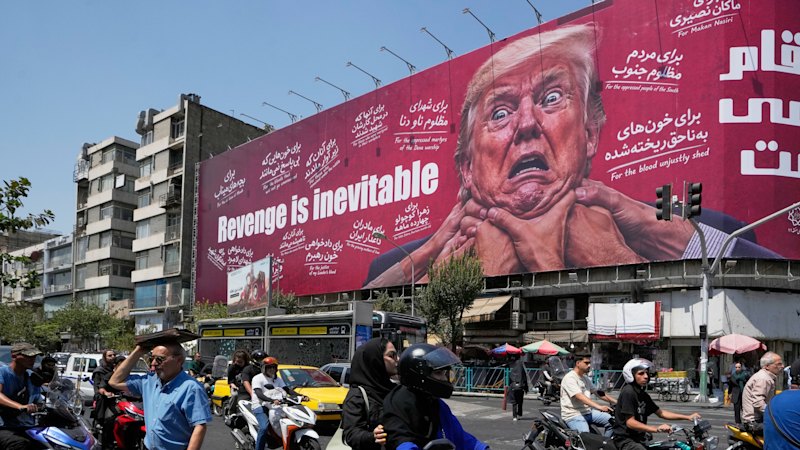
In early March, nine days after starting his war with Iran, President Donald Trump held a news conference to crow about his “military success, the likes of which people haven’t seen”.
“We’re winning very decisively,” he claimed, and “the result will be lower oil prices”.
Instead, Trump’s Iran war should be taught for decades as a model of how not to conduct either war or foreign policy. It’s an example of how hubris can swamp a presidency and lead it to military solutions for difficult global problems – and, in the process, make everything worse.
“The unsettling reality is that the conflict is nowhere near over,” Ali Vaez of the International Crisis Group writes in a Foreign Affairs essay titled The New Forever War.
Still, the Trumpian myopia persists, with the administration continuing to claim that its pressure on Iran is a smashing success. “The blockade is working; it’s working like nothing we’ve ever seen,” Treasury Secretary Scott Bessent told Fox News in September.
Hmm. Diesel prices at a few places in California have hit $US9.99 ($14.40) a gallon, the maximum price those pumps can display. The United States has already spent more than $43 billion on the war, by a lowball Pentagon estimate. Higher prices caused by the war have cost the typical American family about $US1000, according to economist Mark Zandi. More broadly, the US has depleted its arsenal, cost American and Iranian lives, possibly committed war crimes, exposed American vulnerabilities, effectively lost access to some bases and weakened US military credibility as far away as East Asia.
Against that, the Trump administration believes it has the upper hand because of the economic pressure the blockade is creating for Iran.
Well, maybe. It’s true that the Iranian economy is a catastrophe and that ordinary Iranians – the people we are supposed to be helping – are suffering greatly. The exchange rate is now more than 2.5 million rials to the US dollar, one-tenth of the rial’s value in 2021.
Yet Washington doesn’t seem to understand that instead of surrendering, Iran may choose to escalate. “They’ve come to the conclusion that the only way they survive is to shoot their way out,” said Vali Nasr, an Iran expert at the Johns Hopkins School of Advanced International Studies. He suggested that Iran could increase attacks on shipping and, especially if it is attacked, strike oil infrastructure around the Persian Gulf.
I fear that Esfandyar Batmanghelidj, an Iran watcher at a British think tank, is right when he says: “Iran did not wage a scorched-earth campaign – but it may yet do so if the current situation persists for too long. That is what everyone who actually follows this region and its dynamics is worried about.”
It’s difficult to see a deal being reached, partly because both Trump and Iran have a history of overreaching. It doesn’t help that Trump’s chief negotiators, Jared Kushner and Steve Witkoff, are real estate investors chosen for their closeness to Trump rather than for, er, their diplomatic savvy.
Iranian leaders also seem cocky. Ahmad Vahidi, the commander in chief of Iran’s Revolutionary Guard, boasted in August that Iran had brought the US “to its knees.” Foreign Minister Abbas Araghchi told NBC’s Meet the Press that Iran was fully prepared for a new round of fighting, “even if it comes to a doomsday war”.
One rare issue on which I agree with Trump is the paramount importance of preventing Iran from acquiring nuclear weapons. In Trump’s speech to the United Nations – the one in which he mused about whether he should “annihilate the Islamic Republic and do it quickly” – he insisted that “Iran will never have a nuclear weapon”.
That’s easy to say. But Trump’s war may have actually increased the likelihood of Iran’s making a drive towards a nuclear weapon.
Trump’s war began by killing the previous supreme leader, who had issued a fatwa saying that Iran would not develop nuclear weapons. The new supreme leader, his son, does not inherit that fatwa and has not issued his own, so now “there’s a serious conversation in Iran” about pursuing nuclear weapons, Nasr said.
A new measure before the Iranian parliament proposes withdrawing from the Nuclear Nonproliferation Treaty, and 32 Iranian figures have called on the country to do so. That would be a cataclysm.
“Any other country but Iran would have pulled out of the NPT if treated the same way,” Araghchi told reporters.
We should take these warnings seriously.
One reason professors will teach Trump’s war as an example of military malpractice is that it fits neatly into a larger pattern of counterproductive American policies towards Iran. I deplore the brutality, corruption and economic incompetence of Iran’s rulers – so it’s infuriating that America has repeatedly empowered Iranian extremists.
First, the US helped topple a democratically elected prime minister in 1953, energising nationalists and souring Iranians on the West. Then in the 1960s and ’70s, the US gave Iran a nuclear reactor, backed an increasingly autocratic shah and overstepped in ways that helped allow Ayatollah Ruhollah Khomeini to become a national force by denouncing American imperialism.
President George W. Bush’s 2003 Iraq War toppled Saddam Hussein, an enemy of Iran, and empowered Shiite militias that support Iran. In 2018, Trump announced his withdrawal from the Obama nuclear pact with Iran. The capstone in this “march of folly,” to borrow a phrase from historian Barbara Tuchman, was Trump’s war on Iran this year, which has bolstered military hard-liners in Tehran and enabled them to project greater power over the Persian Gulf and global oil markets.
That’s what I find particularly worth studying: How is it that for three-quarters of a century, Americans have so bungled our foreign policy that we have systematically empowered Iranian extremists? They call us the “Great Satan,” but in truth our ineptitude has made us their benefactors.
This article originally appeared in The New York Times.
The Opinion newsletter is a weekly wrap of views that will challenge, champion and inform your own. Sign up here.
KioskNews shows a cleaned-up reading view extracted from the publisher’s page — the original always lives on their site, not ours.