Cynthia Yacowar: Anti-Israel rallies on October 7 may be legal. They are also morally intolerable
October 7 marks the third anniversary of the deadliest massacre of Jews since the Holocaust. Yet across Canada and around the world, anti-Israel rallies and events are once again being planned for that very day.
Sign In or Create an Account
In Toronto, several anti-Israel student groups planned an October 7 event at the University of Toronto under the banner “Honouring Our Martyrs” — on the anniversary of the Hamas-led attack in which approximately 1,200 people, mostly Israelis, were brutally slaughtered and 251 were taken hostage. The university subsequently announced that the event could not proceed as planned, citing “significant safety and operational concerns” — not illegality.
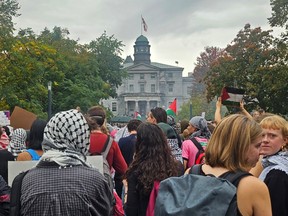
In Montreal, at least two anti-Israel rallies remain planned. An afternoon student rally beginning at McGill’s Roddick Gates is promoted by student groups representing five Montreal colleges and universities, including Students for Palestine’s Honour and Resistance (SPHR). SPHR McGill recently supported a successful undergraduate motion calling on the Students’ Society of McGill University to push McGill to end its exchange program with the Hebrew University of Jerusalem, celebrating the vote in an Instagram post declaring, “Long live the student intifada.”

Columnist Jesse Kline keeps you up to date with what’s happening in Israel and the effects of antisemitism on life here in Canada. Friday mornings.
By signing up you consent to receive the above newsletter from Postmedia Network Inc.
A welcome email is on its way. If you don't see it, please check your junk folder.
The next issue of Channel Israel will soon be in your inbox.
We encountered an issue signing you up. Please try again
A second rally, scheduled for the evening on Sherbrooke Street West, is organized by Montreal4Palestine, a group that describes itself on X as fighting for the “total liberation of Palestine.”
There is something profoundly disturbing about holding such rallies on the anniversary of a massacre — a day on which families remember loved ones who were brutally slaughtered, raped, burned alive and taken hostage. The language surrounding these events compounds the obscenity: in Toronto, “Honouring Our Martyrs”; in Montreal, masked, keffiyeh-clad figures beneath the words “Respect Existence or Expect Resistance.”
Invoking “martyrs” and “resistance” on October 7 appears to glorify the barbaric violence that the families of those murdered and taken hostage that day are mourning. Orwell couldn’t have scripted the irony better.
But what is morally reprehensible is not necessarily against the law. So where does the law draw the line?

Freedom of expression may protect speech that many of us find deeply offensive. But Canadian law does have limits. Publicly inciting hatred against an identifiable group, where that incitement is likely to lead to a breach of the peace, can constitute a criminal offence.
And the question of when antisemitic rhetoric crosses that line is hardly theoretical at a time when Jewish institutions, synagogues and Jewish people themselves have been targets of threats, vandalism and violence.
The criminal threshold is necessarily high. Not everything hateful, inflammatory or morally repugnant will meet it. Nor should criminal law become the arbiter of every offensive idea.
But the fact that the state cannot — or should not — prohibit something does not require our institutions or political leaders to remain morally neutral about it. Condemnation is not censorship, and tolerance under the law need not mean acceptance by society.
Where laws are broken, they must be enforced. But where conduct remains lawful, where are the voices of our political leaders willing to condemn what the law cannot prohibit? When demonstrations cross the line into intimidation, obstruction or unlawful conduct, authorities should act. And when they do not cross that line, our leaders can still draw a moral one.
That responsibility becomes even more urgent against the backdrop of attacks and threats directed at Jewish institutions and individuals. Tolerance of escalating behaviour does not occur in a vacuum. What authorities repeatedly permit can eventually come to be regarded as permissible.
And if rallies held on October 7 glorify or celebrate the atrocities of that day without crossing the criminal threshold, that does not make them morally defensible.
No society can sustain itself by law alone. There is a vast territory between what is criminal and what is morally acceptable. When a society begins to treat everything that is technically lawful as therefore tolerable, something fundamental begins to erode.
The law establishes the minimum standard of conduct a society is prepared to enforce; it was never meant to define the limits of our conscience.
A functioning society depends just as much on the norms and moral judgment that exist beyond the reach of the law. Maintaining those boundaries requires our institutions, universities, political leaders and ordinary citizens to be willing to say that some things may fall short of criminality and still deserve unequivocal condemnation.
When we become afraid even to make that distinction, we don’t become more tolerant. We become morally indifferent.
And perhaps that is the greater danger: not simply that hatred becomes louder, but that society gradually becomes accustomed to it. What once would have shocked the conscience becomes normalized, then excused and eventually defended as merely another form of expression.
A society loses its moral bearings not all at once, but one boundary at a time.
If we as Canadians cannot find the courage to draw those moral lines now, we risk surrendering the very values and principles that hold a free and civilized society together.
October 7 should be a day that tests our conscience, not the limits of our tolerance. By the time we recognize what we have lost, it may be too late to reclaim it.
National Post
Cynthia Yacowar is a Montreal-based writer and artist with a background in philosophy of law who has written on anti-Israel media bias and Middle Eastern affairs since 2000.
Join the Conversation
This website uses cookies to personalize your content (including ads), and allows us to analyze our traffic. Read more about cookies here. By continuing to use our site, you agree to our Terms of Use and Privacy Policy.
KioskNews shows a cleaned-up reading view extracted from the publisher’s page — the original always lives on their site, not ours.