Indigenous township initiative completes first home
By Lo Hsin-chen and Sam Garcia / Staff reporter, with staff writer


The first home built under a township initiative to develop housing on indigenous land was recently completed in Pingtung County’s Sandimen Township (三地門), after land scarcity left some residents unable to build their own homes for decades.
Valjulu Village (馬兒) was relocated to its current site in Sandimen about 60 years ago, the Sandimen Township Office said on Sunday.
As the village’s population grew, some residents were left without legally designated land on which to build homes, it said.
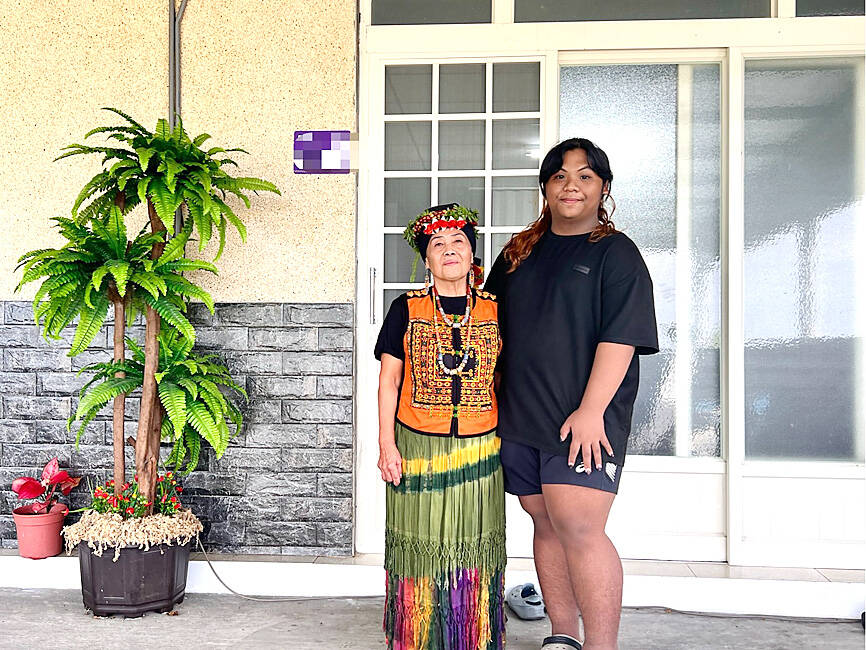
Valjulu Village resident Chen Chu-hsiang, left, and her grandchild pose in front of their new home in Pingtung County’s Sandimen Township on Sunday.
Photo: Lo Hsin-chen, Taipei Times
The office launched a unified planning initiative for residential development, and after 20 years of coordination, secured residential land rights for 17 households in 2019, followed by another five last year, it said.
The project covers more than 3,000m2, with each household allocated about 165m2, it added.
Chen Chu-hsiang (陳主香), 63, was the first to complete their home, finishing construction this year.
Three indigenous communities in Pingtung and Taitung counties are implementing residential planning programs, with Chen’s home the first nationwide completed under such a program.
The village held a ceremony to commemorate the home’s completion, with Sandimen Township Mayor Tseng Yu-chin (曾有欽) attending to congratulate the family.
The home is an important step in safeguarding indigenous people’s housing rights and a milestone in indigenous land policy, Tseng said.
Chen said she left Valjulu Village in her 20s to work in Pingtung City and rented accommodation. She had never owned a home.
After securing the right to a residential plot through the township’s initiative, she spent five years and about NT$3 million (US$91,283) to build a single-story house with two bedrooms, a living room and a kitchen, Chen said.
“I am so happy. It gives me a sense of security,” she said, adding that she finally fulfilled her dream of having her own home and settling down.
Chen lives in her new home with her daughter and grandson.
Her grandson said he used to live with his grandmother in Pingtung City and stayed with his aunt whenever they went back to the village on weekends.
Now he finally has a room of his own and commutes from the village to Pingpei Senior High School, which is more convenient, he said, thanking his grandmother.
Under the unified residential development initiative, residents can build homes on designated lots without owning the land. The land-use rights can be inherited, but not bought or sold.
However, the cost of building a home remains a challenge. Of the 22 that have secured land-use rights, only two other households besides Chen have begun construction, the office said.
KioskNews shows a cleaned-up reading view extracted from the publisher’s page — the original always lives on their site, not ours.