India wants the world’s pension billions. Will regulatory hurdles slow the bet?
Raghupati Mishra, a Mumbai-based management and financial consultant, is thrilled that the six-lane Shree Jagannath Expressway – backed and operated by a major Canadian pension fund between the Odisha state capital, Bhubaneswar, and Chandikhole – has smoothed his regular journeys onwards to the Jagannath Temple in Puri, one of Hinduism’s holiest shrines, where he goes to pray.
“It takes no more than an hour to travel because of the good road,” he said, adding that his journey time had halved.
The 67km (42-mile) highway, which feeds traffic onto the route branching south to Puri, is also helping decongest Bhubaneswar’s crowded streets, while factories, educational institutions and residential flats are springing up alongside it, according to Mishra. “All kinds of activity have increased,” he added.

The project reflects the growing role of Canadian pension money in India’s infrastructure development, as New Delhi seeks to attract more long-term foreign investment to fuel its economic ambitions.
But despite India’s strong growth prospects, analysts warn that regulatory hurdles and uncertainty over returns could complicate efforts to draw more of the world’s retirement savings into the country.
Direct and indirect Canadian investment in India – anchored by the country’s largest public pension managers, known as the “Maple Eight” – has surpassed C$100 billion (US$70 billion). The Indian government estimates that these funds directly hold net assets worth between US$30 billion and US$35 billion in the country.
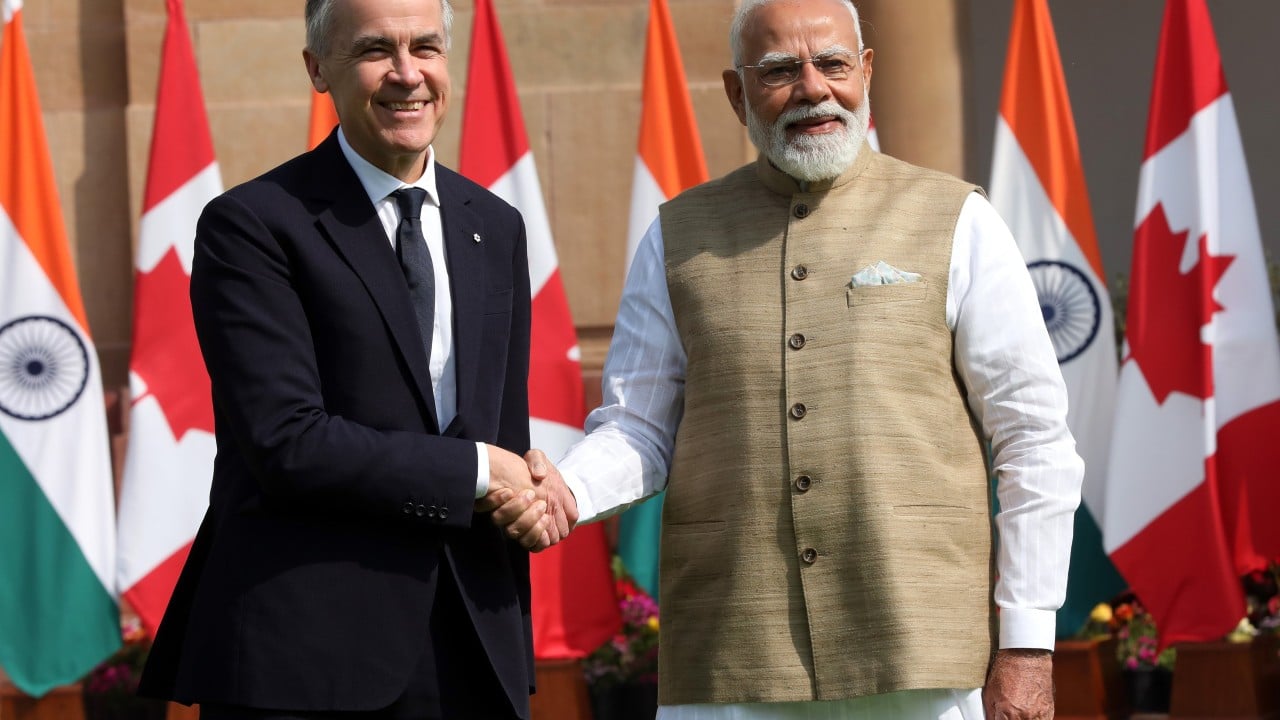
Expanding Canadian institutional investment in India is expected to be high on the agenda when Indian Prime Minister Narendra Modi visits the North American nation in December, according to industry sources. Delhi is also courting pension funds from other countries, including Australia and South Korea, according to reports.
India is seeking overseas pension money to secure long-term, patient capital for key economic priorities – particularly infrastructure, manufacturing, urban development and climate projects – while deepening its domestic bond and equity markets.
Mishra, whose firm advises on management and finance, said he was optimistic that Delhi’s recent moves to ease regulations for overseas pension funds would draw more capital into infrastructure projects similar to the Shree Jagannath Expressway.
The push to deepen foreign pension funds’ participation aims to diversify funding sources, attract more stable capital inflows and support the Indian rupee against the US dollar.
Earlier this year, the rupee hit repeated record lows between January and May, before rebounding to a seven-month high of around 93 rupees to the US dollar as of Friday.
India’s capital markets regulator, the Securities and Exchange Board of India (Sebi), has rolled out several measures favouring overseas pension funds as part of a broader push to ease foreign portfolio investor compliance.
Under the streamlined rules, low-risk investors such as sovereign wealth funds and pension funds need to submit documentation only once every 10 years, compared with the previous requirement of every three years. They are also exempt from disclosing end-investor details required of other foreign portfolio investors, such as private funds and family offices.

“I expect overseas pension money into India to keep rising over the next four to five years because India offers something few emerging markets can: large, long-dated infrastructure and private-market assets at scale,” said Prateek Mittal, director at FinVal Research & Consultancy.
Industry participants say foreign pension funds are drawn to India’s rapid economic growth, large and youthful population and long-term infrastructure demand – factors that, alongside market reforms, are widening access for global investors.
India reported year-on-year gross domestic product growth of 7.8 per cent in the first quarter of the financial year that began on April 1, according to government data, maintaining its position as the world’s fastest-growing major economy amid a volatile geopolitical backdrop, including the ongoing US-Iran war.
Mittal said foreign pension funds were likely to favour co-investing alongside established Indian platforms rather than writing smaller stand-alone cheques. Industry executives added that this approach helped split risk and navigate India’s regulatory landscape.
Eye on long-term growth
Ranjith Narayanasamy, managing director and vice-chairman at Canada-based MAX Power Mining Corp in Saskatchewan, said investing retirement savings in India made sense given expectations that the economy would expand by 7 to 9 per cent annually.
He added that India’s membership in major international groupings such as the G20 and Brics reinforced its appeal as a stable investment destination.
A large Indian diaspora in developed nations such as Canada also means many retirees feel a personal connection to seeing their savings channelled into Indian infrastructure and development projects.
“Global pension funds do not just look for growth. They look for predictability.”
“India is increasingly becoming a market where global investors can participate in long-term structural growth, rather than simply pursue short-term returns,” said Rishi Kumar, founder of EdifyEdu, an India-based education technology platform.
However, the biggest challenge lay in translating investment interest into projects that deliver predictable returns, Kumar said, pointing to regulatory complexity, project delays, varying state-level policies and uncertainty over exit mechanisms.
“Global pension funds do not just look for growth. They look for predictability. India’s ability to provide consistent rules, timely approvals and reliable exit routes will determine how much capital it can attract,” he said.
Pranav Haldea, managing director of market data firm Prime Database, stressed that India would need to consistently carry out market reforms – ranging from regulatory predictability to ease of doing business – to win over pension managers.
“This is important for any long-term investor looking at India,” he said, noting that pension funds by nature stay invested for years. “Also, like other global funds, they too have the choice to invest anywhere in the world. India must remain relatively attractive.”
KioskNews shows a cleaned-up reading view extracted from the publisher’s page — the original always lives on their site, not ours.