RTX beats estimates as aerospace, defense demand drives growth
RTX (RTX) reported better-than-expected third-quarter earnings and revenue Tuesday as demand for commercial aerospace equipment and defense systems helped the company raise its full-year financial outlook.
Shares of RTX (RTX) rose 2% in premarket trading Tuesday. The stock had gained 4.8% for the year through Monday's closing price, compared with a 12% advance for the S&P 500 index.
The Arlington, Virginia-based aerospace and defense contractor reported third-quarter revenue of $24.97 billion, up 11% from $22.48 billion a year earlier. Revenue exceeded Wall Street's consensus estimate of approximately $24.11 billion by $860 million. Organic sales increased 12%.
Adjusted earnings rose 33% to $2.26 a share from $1.70 a year earlier, beating analysts' consensus estimate of $1.78 a share by 48 cents. The latest results included a 25-cent-a-share benefit from cost recoveries associated with the International Emergency Economic Powers Act, or IEEPA.
Net income rose to $2.58 billion, or $1.89 a share, from $1.92 billion, or $1.41 a share, a year earlier.
The results highlight how RTX (RTX), whose businesses include Pratt & Whitney aircraft engines, Collins Aerospace systems and Raytheon missile defense products, is benefiting from rising commercial aircraft production and increased military spending.
For investors, the company's $340 billion order backlog provides visibility into future revenue, while higher aftermarket demand supports profitability. However, the contribution from tariff-related recoveries and a sharp decline in quarterly free cash flow complicate the underlying earnings picture.
Commercial aerospace and defense sales
"Our strong execution and operational focus in the third quarter enabled RTX to deliver double-digit organic sales growth* across commercial aerospace and defense," Chairman and Chief Executive Chris Calio said in the earnings announcement.
The company's backlog reached $340 billion, including $176 billion in commercial aerospace orders and $164 billion in defense contracts. RTX (RTX) reported more than $81 billion in new commercial and defense awards.
Collins Aerospace reported third-quarter sales of $8.38 billion, up 10% from $7.62 billion a year earlier. Organic sales increased 12%, supported by a 23% increase in commercial original equipment sales and 9% growth in the commercial aftermarket business.
Adjusted operating profit at Collins Aerospace jumped 50% to $1.79 billion, reflecting higher commercial volumes, a favorable sales mix and approximately $250 million in IEEPA cost recoveries. Its adjusted operating margin expanded to 21.3% from 15.7%.
Pratt & Whitney reported revenue of $9.23 billion, up 10% from $8.42 billion a year earlier. Commercial aftermarket sales increased 21%, driven primarily by higher maintenance volumes for its Geared Turbofan engines. Commercial original equipment sales declined 5%.
Adjusted operating profit at Pratt & Whitney increased 29% to $968 million, including approximately $160 million in IEEPA recoveries. However, reported operating profit fell 19% to $608 million, reflecting a $363 million charge related to a customer bankruptcy.
Raytheon benefits from missile defense demand
Raytheon, the company's defense business, reported third-quarter sales of $8.03 billion, up 14% from $7.05 billion a year earlier.
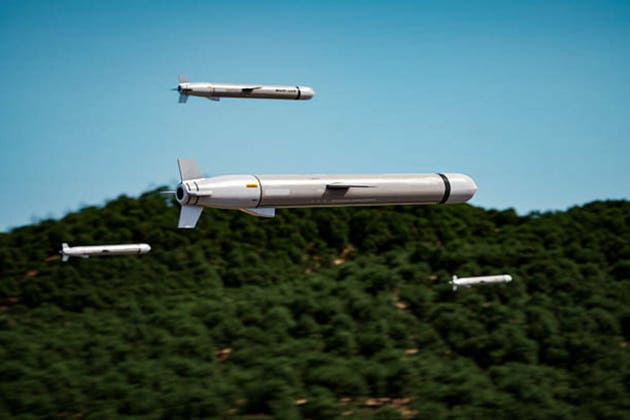
Growth was driven by higher production volumes across naval programs and air defense systems, including Patriot missile defense equipment, Standard Missiles and Tomahawk cruise missiles.
Adjusted operating profit increased 32% to $1.13 billion, while the segment's operating margin expanded to 14.1% from 12.2%.
The company also secured multiyear production contracts for Tomahawk cruise missiles and Advanced Medium-Range Air-to-Air Missiles, known as AMRAAM, during the quarter. The contracts have not yet been finalized.
Improved productivity, higher production volumes and a favorable sales mix contributed to the defense segment's earnings growth. Results also included approximately $85 million in benefits related to an international contract modification and an adjustment to an offset obligation.
RTX raises full-year earnings and sales guidance
RTX (RTX) raised its 2026 adjusted earnings forecast to $7.65 to $7.75 a share, compared with its previous outlook of $7.10 to $7.25. The revised range is above Wall Street's consensus estimate of $7.25 a share.
The company also increased its adjusted sales forecast to $97 billion to $97.5 billion, up from its previous projection of $95 billion to $96 billion. The new outlook exceeds analysts' consensus estimate of $96.2 billion.
Management now expects organic sales growth of 10% to 11%, compared with its previous forecast of 8% to 9%.
RTX (RTX) also raised its full-year free cash flow outlook to $9 billion to $9.2 billion from $8.5 billion to $8.75 billion.
The higher guidance reflects stronger sales across all three business segments and improved operating performance, although the contribution from IEEPA recoveries remains a factor in assessing the sustainability of earnings growth.
Quarterly cash flow declines
Despite the increase in revenue and profitability, RTX (RTX) reported a 47% decline in third-quarter free cash flow to $2.12 billion from $4.03 billion a year earlier.
Cash from operating activities fell 38% to $2.87 billion from $4.64 billion, even with approximately $300 million in IEEPA recoveries.
Capital expenditures increased to $749 million from $614 million, reflecting continued investment in the company's operations.
For the first nine months of 2026, however, free cash flow increased to $6.31 billion from $4.75 billion a year earlier. Operating cash flow rose to $8.27 billion from $6.4 billion.
The divergence between quarterly earnings growth and cash generation highlights an important issue for investors. RTX (RTX) is expanding production to meet commercial aerospace and defense demand, but converting its growing backlog into cash will depend on manufacturing efficiency, working capital management and the timing of customer payments.
With its full-year outlook raised and demand remaining strong, the company's ability to sustain profit growth beyond temporary cost recoveries will be a key measure of its operating performance.
KioskNews shows a cleaned-up reading view extracted from the publisher’s page — the original always lives on their site, not ours.