‘Can’t be inaccurate’: how 2 tiny robot arms could halve digestive cancer surgery time
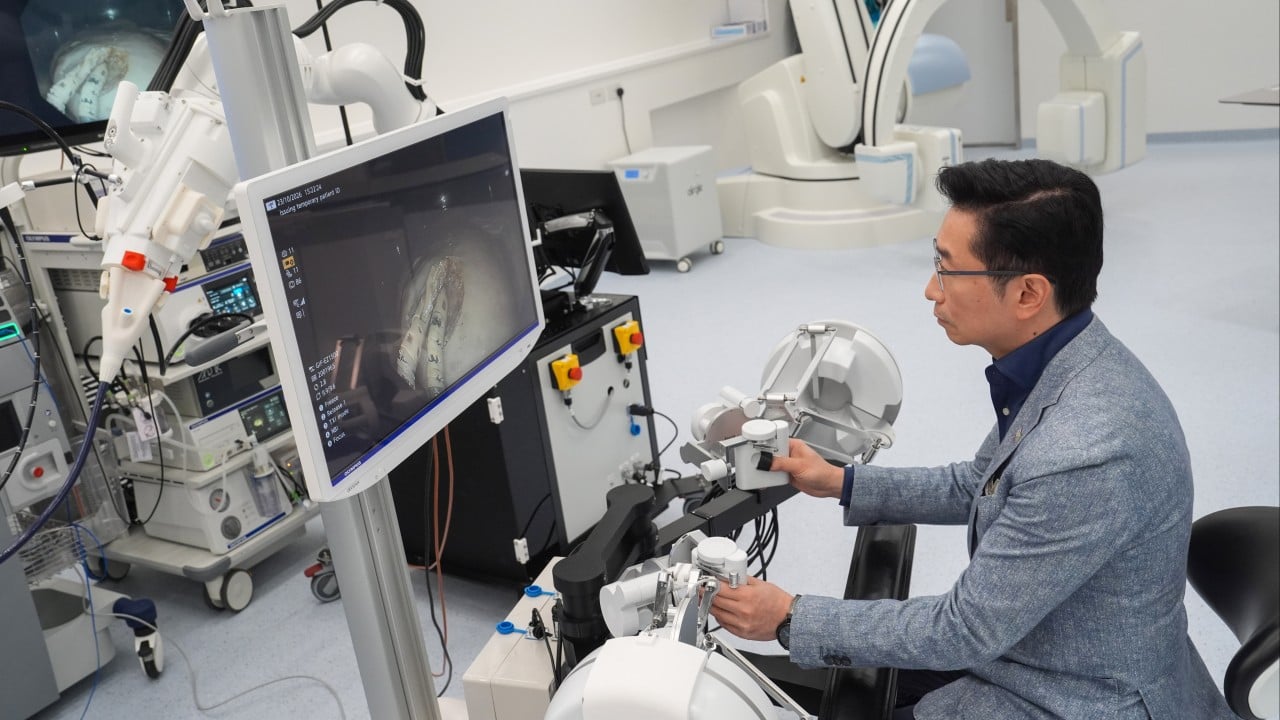
In the final instalment of a four-part Health Matters wellness series on frontier medicine in Hong Kong, Elizabeth Cheung examines a dual-arm surgical robot that could remove gastrointestinal tumours in about half the usual time, and the hurdles between its first human trials and wider patient access.
Ho Man-wai underwent a colonoscopy in late August, during which doctors identified three polyps that needed to be removed before they could develop into cancer.
Two were removed during the initial examination, but the third was more deeply rooted and required a more complex procedure.
Ho, a 52-year-old property management worker, returned to hospital in September for an endoscopic submucosal dissection (ESD), a technique used to remove larger or more difficult polyps through an endoscope.
His polyp was relatively small, so the procedure took about an hour and Ho was discharged the following day.
But removing a polyp or a lesion measuring 3cm (1.2 inches) to 4cm can take up to two hours, according to Professor Philip Chiu Wai-yan, dean of medicine at the Chinese University of Hong Kong (CUHK), who performed Ho’s procedure.
A new surgical device, developed under Chiu’s leadership, could cut the operating time for lesions of a similar size by half, to an average of 49 minutes.
Chiu, an internationally renowned surgeon, performed the world’s first robotic ESD in the stomach in 2011 and the world’s first such procedure in the colorectum in 2020.
CUHK team demonstrates new EndoR Surgical System
The new device, known as the EndoR Surgical System, is designed to carry out the procedure more quickly and safely. It primarily targets patients with early-stage gastrointestinal cancers, or those with polyps that are difficult to remove.
The system consists of a long, thin tube that enters the body through a natural orifice, such as the anus or mouth, and performs surgery inside the gastrointestinal tract without making any incisions.
At present, it is the world’s only surgical robotic system equipped with two arms that can work throughout the entire gastrointestinal tract, and it has entered clinical trials.
Other surgical robots that enter through the body’s natural openings may not be able to reach some parts of the gastrointestinal system.
Chiu said the system’s robotic arms were what set it apart.
“The EndoR has two robot arms and they are really small,” Chiu said. “They have to perform this dissection with one arm for traction, the other arm is for dissection.”
The two arms, fitted with knife tips measuring just 1.5mm to 2mm, are housed inside the long, thin tube that also contains an endoscopic camera. The device enters the body and navigates the tortuous pathways of the gastrointestinal tract, sometimes travelling 70cm to 80cm from the entry point to reach the lesion.
The surgeon controls the robotic arms using two hand controls at a console.
Chiu said such precise, delicate arms were necessary because early-stage tumours were usually located in the mucosa, the innermost layer of the gastrointestinal tract.
To remove a tumour thoroughly, doctors must cut through the layer beneath it, known as the submucosa.
The procedure allowed doctors to remove cancerous cells while preserving the patient’s organ, helping to maintain their quality of life, Chiu said.
ESD was first developed in Japan in the late 1990s, but the procedure can be lengthy because the endoscopic camera and knife are attached to the same instrument in the earlier generation of devices.
“It’s like attaching the knife to the forehead [for the surgery], it’s very difficult,” Chiu said, describing the movement as using a small knife to slowly peel off the tissue. “When we are doing this only with the endoscope, it moves on a millimetre scale.”
With the new device’s two robotic arms, however, surgeons have greater flexibility and can move more freely during dissection.
“Because it can continuously move over here, the speed of the procedure is faster,” he said.
The robot’s design also gives surgeons a better view inside the body and allows them to stop bleeding quickly, as the knife can also stop the condition. Under the conventional approach, doctors may need to withdraw the original instrument and insert another to control bleeding.
The system, which received support from the government funding scheme RAISe+ last year, has just begun human clinical trials. It was first tested on a patient in September at Prince of Wales Hospital, the university’s teaching hospital.
The team is testing the device on patients with colorectal cancer, which has a higher incidence rate than other gastrointestinal cancers because of the city’s screening programme. The programme began as a pilot in 2016 and became a regular programme two years later.
Colorectal cancer is the third most common cancer in Hong Kong. In 2023, more than 5,400 people were diagnosed with the disease, and more than 2,200 died from it.
The team now aims to recruit six to eight patients with early-stage colorectal cancer for the trial. It hopes to test the device on patients with upper gastrointestinal cancers, such as stomach and oesophageal cancer, after making the system smaller.
“If we can downsize [the system] enough, then we can also use it in the upper gastrointestinal system,” Chiu said. “If we want to be safe, we don’t want a big system to put in the oesophagus and cause perforation.”
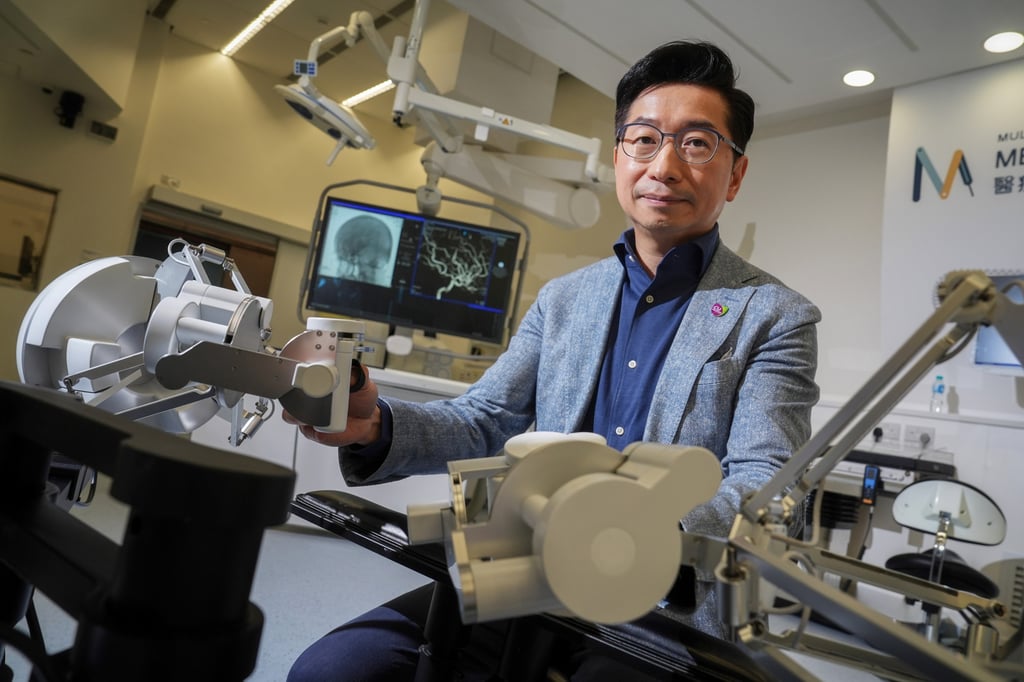
With trials under way, the team aims to seek regulatory approvals from the National Medical Products Administration in mainland China. Chiu said it was also considering clinical trials in mainland cities such as Beijing, Shanghai, Shenzhen or Guangzhou.
He expects the device can be approved by the Chinese regulator within three years. It has been under development for five years at the university’s Multi-scale Medical Robotics Centre, where Chiu is a director.
In the long run, he also hopes to bring the technology to markets in the United States and Europe.
EndoR is the result of collaboration between medicine and engineering – a partnership that began with a conversation on a tennis court 12 years ago.
Chiu was the first person to introduce ESD in Hong Kong after learning the technique in Japan in 2004.
“So in 2010, I already did hundreds of cases. But then I thought that this was a difficult technology,” he said.
He later came across a Singapore-based company specialising in flexible robotics, and the two teamed up to develop an earlier generation of robotic technology for ESD.
As Chiu wanted to build stronger collaboration between clinicians and engineers at CUHK, he struck up a partnership with Professor Yam Yeung of the department of mechanical and automation engineering during a tennis competition at the university in 2014.
Chiu, then affiliated with Wu Yee Sun College, and Yam, from Lee Woo Sing College, joined the same tennis team, as both colleges were relatively new at the university.
“While we were playing tennis, I knew that he was an engineer. I said I was working with a Singaporean engineer, but it was difficult and we didn’t have this collaboration [in CUHK],” Chiu recalled.
“And then he said, OK let’s collaborate together, on the tennis court.”
That conversation sparked a decade-long partnership between the two experts on the surgical device.
The EndoR prototype was built in 2017, and the team spent years refining it before beginning patient trials.
“It’s a long time because it’s technically very challenging,” Chiu admitted.
The biggest challenge, he said, was navigating the device precisely inside the human body.
“How you can precisely control your flexible robot arms when they pass into the long curvature track inside the gastrointestinal tract lumen and still perform the same procedure. That is the most challenging,” he said.
“When you have a curvature, you have resistance, you have friction, you have a difference in control, you’re not so precise.
“After passing through the whole curvature, how can you still be accurate in control?”
But there is no room for error when cutting inside the body.
“You can’t be inaccurate in cutting something inside, right? That is one of the most difficult and challenging points,” he said.
Chiu, a surgeon with a well-known love of fictional piloted robots, said that interest had helped fuel his work.
“I’m not too much against complex robotics, because I have a good impression of the robot,” he said. “I think that the potential of having some machinery to work in the human body … may be also this is the time because we currently have all this manufacturing technology.”
Although Chiu has been a doctor for more than 30 years, he believes this is the best time for medical technology research and development, given government support, strong universities, investment opportunities and the Greater Bay Area’s large patient pool, which can help speed up clinical trials.
The Greater Bay Area is a development initiative linking Hong Kong, Macau and nine cities in Guangdong province into an innovation and business hub with a combined population of more than 88 million.
As the device still requires manual control by doctors, Chiu did not rule out the possibility that it could one day be operated autonomously, even though it does not yet incorporate artificial intelligence.
“We never exclude this possibility because of the development of AI,” he said.
“Definitely, AI can be one of the development areas for this system, after it has full-blown development so that we can add AI to help the procedure and make it safe.”
KioskNews shows a cleaned-up reading view extracted from the publisher’s page — the original always lives on their site, not ours.