Reliving the drama: England and Argentina stars watch 1986 classic with fresh eyes
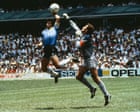
“Is there anything new to say about it?” Gary Lineker asked the producer Flora Fernandez-Marengo when she first approached him to take part in The Match, a documentary about the 1986 World Cup quarter-final between England and Argentina. Flora told an audience at the London film festival premiere of the film that she played her best card then and showed Lineker an image of Maradona with Queen in 1981, during the band’s tour of Argentina. Maradona wearing a union jack T-shirt and Freddie Mercury an Argentina strip. It worked. Lineker said yes.
The rock’n’roll angle, with Brian May as a talking head, is one of the very few details the film-makers added to Andrés Burgo’s book, The Match, on which the documentary is based. The directors Juan Cabral and Santiago Franco play with the timeline, hopping between past and present across 91 minutes, the exact duration of the match itself. Anecdotes that now form part of Argentina’s football folklore are spliced with excellent archive material.
“There are two types of humans,” Jorge Valdano narrates, “Carlos Bilardo and everyone else.” Ricardo “El Gringo” Giusti recounts how he buried a sweet in the pitch before kick-off of every game, just one of the many cábalas the Argentina squad religiously followed under pressure from their obsessive manager. On the eve of the match with England, the players requested lighter shirts as the official ones were too heavy when drenched in sweat. Footage of women working at the squad hotel hand-stitching the numbers on to light T-shirts bought locally, shot by the players themselves with a handheld camera, conveys an intimacy in stark contrast to grainy archive material depicting British explorers in the South Atlantic.
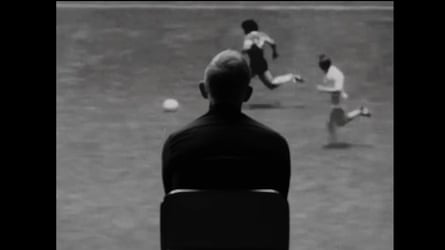
Rather than run-of-the-mill talking head-style interviews with members of both teams, the interviewees are shot in monochrome, widescreen closeups, “like Roman statues”, as Cabral told the Guardian. Like monuments to themselves, the camera lingers on their eyes. What are they watching? We don’t know if they see what we see, if they are reliving the match, or seeing a cut of the actual film.
The documentary pivots around Diego Maradona’s two goals. I have long ceased to think of them as two separate goals. They are a single event, a handful of minutes when everything that is possible in football happened before our very eyes: the ugly, rule-breaking handball followed by the spectacular, beautiful gambeta. The film cleverly uses a sequence of stills taken by the Mexican photographer Alejandro Ojeda Carbajal to prove the handball, with a tongue-in-cheek nod to the paradox that they have been credited and licensed through the Englishman Bob Thomas ever since.
after newsletter promotion
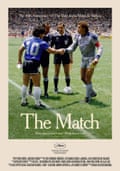
Films about football are hard to get right because football is a narrative form in itself. This one comes pretty close to being as good as it gets. Slick and elegant, if at times a little too glossy, The Match is an excellent piece of work filled with beautiful images, such as the crisp vintage radio illustrating soldiers listening to the game in the trenches. There are also newsreels of Margaret Thatcher and Argentinian generals at the height of the Falklands/Malvinas conflict; a score that includes Queen and giants of Argentinian rock such as Charly García. Nostalgia, history, and the backdrop of the war, handled with respect and sensitivity.
The perversity of Argentina’s military is reflected in images of an emaciated soldier spliced to the voice of a general who dismisses claims the troops were cold and starving: “They probably eat better than they did at home.” Lou Armour, a British veteran, explains he couldn’t see young Argentinians as the enemy. “We both suffered a tragedy,” Cabral says. “I’m interested in the human duality in which we go from killing each other to hugging each other.” Cabral asks when a match starts and when it ends, and also when a conflict does so.
Valdano reads Juan López y John Ward, a Jorge Luis Borges poem about the war, in Spanish. Lineker, sitting by his side, utters “very moving”, also in Spanish. English and Spanish coexist throughout the film, including in the scene showing a table football game in which John Barnes and Peter Shilton take on against Giusti, Óscar Ruggeri and Jorge Burruchaga. Burruchaga, the scorer of the winning goal in the 1986 World Cup final, cheers his opponent: “Vamos, Peter!”
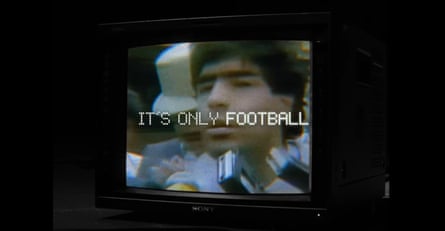
An audience containing young people reacted to the documentary with a standing ovation at the London screening, where Shilton was the only cast member present. In Buenos Aires, the release of the documentary, which coincided with this summer’s World Cup, saw cinemas packed with young people. For a generation in England and Argentina who never saw the 1986 classic, almost everything in The Match is new.
KioskNews shows a cleaned-up reading view extracted from the publisher’s page — the original always lives on their site, not ours.