I hoped my children would have epiphanies while visiting my homeland; my father suggested we go swimming instead
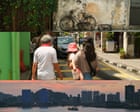
As I stepped out of Penang international airport, the humidity hit me like I was peering into a just-opened rice cooker. The air carried whiffs of exhaust fumes, fried food and something earthy. It felt thrilling and familiar because I was born in Penang and lived there for six years before I moved to Australia. I looked back at my three children who were visiting for the first time. They were draped over their suitcases like wilted lettuce. “Welcome to Penang,” I said, wiping sweat off my brow.
It was July 2026. It had been 13 years since I last visited Penang, when my father had hosted a lavish wedding dinner featuring a champagne fountain and swan-shaped ice sculpture for me and my new husband. For my white, Australian husband, it was a trip of firsts: his first Chinese tea ceremony; his first 10-course banquet; the first time he met my extended family. But for me, it had been the last time I’d spoken Mandarin and the last time I had seen my grandmother before she died.
As my parents grew older, I worried my Chinese heritage would be lost for ever. My children spoke only English and spent their Saturdays playing sport rather than attending Mandarin lessons and calligraphy classes like I had. When Gong Gong (maternal grandfather) spoke of his childhood, the children smiled indulgently but thought he was exaggerating when he said his only toy was a discarded bicycle tyre and he’d had to share one apple with his five siblings.
I wanted to bring my children to Penang to immerse them in the places of their grandparents’ stories. My father, who lives in Perth but travels there frequently, booked his flight the night I floated the idea to him.
On the first morning of our trip, my father met me, my husband and our children at our hotel in central George Town. He gazed at the gleaming marble floors and wood panelling of the Eastern & Oriental Hotel and said: “When I was young, I never dared to set foot in this hotel. Only rich Europeans stayed here.” Now we were the rich tourists – a fact that made me feel guilty and grateful – and to the man dressed in a khaki colonial outfit and safari helmet who held a door open for us, my toddler sang a cheery: “Thank you!”
We began our trip gently, letting the children luxuriate in an air-conditioned mall and paw through racks of fast fashion before we ventured outside to explore George Town on foot. “It’s not every day you get to walk through a Unesco world heritage site,” I chirped. But the heat was intense and the children’s interest in colonial architecture and street art evaporated in the afternoon sun.
In the evening, my father led our search for dinner through a labyrinth of alleyways, shepherding us off the road when cars and motorbikes rumbled through. At the first restaurant, there were no free seats and the air was sulfurously pungent from a nearby durian stall. In the second place, the smoke billowing from the satay grill triggered my daughter’s asthmatic cough. Finally, we found a place that dished up barbecued pork on springy egg noodles coated in a sticky soy sauce. We fell upon our food in a frenzy. Later, we walked back to the hotel along the esplanade, marvelling at the sunset that lit up the clouds like smears of mandarin sorbet across the sky.
Towards the end of our trip, we visited my father’s childhood home. We drove along a winding road that hugged the contours of the hills in the island’s north. On one side, verdant rainforest towered above; on the other side, past the guard rail, was a sharp drop, with dizzying glimpses of the houses in the valley below. When we reached Tanjung Bungah, the suburb where my father had lived, the children scowled from the backseat. My 10-year-old hissed: “When can we go shopping?” The toddler pleaded to return to the hotel’s infinity pool, which was fringed by palm trees and overlooked the Andaman Sea. Undeterred, my father stopped by a truck piled high with coconuts. A shirtless man used a machete to hack one open and stuck a plastic straw in it. My father handed it to my son, who spilled it on to his lap.
We continued down a narrow dirt road and stopped at a small weatherboard house with a red tin roof. The house was empty and neglected but my father still had a key. We squeezed past two bedrooms and shuffled to the kitchen at the back. The electrical wiring was exposed and the concrete floor was gouged with holes. There were no ceilings; sunlight filtered in through the holes in the roof. The toilet was outside. The entire house was smaller than our two hotel rooms. I pictured my father, who was one of six children, living there with his family.
“How did you fit all eight of you in this tiny house?” I asked.
“Fourteen,” he corrected me. “With my grandparents, three uncles and one aunty.”
“Woah,” my eldest daughter said, her eyes wide. Perhaps she was thinking of her bedroom at home, which was spacious enough for two bookcases and a double bass, and had a door that she slammed for privacy. The toddler began to cry and I picked her up, wondering if she finally understood the grim poverty that her Gong Gong had endured.
“I want to go back to the pool,” she sobbed.
My father ushered us back into the minivan and we drove back to the hotel. I thought he might be disappointed in the children’s behaviour but, instead, he urged me to take them for a swim. I realised that I’d expected too much of them; what child could resist leaping into cool water on a muggy day or lying on a sun lounger eating ice-cream? I stopped lecturing them about gratitude and privilege and we enjoyed our final days doing as Penang locals do: shopping and eating. On one occasion, when I ordered food in faltering Mandarin, my toddler stared at me with wonder and exclaimed: “Mum, you can speak Spanish!”
Our trip did not, as I had hoped, inspire epiphanies in the children about their heritage or their grandparents’ early struggles. Perhaps these will dawn on them as they grow up. For now, it was enough that they shared some experiences that featured in my earliest memories – they’d sweltered in tropical humidity and sat on red plastic stools, slurping noodles. And their Gong Gong had hugged them goodbye in a hotel lobby where he’d once believed he did not deserve to step foot.
KioskNews shows a cleaned-up reading view extracted from the publisher’s page — the original always lives on their site, not ours.