China's Liaoning aircraft carrier group in PH waters 'no cause for alarm' --AFP
Make this your preferred source to get more updates from this publisher on Google.
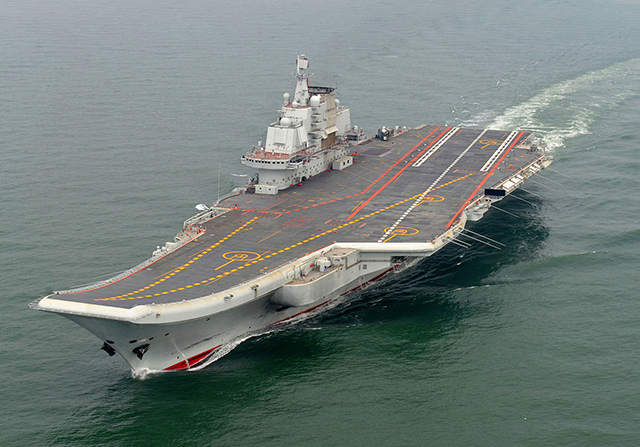
The passage of China's Liaoning aircraft carrier group through Philippine waters is “no cause for alarm,” the Armed Forces of the Philippines (AFP) said Tuesday.
At a press briefing, AFP spokesperson for the West Philippine Sea Rear Admiral Roy Vincent Trinidad said the movement was part of the Chinese People's Liberation Army Navy's (PLAN) periodic exercises.
“It is no cause for alarm. It is not the first time that a carrier battle group of the PLAN has transited international and Philippine waters,” Trinidad said.
“What happened recently is part of an annual, twice a year, periodic aircraft carrier operation exercise, training exercise, conducted by the PLA Navy,” he added.
The Liaoning last week followed a route along the country's western seaboard, coming within 15 nautical miles of the Philippine landmass before exiting southward, according to the AFP official.
He said the carrier group's usual route involves passing through the Bashi or Balintang Channel, proceeding along the eastern seaboard toward Australia, and returning through the Sibutu Passage and the West Philippine Sea.
“Every month we monitor approximately 16,000 different maritime merchant and naval assets passing through our waters,” he said.
“Of these approximately 16,000 all of them are challenged. Around 3,000 do not respond. The aircraft carrier Liaoning did not respond to our challenge. They are not the only ones who do not respond,” he added.
Asked whether the carrier group's passage constituted an incursion into Philippine waters, Trinidad cited the United Nations Convention on the Law of the Sea (UNCLOS), saying foreign vessels are allowed innocent passage through a coastal state's archipelagic waters.
A typical carrier strike group includes destroyers, air-defense destroyers, other surface vessels, replenishment ships, and is expected to have a submarine, according to Trinidad.
He said the AFP's Western Mindanao Command reported that the Liaoning exited southward. However, he could not immediately provide the exact date, time, and location of the carrier group's exit. — BM, GMA News
KioskNews shows a cleaned-up reading view extracted from the publisher’s page — the original always lives on their site, not ours.