Victoria’s 12-year Labor government is about to end. Could the new premier kick-start a wider Liberal Party redemption?
On Sunday, Victorians will wake up with a new government-elect. The complexion of that incoming administration is still not certain, but what is clear is that more than a decade of Labor rule over the state will be over.
We barely need public opinion polls to read the political temperature of Victorians in this election: the community’s fury towards the incumbent government radiates.
Labor is set to be trounced, suffering a more calamitous defeat than when it last ended a term of government in ignominy in 1992 and it was tarred in Liberal advertisements as the “Guilty Party”. On that occasion, led by Joan Kirner, Labor shed 19 seats as its primary vote tumbled by eight percentage points to 38.4%.
Fledging Labor Premier Ben Carroll would be hailed as a miracle worker if Labor escapes this election with that scale of loss. Instead, the party faces forfeiting up to 30 seats and a collapse of primary vote of more than 12 percentage points to the mid-20s or lower.
Indeed, the election result will give us a good measure of what is the “rusted on” Labor vote, because only they are expected to stick with the government.
Labor was always likely to be beaten at this election. This will be the third time since its dominance of Victorian politics began almost a half century ago that the party will have fallen at the hurdle of winning a fourth consecutive term of office. Asking for an extension of tenure to 16 years is a bridge too far.
Yet the magnitude of the imminent defeat, especially on the heels of consecutive landslide victories in 2018 and 2022, speaks to how calamitously the wheel has turned against Labor during its final term.
The Andrews factor
Daniel Andrews’ shadow still looms so large over this poll, despite him having resigned the premiership over three years ago. He has metastasised in the popular imagination since his 2023 retirement into a pariah in his own land. He has become a byword for governing excess, and widely scorned as a man who pillaged his own state.
Squaring the ledger on Andrews’ governing record will take time and perspective. Both of these have been abjectly missing in the hyperbolic mainstream and social media commentaries of the past few years, which have bordered on characterising Victoria as a failed despotic state.
Three times endorsed by Victorians at the ballot box, Andrews was a premier who left behind an outsized public policy legacy. At his best, he was the boldest, most progressive and effective head of government in the country. The scale of public infrastructure construction under his watch was enormous, including the removal of scores of railway level crossings, gargantuan, transformative projects such as Metro Tunnel, and an extensive program of hospital and school building and upgrades. The latter still could not keep up with Melbourne’s tsunami of population growth, itself a phenomenon that belies the failed state tag.
Added to this was his government’s national leadership in areas such as voluntary assisted dying legislation, diversity protections, promotion of equality for women, the transition to renewable energy and a decade-long painstaking process culminating in Australia’s first and only Treaty with First Nations communities.
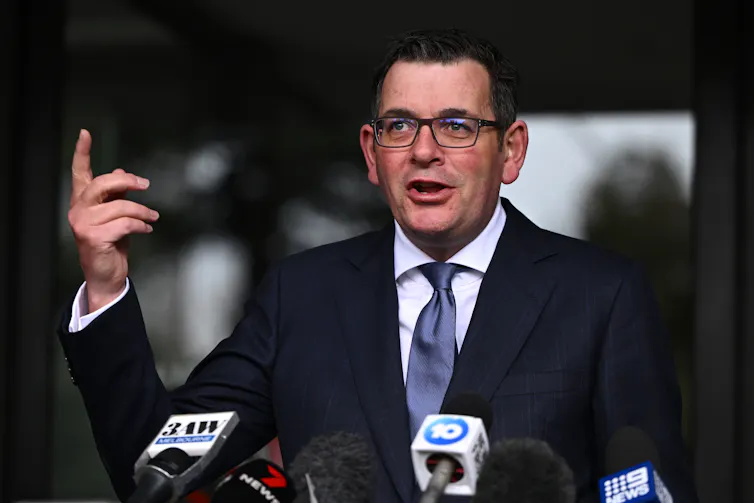
Yet the follies were equally great. Somewhere along the way, Andrews’ operating principle of “getting shit done” became an alibi for barging through proper process, evading accountability and an overweening determination to get his own way, irrespective of consequences. What tic lurking in his leadership makeup impelled this recklessness is as intriguing as it is mysterious.
At the same time, it is evident the premier’s office acted as an auxiliary instrument of his oppressive leadership practices. His cabinet colleagues cannot be excused responsibility. Regardless of how overbearing and intimidating Andrews and his staffers were, they had an onus to rein him in.
What we now know is that of all the sins Andrews committed as premier, probably the most egregious was engaging in factional labour movement power games, most disastrously through favouring the left-aligned CFMEU. It was conduct his major Labor predecessors as premier, John Cain and Steve Bracks, would never have entertained. This imprudence seeded the conditions for a miasma of coercion and criminality on the state’s Big Build infrastructure projects.
The moment the Labor government’s fate was sealed beyond doubt was in February this year, when Geoffrey Watson SC alleged $15 billion of taxpayer money had been extorted on those projects. That figure is seared into the consciousness of Victorians, and the allegations of corruption at the heart of the Carroll-appointed royal commission now underway are providing a deadly backdrop to his election campaign.
No government could or indeed should survive this stain on it. Carroll’s four-month premiership has been mostly spent distancing himself from Andrews and his immediate predecessor, Jacinta Allan, whose three years in office were plagued by an inability to forge a distinctive leadership identity.
Carroll’s tactic of disavowing his predecessors reached comical levels in this campaign’s one leadership debate, when the premier stoically refused to utter the name Andrews. “He’s not Voldemort,” Opposition Leader Jess Wilson quipped in a rare moment of levity.
The spectre of One Nation
If perhaps unavoidable, Carroll’s strategy of denying Labor’s inheritance has had the effect of leaving him with little to campaign on in the election. Most starkly, it is in the invidious position of daring not speak the name of the Big Build developments.
Carroll’s premiership reminds me a little of Kevin Rudd’s second coming as prime minister in 2013 when, having disowned Julia Gillard’s prime-ministerial achievements, his claim for staying in office was not only threadbare but had negligible emotional appeal to Labor faithful. He slipped to defeat unloved and unmourned.
About the only thing Labor has had going for it in this election is fomenting a scare about an unholy governing alliance between the Coalition and One Nation.
Until recently, that seemed a live prospect. The irony was acute. Victoria, the state regarded as the most progressive in the country and an emblem of multiculturalism, appeared to be on the threshold of granting One Nation a watershed achievement of a foothold in government. It felt unVictorian, aberrant to the state’s political culture.
The support opinion polls were registering for One Nation was most explicable as a reflection not only of disgust in Labor but also abiding distrust of the Liberal Party as a viable alternative government following years of internecine squabbling, leadership chaos and policy negligence. In short, a powerful sentiment of a pox on both houses has been abroad in the community, with deep-seated misgivings that either Labor or the Liberals merit support. Voters have felt cheated.
Yet, as the election has neared, the One Nation vote has softened, while support for the Coalition has climbed, albeit to a primary vote of barely above 30%, according to opinion polls.
One Nation’s tapering off was probably always foreseeable. The enthusiasm it was generating within sections of the community was driven more by a nihilistic-like “blow up the traditional order” wrath than genuine conviction the party was a constructive policy agent. The Liberal message that a vote for it is the only credible option for changing government has belatedly cut through in that context.
One Nation’s fitness for office, or lack thereof, has been reinforced by a familiar cavalcade of missteps as the campaign got underway. It has, for example, been forced to disendorse a candidate who boasted a history as a fan boy of Adolf Hitler and Holocaust denier.
The party’s policies are mostly flaky, as well as uncosted. And there’s also been a sense that this has been an operation foisted on Victoria from outside, highlighted by the incongruous spectacle of the Queenslander Pauline Hanson at One Nation’s campaign launch invoking the spirit of the Eureka Stockade and Ned Kelly, only for her to then become largely invisible on the hustings as her party’s fortunes have dwindled.
Events have also conspired against One Nation. The unspeakable violence against Helen Haines unquestionably prompted a chastening as to the dangers of hate politics. Nor could the momentum of the so-called local franchise of Donald Trump’s MAGA movement have been helped by the mid-term election results in the United States at the beginning of November, with their emphatic rebuff of charlatanry and cruelty as governing philosophies.
Challenges abound for a new premier
None of this is to say that One Nation will not make significant headway this weekend in Victoria – a state in which its vote has hitherto sat at risible levels. (It was at less than 0.3% in the Legislative Assembly four years ago.)
In the upper house, elected under proportional voting, the party stands to gain substantial representation and, very conceivably, the balance of power. But One Nation’s likely slim pickings in the lower house should invite scepticism towards inflated claims about how it might perform at the next federal election, which have extended to predictions that Hanson could end up as prime minister.
Such forecasts are not only ahistorical, disregarding as they do Australia’s baked-in political culture of moderation and intolerance of demagogues, but they also overlook the reality that preference flows will cruel One Nation in House of Representatives contests unless its primary vote grows well beyond 30%.
With the ebbing of the threat of One Nation, the most probable outcome of Saturday’s election is that the Coalition, led by first-term MP Wilson, will scrape over the line to form majority government. Wilson’s impending elevation to premier is a stark illustration of one of the timeless observations of Niccolo Machiavelli in The Prince — that luck, or what Machiavelli called fortuna, governs at least half of the fate of political leaders.
When Wilson was elected to the position only 12 months ago, it was the fifth time the Liberal Party had turned over leaders since Andrews delivered Labor to office at the end of 2014, and the third change this term alone.
Her tenure has coincided perfectly with The Age’s drip-feed of the so-called “Building Bad” revelations, which have been a near daily gift to the opposition. Only three months after Wilson’s elevation came the Watson allegation of industrial scale rorting on those projects. As noted above, this was the point of no return for Labor.
At the same time, there is no gainsaying the pluck and composure Wilson has displayed during the past year. Her performance in burnishing the opposition’s credentials has been even more impressive for the fact that nearly everything has seemed to rest on her shoulders.
She does have some wise owls behind her, most notably the veteran campaign mastermind, Brian Loughnane, who became state party president earlier this year. But she is leading a parliamentary party that has been distinguished by its shortage of talent and genius for poisonous infighting and ineptness.
We are long accustomed in Australia to leaders dominating election campaigns, but on this occasion it has been presidentialisation in extremis. Wilson’s face smothers the campaign. At the party’s launch, we even had the spectacle of her deputy hollering the chant, “Jess we can!”. Goodness.
Nobody can deny Wilson’s ambition and confidence. She first put her hand up for the Liberal leadership at the end of 2024 when she had only been in the parliament for two years. A millennial (she is 36), the mother of a toddler and professional woman, she is an almost perfect foil for a Liberal Party that in recent decades has frequently seemed out of alignment with the sensibility of modern Victoria.
That problem was encapsulated in the declaration of another rising, youngish, woman Liberal parliamentarian, the federal member for Higgins, Kelly O’Dwyer. After the party was crushed by Andrews at the 2018 state election, O'Dwyer acknowledged her party was widely perceived in the community as “homophobic, anti-women, climate-change deniers”.
Wilson has lent the Liberals a different face, although it is notable that younger voters aren’t sold. A breakdown of polling shows the Coalition’s support among Gen Z and millennials remains paltry.
The challenges facing Wilson should she be elected premier on Saturday will be vast. She will come to office with the Coalition enjoying a primary vote share of less than one third: a new reality of contemporary politics that means governments are precariously grounded.
While the “failed state” scenarios are overblown, Victoria does have significant fiscal and debt problems. Wilson has chosen to fill the role of shadow treasurer, as well as the leadership, in a signal she will bear personal responsibility for repairing the state’s finances. In doing so, she is emulating the example of Labor’s Bracks when he led Labor to power in 1999. However, Bracks had John Brumby, a serious public policy person, waiting in the wings to take over Treasury seven months into his premiership.
It’s less immediately apparent who will replace Wilson when, as inevitable, she must relinquish the portfolio relatively early after entering government. In turn, taking charge of Treasury only underscores the dearth of reliable hands among her colleagues.
There is also the compounding factor of Wilson’s greenness. She is a parliamentarian on training wheels with no executive experience, notwithstanding that she was raised in a political family (her father was a single term Victorian Liberal MP), was a Victorian Young Liberals president and briefly worked as an adviser to the former Liberal federal treasurer, Josh Frydenberg. As George Megalogenis has archly observed of that background, Wilson is an “insider presenting as an agent of change”.
Her shadow ministry is similarly packed with governing ingenues. The Liberals do stand to gain some promising talent at this election such as Roshena Campbell and Amelia Hamer. But that won’t solve the callowness of its executive team.
Then there is the reality that, while Wilson has spent this campaign brandishing a “plan” for the state’s renewal, even the most cursory inspection reveals it to be a flimsy document.
A wider disease afflicting modern political parties, there is scant evidence the Victorian Liberals have engaged in comprehensive policy development. The media, preoccupied in reading the last rites to Labor, has not pressed Wilson on that policy meagreness, but has instead mostly colluded in a coronation of her. This is unlikely to be beneficial long-term. A reckoning will come.
Yet another nagging question over a Wilson government is whether it can avoid the internal warring that bedevilled the administrations of her Liberal predecessors, Ted Baillieu and Denis Napthine, between 2010 and 2014. Those divisions were paralysing, leading to policy inertia and culminating in defeat after just one term.
With the scent of victory in their nostrils, the Liberals are exuding a newfound esprit de corps, but it is hard to imagine years of personal and philosophical antagonisms have magically vanished.
Wilson, the only Victorian Liberal MP who publicly supported the Indigenous Voice to Parliament, has pledged one of her first acts as premier will be to repeal the Indigenous Treaty legislation. That suggests her professed “sensible moderate” outlook will compete with the hardline conservative forces behind her. The abolition of Treaty will be a gratuitously heartless and destructive beginning to her premiership.
Nevertheless, let us wish Wilson well. For much of the 80 years since the second world war, Victoria has been akin to a one-party state. First, it was dominated by the Liberals under Henry Bolte and his successor, Rupert Hamer. Then, since the 1980s, apart from Jeff Kennett’s two terms in office, Labor has enjoyed a virtual stranglehold on government.
This is not a healthy democratic scenario. Wilson is poised to have the rare opportunity to restore the Liberals as a party of government in Victoria – an achievement that eluded Baillieu and Napthine – and overcome the scepticism that the public still harbours towards it.
Perhaps Wilson could accomplish something more: provide a launchpad for the rejuvenation of the Liberal Party nationally. This would be a supreme irony since the story of the 21st century has largely been one of the federal Liberals treating Victoria, and particularly Melbourne, as electorally expendable – as a kind of woke outpost inhospitable to the party’s conservative march that began under John Howard.
In tandem, the once-mighty Victorian influence in the federal Liberal Party declined and it found itself virtually exiled from Melbourne, the fastest-growing metropolis in the country. It was a study in a party fouling its own nest. So doleful did its plight in the state grow that one former party strategist melancholically announced that “the Victorian Liberal Party is where hope goes to die”.
KioskNews shows a cleaned-up reading view extracted from the publisher’s page — the original always lives on their site, not ours.